

An enormous ring of gas around a star nearing the end of its evolution has preserved a trace of its last outburst. It was observed using radio telescopes in Chile’s Atacama Desert. However, researchers found no evidence of the mechanism usually invoked to explain the nonspherical shape of such shells.
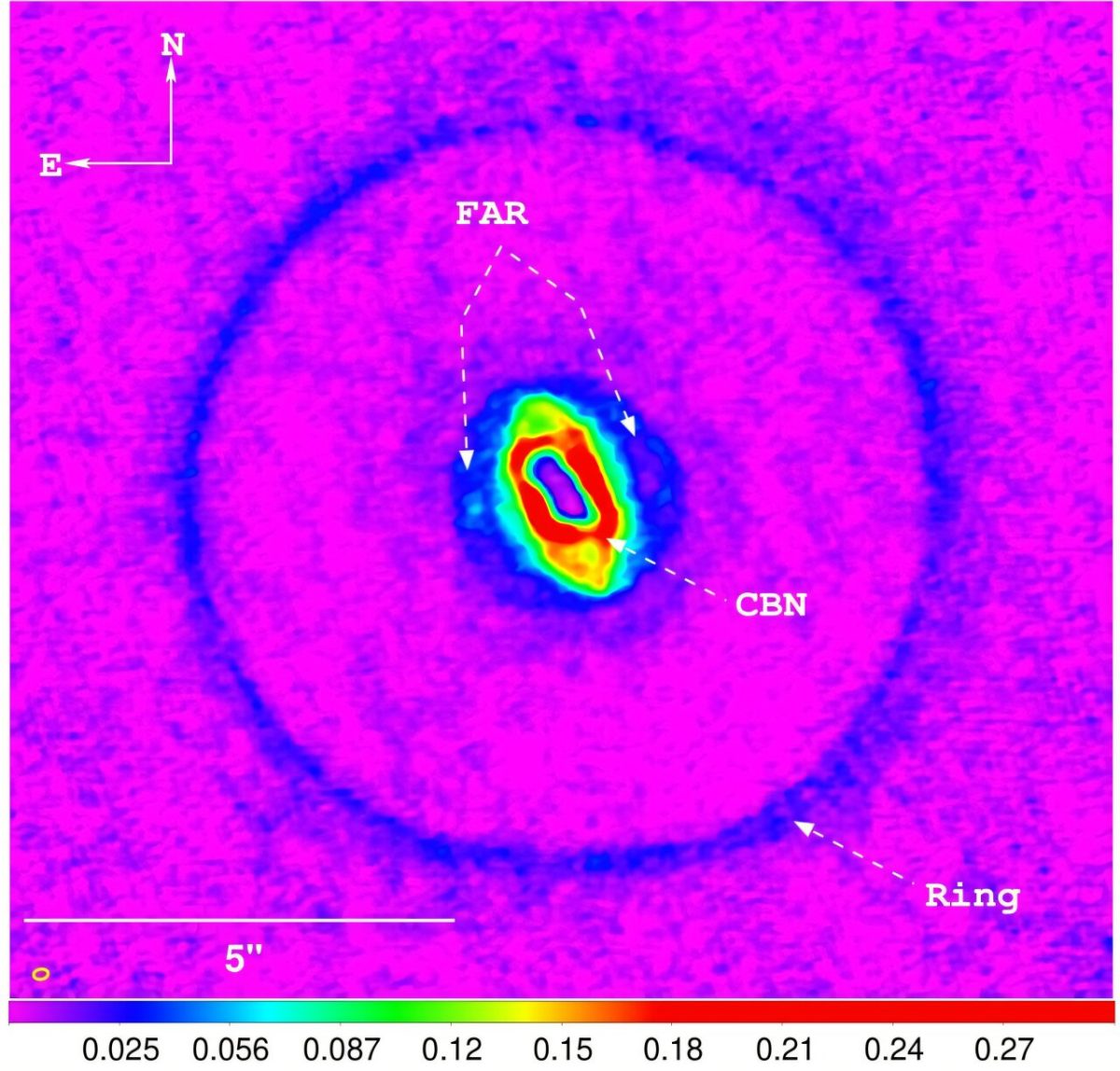
A Ring from a Thermal Pulse
The protoplanetary nebula IRAS 06530-0213—a gaseous shell shed by a star that will eventually glow as a planetary nebula—is surrounded by a ring with a radius of approximately 16,950 astronomical units. One astronomical unit equals the distance between Earth and the Sun. Voyager 1, the spacecraft farthest from Earth, has traveled approximately 170 astronomical units in 49 years—about a hundred times less than the ring’s radius.
Deep inside a red giant, nuclear fusion periodically flares up in the helium shell surrounding the core. Each such thermal pulse ejects part of the star’s envelope into space. According to phys.org, the ring provides the first evidence of the carbon star’s final thermal pulse. Afterward, the star lost material more slowly for approximately 2,000 years before its mass-loss rate increased again.
How Asymmetric Nebulae Form
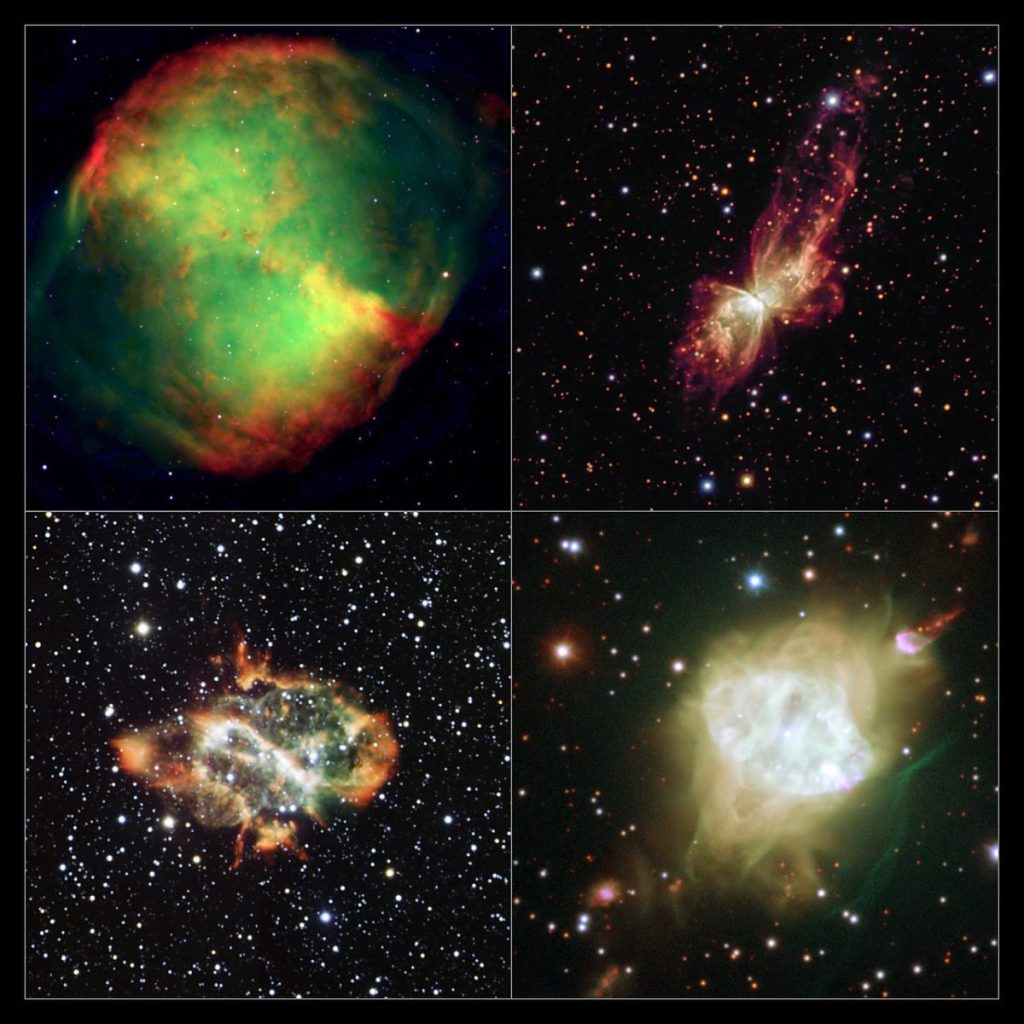
Most stars with masses similar to the Sun’s end their evolution by forming a planetary nebula rather than exploding as a supernova. A red giant ejects nearly spherical shells, yet most planetary nebulae and their precursors have elongated or bipolar shapes.
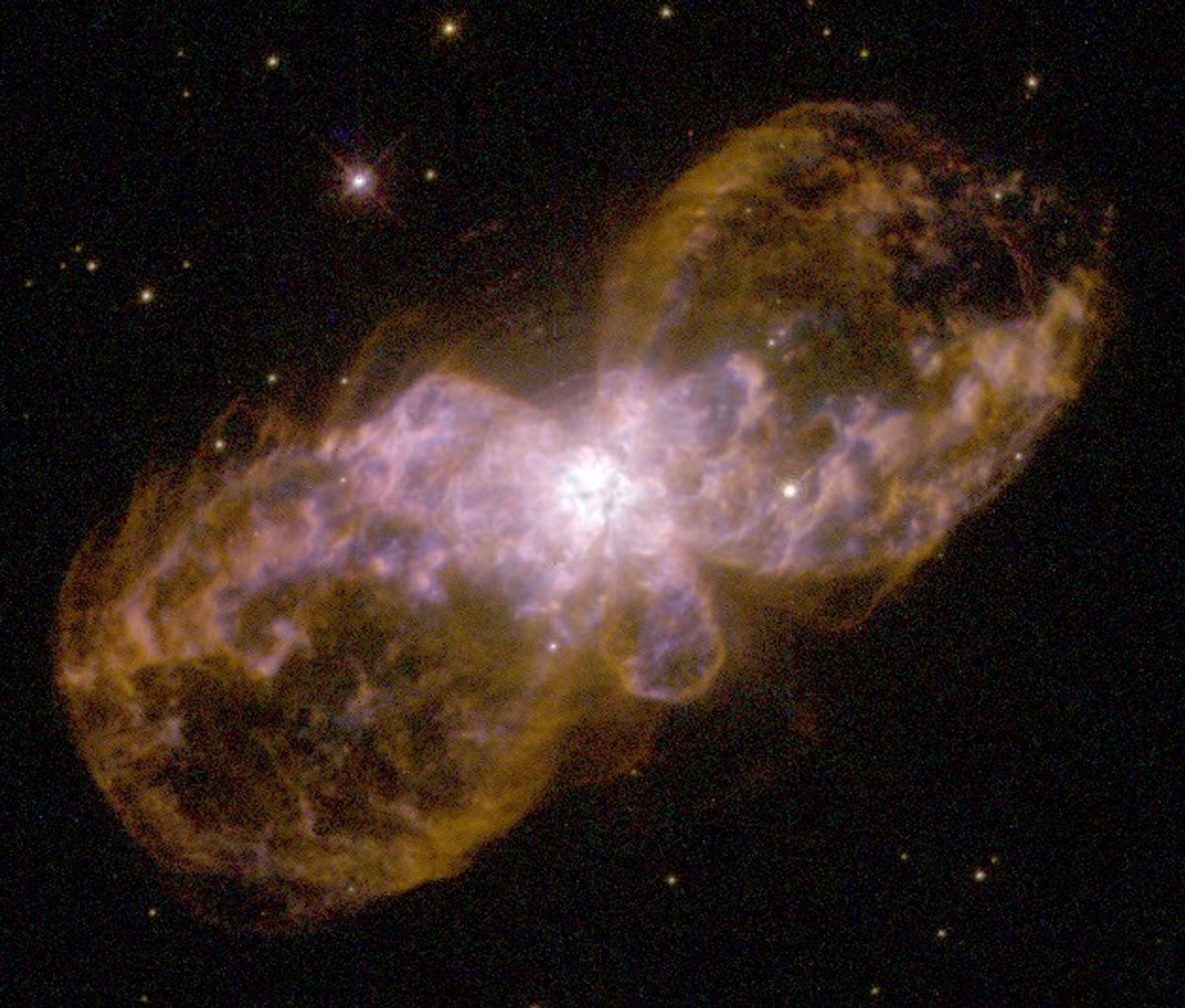
The most common explanation attributes this to narrow, fast-moving jets of gas, probably produced by interactions between the star and a companion. The jets move much faster than the expanding shell, piercing it from within along a single axis and stretching it in opposite directions.
The PANORAMA survey using the Atacama Large Millimeter/submillimeter Array (ALMA) is helping test this model. The study of IRAS 06530 was led by Raghvendra Sahai of NASA’s Jet Propulsion Laboratory. The paper has been accepted for publication in the peer-reviewed journal The Astrophysical Journal, and a preprint is available on arXiv.
The Structure of the Nebula
The central bipolar nebula consists of two lobes and a dense, doughnut-shaped torus surrounding the star. Their expansion speeds indicate that they are no more than 700 years old.
The torus contains an excess of the rare isotopes carbon-13 and oxygen-17, along with a smaller excess of nitrogen-15. These proportions do not fit standard models of nuclear fusion and may point to explosive thermonuclear reactions.
Most of the molecular gas, amounting to between 0.12 and 0.25 solar masses, is concentrated in the faint arcs between the torus and the ring. Similar spirals are observed around red giants in binary systems, so the shape of the arcs may indicate a hidden companion at a distance of 155 to 340 astronomical units.
No Fast Jets Detected
Gas moving faster than 50 kilometers per second is usually detected in protoplanetary nebulae. In IRAS 06530, researchers found neither gas moving faster than 16.5 kilometers per second nor a compact dust disk at the star’s location. The authors suggest that short-lived jets may have been launched by a disk that subsequently dispersed.
A strong interaction with a companion at such a distance is rather unlikely. It would be possible only if the orbit were elongated enough to bring the companion close to the primary star. Whether such an orbit could explain both the jets and the spiral arcs remains to be determined through models of mass loss in binary systems.
