

In astronomical images, we frequently observe depictions of diverse and remarkably beautiful nebulae that resemble a horse’s head or a butterfly. However, it is often challenging to comprehend their true nature, as most of the time, when we look up at the sky, such formations are not visible to the naked eye.
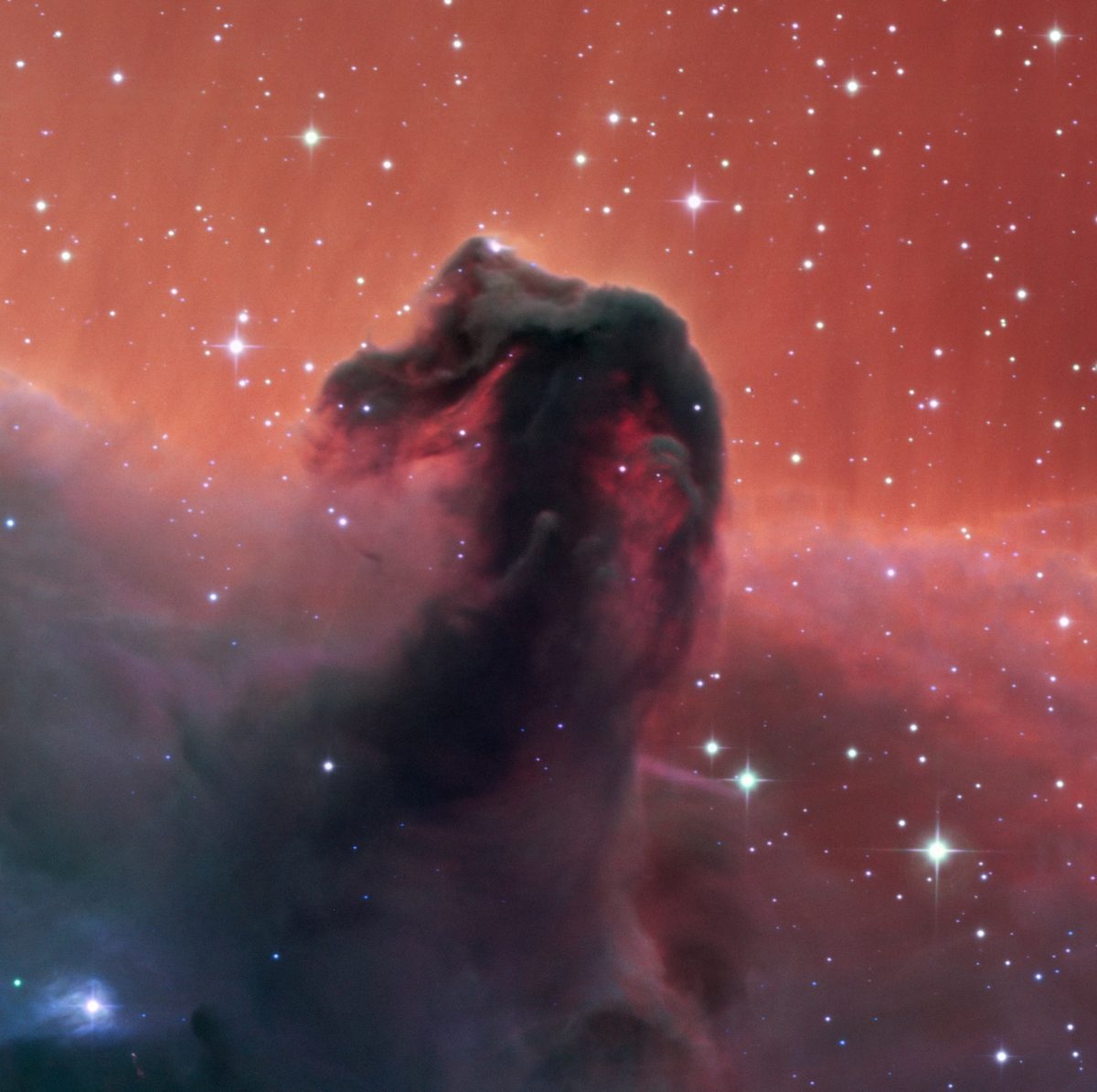
Nebulae in the starry sky
When individuals envision the Milky Way, the initial aspect that arises is the hundreds of millions of stars comprising it. Indeed, these are virtually the sole objects observable in the sky, aside from the celestial bodies constituting the Solar System. Nonetheless, it is likely that everyone has encountered images in popular science and other publications depicting exquisite nebulae, which frequently resemble the fantasies of artists.
Hence, the questions arise regarding the location of these objects, their nature, and the reasons for their invisibility. Several approaches exist to address these inquiries; however, we shall commence with the last. The vast majority of what are referred to as nebulae are not visible to the unaided eye due to their excessive faintness.
This is likely the reason why, during the initial millennia of astronomical observation, their existence was unknown. More specifically, they remained unidentified by European astronomers. For instance, populations residing in the Southern Hemisphere have been able to observe two small clouds in the night sky since ancient times — celestial formations that appear to have separated from the Milky Way and consistently occupy the same position.

Among Europeans, they were first observed by the crew of the circumnavigational expedition led by Ferdinand Magellan in 1520. Their description of these stationary clouds—twice and ten times the size of the Moon — so deeply impressed astronomers that they named them in honor of the renowned explorer.
The Andromeda Nebula
Another object visible to the naked eye — and one that was discovered by Arab astronomers long before European astronomers — is the Andromeda Nebula. It has an angular size of 3.2° × 1°, which is six times larger than the full Moon. However, most of it is very faint, and only the central regions are bright enough to be seen as a small, bright spot.
The object was first documented in 946 by the Persian astronomer al-Sufi. European scholars commenced detailed investigations in the 17th century following the invention of the telescope. It is observable to the naked eye; however, optimal viewing conditions include a clear, moonless night away from the extensive light pollution typical of major urban areas.

If you are positioned appropriately at the opportune moment, you should be able to identify the three brightest stars in the constellation Andromeda. Instructions on how to accomplish this can be found in this article. Subsequently, mentally connect the middle star of these three, known as Mirach, with the highly prominent constellation Cassiopeia, which resembles the letter M, and follow the line. You will shortly discover a small, bright spot, which is the central region of the Andromeda Nebula.
Real nebulae
However, the objects in Andromeda, the Magellanic Clouds, and the faint luminous point observable on a very dark night within the constellation Triangulum are not nebulae in the contemporary understanding of the term. Rather, they are galaxies akin to the Milky Way. They appear as spots with diffuse boundaries — comprising the light emitted by millions of stars that constitute them.
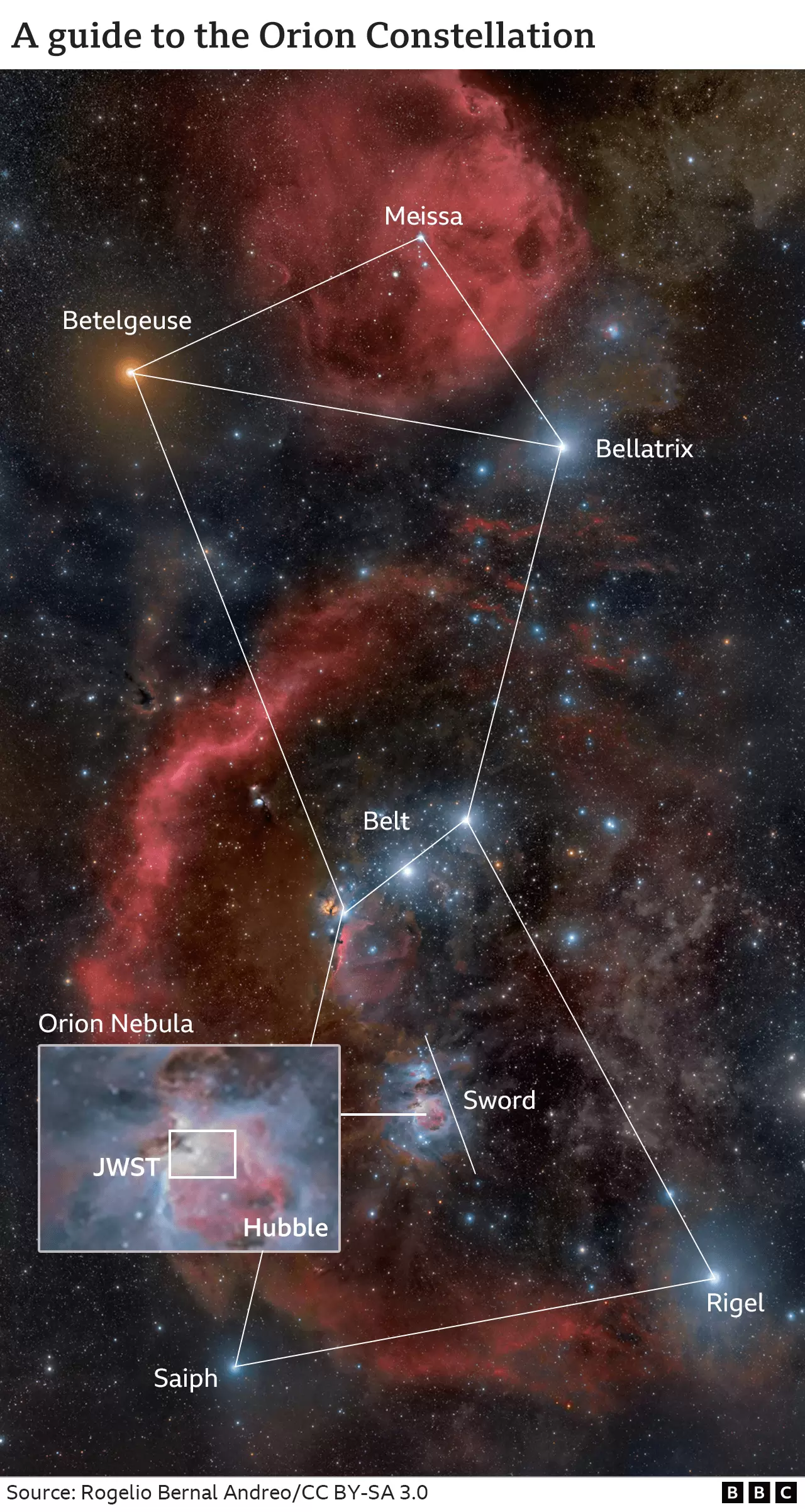
Nevertheless, it is possible to observe genuine nebulae with the unaided eye. The most notable of these is the Orion Nebula. To appreciate it, one must first identify the constellation Orion. Subsequently, locate the three stars that constitute its belt. Beneath these stars, there is an elongated cluster of stars known as Orion’s Sword. In actuality, these objects are not gravitationally bound; however, among them, a hazy patch with indeterminate edges can be observed. This is precisely what we seek.

A comparable celestial object is located within the constellation Sagittarius. Its most conspicuous feature is an asterism known as “The Teapot.” Just above the “spout” of this Teapot, and contingent upon sufficiently dark skies, one can observe a faint, hazy region known as the Lagoon Nebula, or M8.
In other words, nebulae are inherently too dim to be fully perceived with the unaided eye. However, when employing binoculars or a modest amateur telescope, the quantity of such observable objects increases to dozens.
One of the most effective methods to study nebulae is through the catalog initiated by Charles Messier in 1771. Currently, it comprises 110 objects, predominantly nebulae or galaxies, with some star clusters included. This catalog provides sufficient scope to understand the remarkable diversity within the realm of nebulae.
What are nebulae?
Nevertheless, the question persists: what precisely are these entities referred to as “real nebulae”? If they are neither remote galaxies in which individual stars are discernible nor star clusters situated within the Milky Way, then what could they be? They appear akin to clouds in the Earth’s sky — and indeed, are clouds composed of gas and dust occupying a specific region within the Milky Way.
What is their size? For instance, the Orion Nebula, previously referenced, extends across 24 to 33 light-years, with one light-year equating to 63,241 times the distance from Earth to the Sun. The Lagoon Nebula surpasses this in scale, measuring between 110 and 140 light-years.
The fact that the former appears larger is attributable to its proximity, being approximately 1,344 light-years away, in comparison to the 5,200 light-years for the Lagoon Nebula. Nonetheless, there are more extensive clouds within the Milky Way; however, they are significantly more distant from our location.
Simultaneously, nebulae can be characterized as relatively sparse environments. Most exhibit a particle concentration ranging from 100 to 10,000 per cm³, with only the densest regions reaching up to one million particles per cm³. In comparison, Earth’s atmosphere at the surface contains approximately 10¹⁹ molecules per cm³.

Nebulae predominantly comprise hydrogen and helium, rendering them remarkably akin to stars in this regard. Nevertheless, they also encompass heavier elements, water, silicates, and organic molecules, such as amino acids. Some of these substances are found in nebulae as small solid grains.
Nebulae typically do not emit their own light; instead, they predominantly absorb or scatter the light that traverses them. This phenomenon occurs because, notwithstanding their low density, they extend over vast distances. Consequently, as light passes through these regions, it is partially absorbed and scattered, which accounts for their appearance resembling dark clouds.

Nevertheless, it is frequently observed that one or more luminous stars are positioned near the periphery or even within a nebula. Their emitted light reflects off the outer layers of the nebula, rendering it visible. It is due to this phenomenon that we are able to perceive its remarkable shapes.
All of these principles are applicable to nebulae in which the molecules exist in an inactive state. However, it is frequently observed that, owing to a proximate source of radiation, these molecules become ionized, heat up, and subsequently emit energy independently. Such nebulae are referred to by astronomers as emission nebulae.
Nevertheless, an emission nebula does not inherently emit radiation within the visible spectrum or across a wide range of frequencies. Many of these nebulae are detectable solely at particular wavelengths. In such instances, they are designated as radio nebulae.

An exemplary instance is represented by the Fermi bubbles — immense spherical formations of gas ascending on opposite sides of the Milky Way’s plane, situated above its central region. Their existence remained unknown until the early twenty-first century, owing to their composition of exceedingly rarefied matter that radiates within the X-ray spectrum. This radiation is subsequently absorbed by Earth’s atmosphere. The bubbles could only be detected following the advent of space telescopes designed to operate within that particular range.
Nebulae and the evolution of stars
All of the above considerations pertain to large nebulae that span tens of light-years into space. However, they merely constitute a specific phase within the matter cycle of the Milky Way, which is intrinsically connected to stellar evolution.
When cold interstellar clouds commence condensation, the process unfolds in an uneven manner. Regions of increased density emerge within the clouds, attracting surrounding material. Over time, these regions evolve into globules, where protostars are formed. Subsequently, these stars ignite, and the radiation pressure expels some of the gas and dust, while the remaining material persists in the form of protoplanetary disks.

Protoplanetary disks are also classified as a type of nebula; however, their dimensions are so diminutive that amateur telescopes lack the required capability for detection. Subsequently, planets originate, and the star commences its typical lifecycle. Beyond this point, the subsequent evolution is contingent upon its mass.
Stars that are comparatively light and cool, such as our Sun, do not share characteristics with nebulae until they attain the concluding phase of the red giant stage. Subsequently, they disperse their outer layers, which then expand into space and contribute to the formation of a nebula.
These shells, referred to as planetary nebulae, exist for a comparatively brief duration by cosmic standards. Nonetheless, they can assume a diverse range of shapes, frequently exhibiting near symmetry: from rings and bipolar formations to intricate asymmetrical shells. It was specifically this similarity to a planetary disk that earned them their name.
These intriguing celestial objects are observable even by amateur astronomers utilizing modest telescopes. The apparent magnitude of planetary nebulae such as the Dumbbell, the Helix, and the Ghost of Jupiter ranges from 7 to 8, thereby rendering them accessible targets for amateur observation.

The relationship between large, luminous stars and nebulae exhibits considerable complexity. The majority of these stars, which are already in the final stages of their evolutionary journey, are enveloped by gas and dust of diverse origins. Such structures may also be classified as nebulae; however, these formations can only be observed utilizing the most powerful telescopes across different wavelength ranges.
Subsequently, a supernova explosion transpires, dispersing vast quantities of gas and plasma into the cosmos. This process leads to the formation of supernova remnants, which are, in essence, nebulae as well.
However, both they and planetary nebulae share the same fate. In a few tens or hundreds of thousands of years, they will disperse completely, and their material will form new giant clouds stretching for tens of light-years.
The realm of nebulae is astonishing and heterogeneous. It also encapsulates a distinct moment in the history of the universe — one that will dissipate within a relatively brief period, merely a few thousand years. Therefore, cherish this moment.