

In 2029, the asteroid Apophis will pass by Earth at a record-breaking close distance. One of the spacecraft that will study it will be the START mission. It was developed by students at Tsinghua University in China.
START Mission
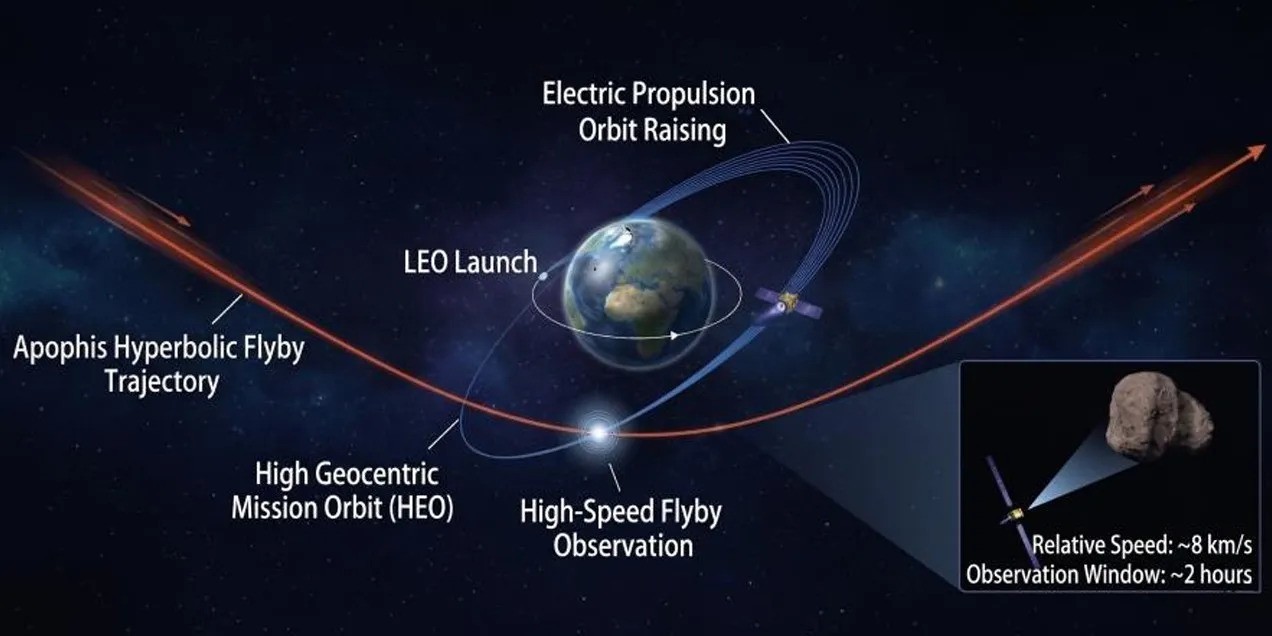
Tsinghua University in China plans to launch START (Student-led Threatening Asteroid Reconnaissance of Tsinghua)—its own mission to an asteroid. The mission’s target will be Apophis, which is expected to fly past our planet in 2029.
Apophis was once considered the most dangerous of all asteroids because there was a possibility that it would collide with Earth in 2029 and cause a catastrophe. However, a more precise calculation of the trajectory of this 340-meter-diameter asteroid has shown that a collision can be avoided.
The Japanese DESTINY+ probe is scheduled to fly by Apophis in January 2029. Later, the European Space Agency’s (ESA) RAMSES mission will arrive at the asteroid and is expected to operate near it from February through August 2029. It is scheduled to launch on an H3 rocket alongside DESTINY+. Meanwhile, NASA’s OSIRIS-APEx spacecraft will approach Apophis in April 2029 and begin an 18-month observation program.
What is START?
Overall, China has already announced several potential missions to Apophis, but START is currently considered the most realistic of them. As part of a government funding program, $2.8 million has been allocated to the project. Twenty university students began developing it in 2025, and it is now complete.
Construction of a prototype is expected to begin this September, and by September 2027, it will undergo final testing, after which preparations for launch will begin. The launch itself is scheduled for early 2028. The probe will be placed into an orbit with an inclination of 55°, where it will remain until it encounters Apophis in April 2029.
Overall, it is a small spacecraft weighing only 20 kg. However, as the asteroid flies past Earth, it is expected to capture images of a significant portion of its surface at a resolution of 8 cm per pixel. This means it will be able to see virtually every pebble on its surface. To do this, the spacecraft will be equipped with wide-angle and narrow-angle visible-spectrum cameras, as well as broad-spectrum observation instruments.
According to spacenews.com
