

For the first time, astronomers have confirmed the presence of an atmosphere around a rocky planet orbiting another star within its habitable zone. The gaseous envelope was detected through helium slowly escaping from it into space. This is the most convincing evidence to date that worlds with Earth-like conditions may exist beyond the Solar System.
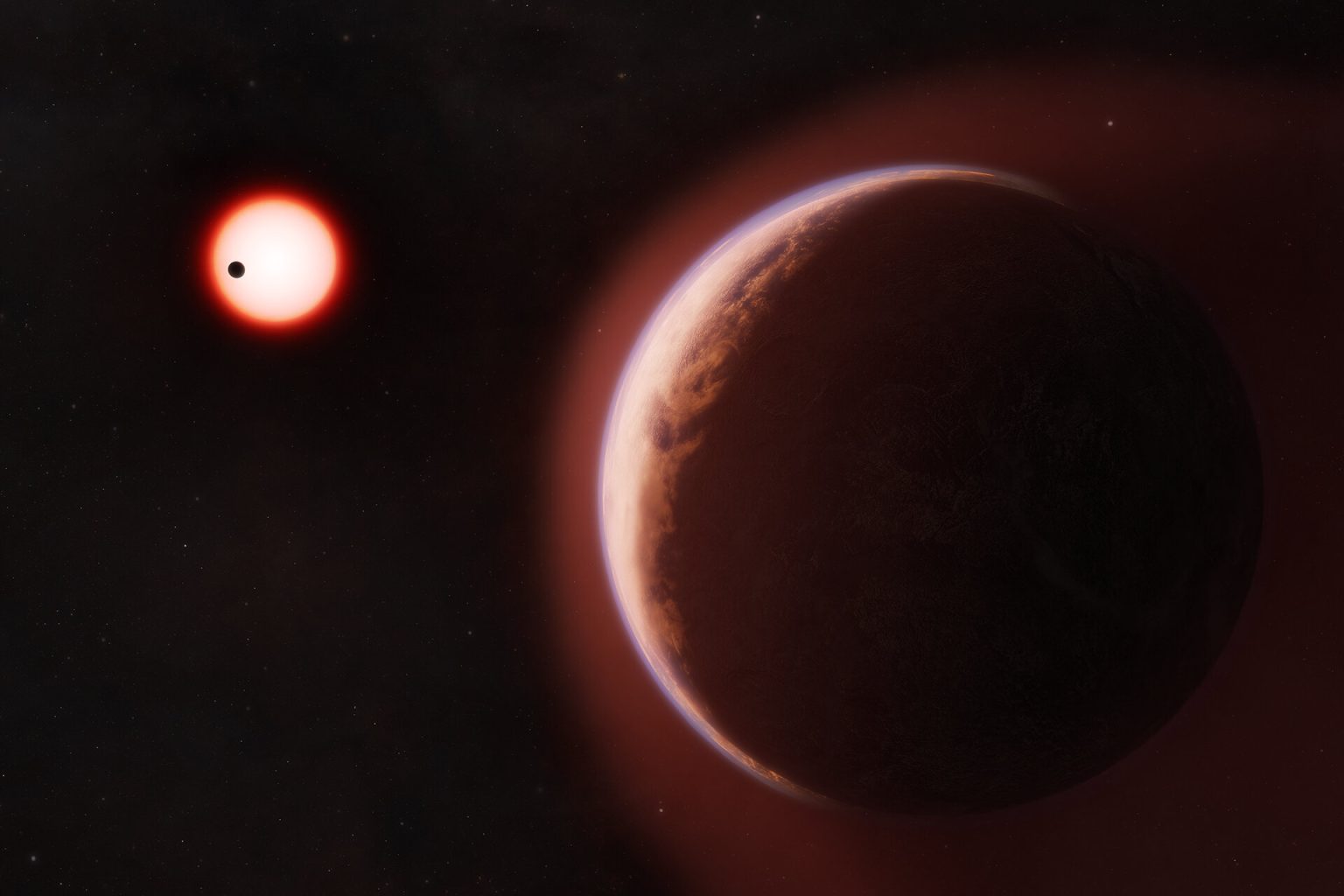
A Planet Near a Red Dwarf
The exoplanet LHS 1140 b is located approximately 48 light-years from Earth. It orbits a red dwarf within a zone where temperatures may allow liquid water to exist on the surface.
Astronomers have already discovered thousands of worlds beyond the Solar System, including several rocky planets in favorable orbits. However, they had been unable to determine whether these objects retained atmospheres. This task remained one of the most difficult challenges in modern astronomy.
From Prediction to Discovery
The originator of the idea, Collin Cherubim, recently earned his doctoral degree from Harvard University. Together with his colleagues, he developed a theoretical model predicting a helium-rich envelope in the upper layers of this world. The calculations indicated that the gas was gradually escaping into interstellar space.
David Charbonneau, one of his dissertation supervisors, was initially skeptical because the conclusion was based solely on mathematical calculations. The data ultimately convinced him, as the statistical significance of the signal proved indisputable.
The study was published in the peer-reviewed journal Science, phys.org reports. Co-author Robin Wordsworth noted that just twenty years ago, scientists still doubted whether other Earth-like planets even existed.
The prediction was tested using the WINERED infrared echelle spectrograph installed at the Magellan Observatory in Chile. The observations took place on a night when LHS 1140 b and another planet in the system both passed across the disk of their star.
No signs of a gaseous envelope were found around the neighboring world. Around LHS 1140 b, however, researchers detected a clear helium signal that confirmed the presence of an atmosphere.
An Atmosphere Billions of Years Old
According to the researchers’ estimates, the helium envelope of LHS 1140 b has survived for more than three billion years. This makes the planet one of the most valuable targets for future observations.
The team now plans to determine the atmosphere’s full composition and establish whether liquid water is present. The same model will also be applied to the search for similar worlds in other systems. Possible traces of nitrogen and even an ocean were identified here as early as 2024 in data from the James Webb Space Telescope. At that time, however, the signal from the dense lower layers of the atmosphere was close to the sensitivity limit even for the space telescope.
This time, researchers searched for something different. Helium escaping from the planet forms a diffuse cloud much larger than the world itself. It absorbs the star’s light at one specific wavelength, and this absorption is strong enough to be measured with confidence. High-resolution ground-based spectrographs can detect precisely these signals even more effectively than space-based instruments.
