

Rings of material surrounding three young stars are tilted at different angles instead of lying in a single plane. Astronomers spent years trying to determine the cause of this imbalance. Now they have found it outside the system itself. A huge stream of gas is flowing in from the surrounding environment, striking the disk at almost exactly the same angle as the outer ring.
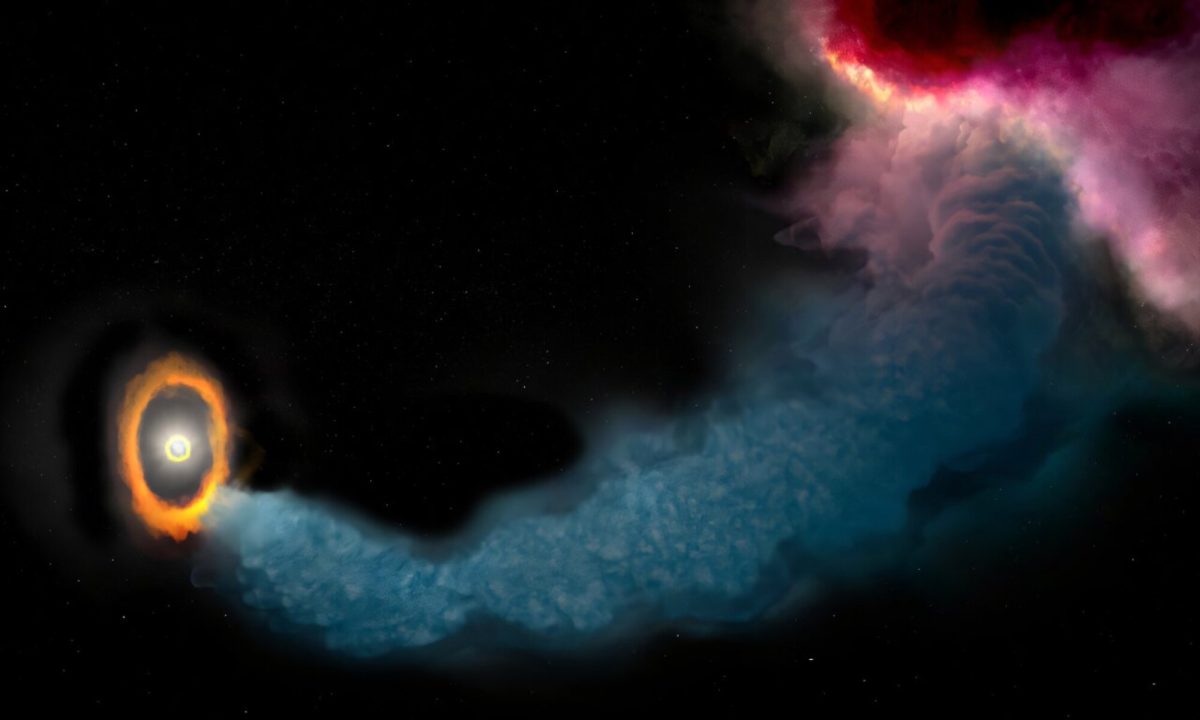
A Young System in the Constellation Orion
GW Orionis is located about 1,300 light-years from Earth in the constellation Orion. Three young stars there are surrounded by several rings of gas and dust from which planets are forming.
What makes this configuration unusual is that the rings lie in different planes. The inner, middle, and outer rings are each tilted at their own angle, that is, strongly inclined relative to each other.
Because of this, the system has long been used as a natural laboratory for studying unusual planetary architectures. As early as 2020, observations showed that one of the rings was effectively detached from the rest of the protoplanetary disk.
A Stream of Material from Outside
Observations with the Atacama Large Millimeter/submillimeter Array (ALMA) revealed a gas stream about 1.6 trillion kilometers, or 0.2 light-years, long. Material is flowing from the surrounding environment toward the disk and replenishing it, which is why such structures are known as streamers. Phys.org reported on the measurements.
In length, the stream is nearly 5% of the distance from the Sun to Proxima Centauri, the nearest star to us. One end reaches the disk, while the other extends toward remnants of the gas-and-dust cloud from which the system’s three stars originally formed.
The Angle of the Incoming Material
The research team was led by Maria Galloway-Sprietsma, a doctoral student at the University of Florida. Her team measured the motion of the streamer and its angular momentum, then compared its direction with the orientation of the rings.
The trajectory of the stream matches the outer dust ring almost exactly but differs strongly from the orientation of the inner ring. According to Galloway-Sprietsma, simulations showed that the infall angle is closely aligned specifically with the outer part of the disk, as reported by the U.S. National Radio Astronomy Observatory.
The result points to a causal connection between the incoming material and the tilt of the outermost ring. Previously, such misalignments were explained mainly by the gravitational influence of the three stars themselves.
Molecular-Line Data
The kinematics of the streamer were traced using molecular emission lines of carbon monoxide in two forms: ordinary ¹²CO and ¹³CO, which contains the heavier carbon isotope. All three ALMA antenna groups were used for the observations: the 12-meter array, the 7-meter array, and the Total Power array. Only together can they capture the full length of the structure.
The stream’s total angular momentum turned out to be noticeably lower than that of the disk. Jaehan Bae, assistant professor of astronomy at the University of Florida and Galloway-Sprietsma’s academic adviser, explained that the incoming material is no longer capable of significantly changing the tilt of the rings. In the past, however, its angular momentum was greater, and that was when the disk became tilted. The observations therefore appear to capture a late stage of the process.
The Picture of a Calm Disk Is Outdated
For decades, diagrams in textbooks depicted planetary systems forming from calm, flat disks of gas and dust. The study, published in the peer-reviewed journal The Astronomical Journal, supports a far more dynamic picture. Uneven, turbulent streams arriving from outside can reshape a disk even during the later stages of its evolution.
The implications also extend to exoplanets. Material arriving at random angles may place future planets on highly tilted or even retrograde orbits relative to the rotation of their host star.
The next step will be to search for molecules sensitive to shock waves, including sulfur-bearing compounds, in order to determine the exact location where the incoming stream collides with the disk.
