

Compact stars with surface temperatures reaching several tens of thousands of kelvins constitute a limited portion of the celestial catalog. They can be identified by analyzing the morphology of their spectra; however, manual classification is excessively time-consuming. Researchers from Lithuania, Spain, and Italy delegated this task to a neural network, which subsequently classified 20,000 candidates within seconds.
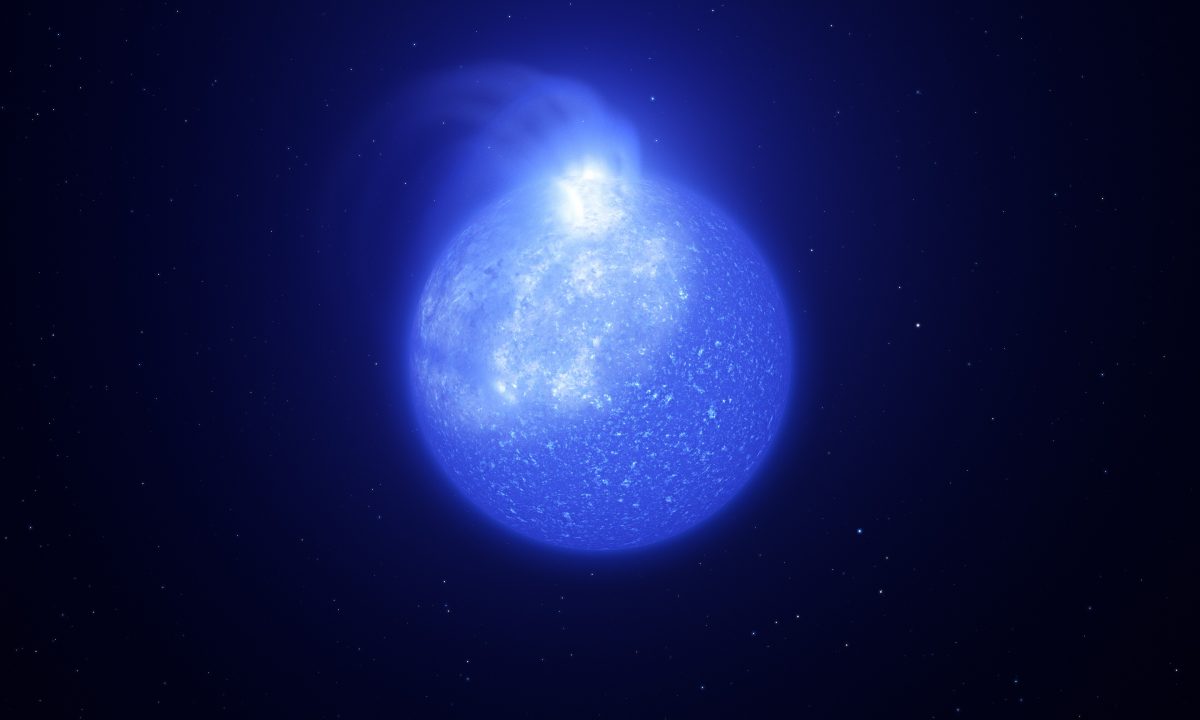
Source: ESO
Outside the main sequence
On a diagram depicting the relationship between stellar temperature and luminosity, the majority of stars are situated within the extensive band known as the main sequence. The Sun is also positioned within this band, provided that hydrogen fusion occurs in its core. Conversely, hot subdwarfs are not classified as members of the main sequence; despite having comparable temperatures, they exhibit significantly lower luminosity and are located below this band on the diagram.
Regarding coloration, they exhibit a blue hue akin to massive stars of spectral classes O and B; however, they are distinctly smaller and less luminous. Their surface temperatures span from 20,000 to 50,000 kelvins, and their masses approximate half that of the Sun. This research was published in the peer-reviewed journal Astronomy & Astrophysics.
The result of a close combination
The primary explanation for this unusual amalgamation of parameters pertains to binary systems. The more massive constituent expands into a red giant, and under the gravitational influence of a proximate compact star, its outer hydrogen envelope is systematically removed. The residual core subsequently evolves into a white dwarf through an atypical process.
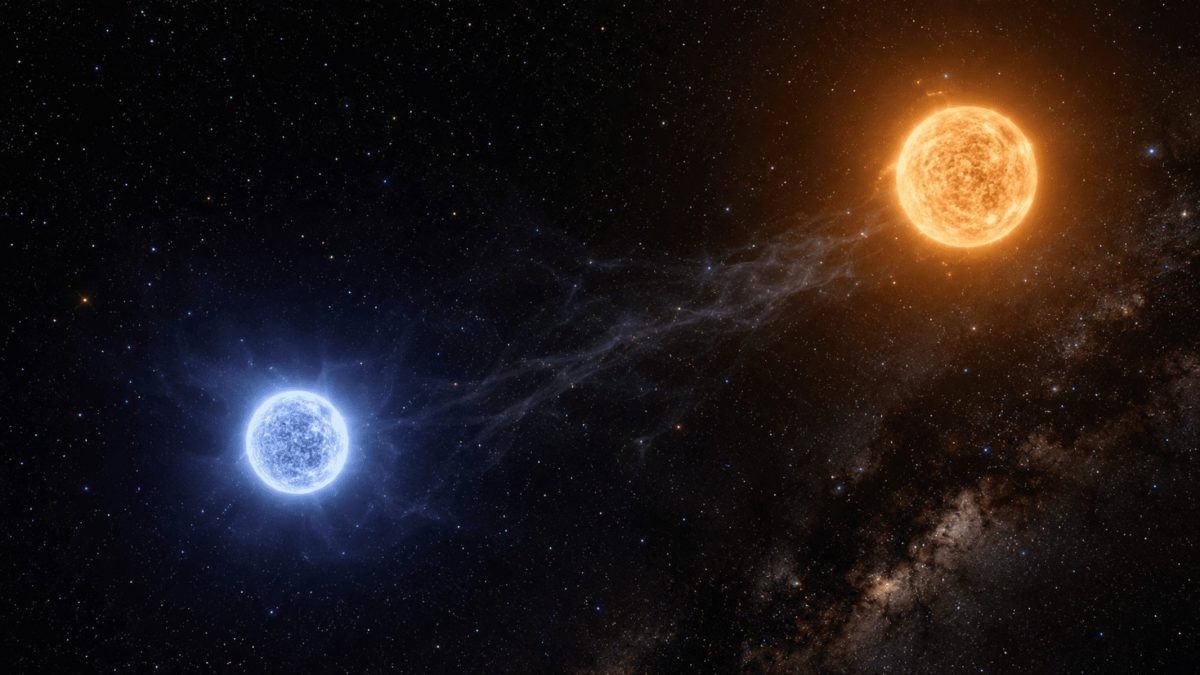
Different pairs produce varying outcomes. In addition to hot subdwarfs, the spectrum includes ordinary main-sequence stars, white and red dwarfs, and, on occasion, brown dwarfs. The composition of the pair fundamentally influences the future destiny of the entire system.
A network as opposed to manual selection
Over a period exceeding ten years of operation, the Gaia space observatory has compiled a catalog comprising over half a billion stars. According to the preliminary third data release of the mission, merely about 62,000 of these — less than one in a thousand — are classified as hot subdwarfs. It is impractical to select models for each star individually, calibrate the temperature, and verify the fit on such a large scale.
Conversely, the team developed a neural network that methodically examines the entire wavelength spectrum and searches for distinctive spectral line profiles. Subsequently, they inputted the comprehensive dataset of 20,061 low-resolution spectra into the network. As Markus Ambrosch observes in an article on phys.org, the algorithm was not supplied with any physical equations; nonetheless, during the training process, it accurately identified the regions that physicists deem to be critical.
One in six within a pair
For the entire sample, the network identified approximately 17 percent of double-star systems, amounting to 3,359 objects. A separate classification, based on temperature and helium content, categorized approximately two-thirds — or 13,174 stars — in the cooler sdB class.
The most noteworthy findings emerged from the examination of brightness variability and minor positional shifts. In instances where no signs of variability are observed, 17.6 percent represent binary systems. Conversely, in cases where astrometric shifts are identified, the proportion increases to 80.8 percent.
The improvement in processing speed advances the limitations to a subsequent stage. The network supplies solely probabilistic data, necessitating each candidate to undergo verification through discrete observations from Earth’s surface. Furthermore, the available observing time on large telescopes will be insufficient for all candidates once the new Gaia catalog is released. The team is currently initiating the first series of such verifications utilizing the spectrograph at Vilnius University.

Impurities present in the sample
The same approach facilitated the identification of extraneous objects within the catalog. A distinct group comprising 561 entries exhibits a spectral shape that is excessively cool to be attributed to hot subdwarfs and most likely consists of ordinary main-sequence stars.
An additional 203 entries were identified as cataclysmic variables — that is, close binary systems in which a white dwarf accrues matter from its companion. Virtually all of these entries were located within the same region of the similarity diagram, indicating that the same method is equally appropriate for the identification of objects of this nature.
