

In detailed images obtained with the Hubble Space Telescope, the galaxy NGC 4698 appears to be a typical, elegant spiral system. It is located 55 million light-years from Earth and is part of the enormous Virgo Cluster — the nearest large gravitationally bound association of more than a thousand galaxies.
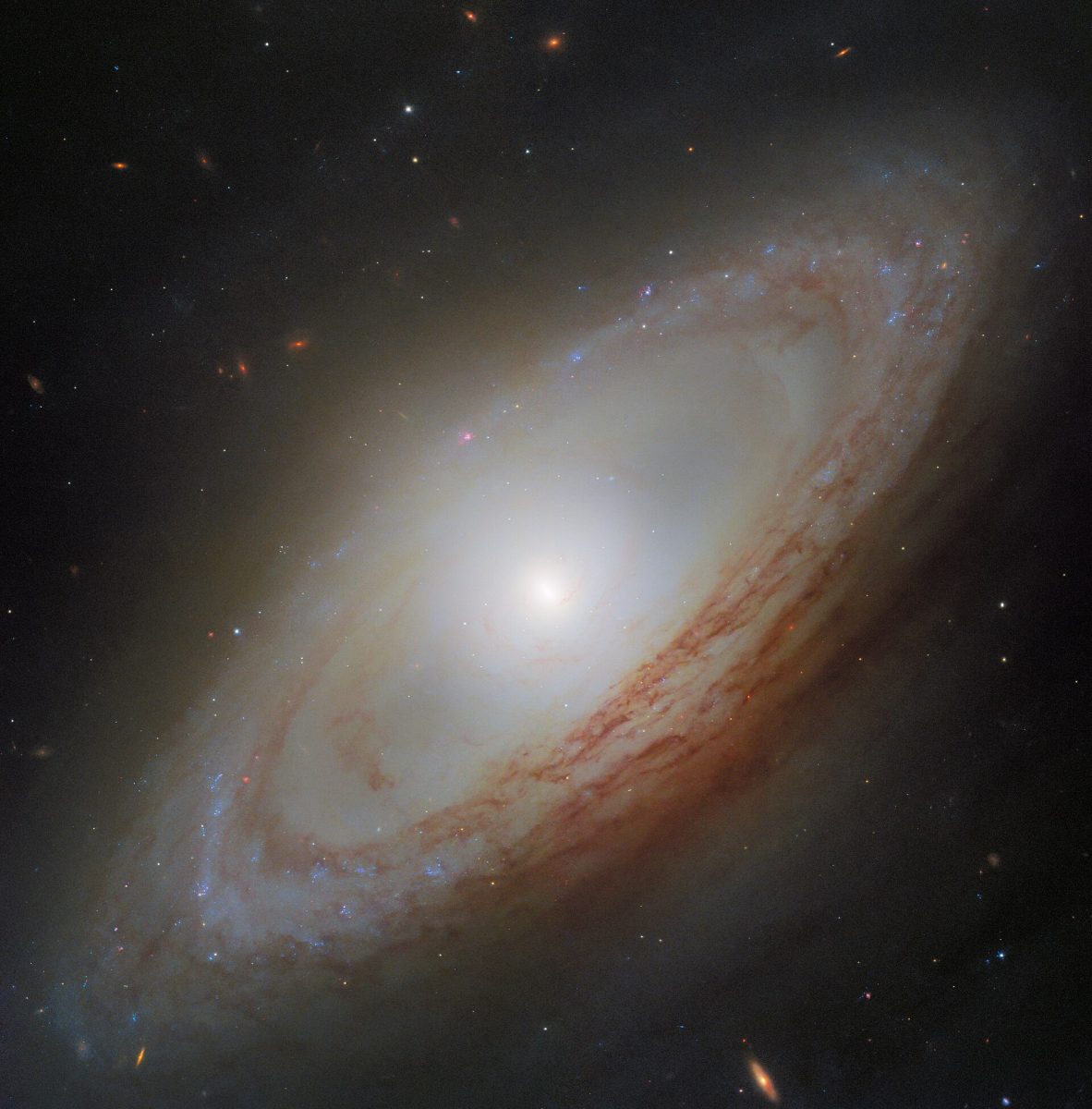
From the outside, NGC 4698 resembles our Milky Way: a thin disk of gas, dust, and stars is decorated with graceful spiral arms dotted with bright blue young stars and dark dust clouds. However, a closer study of the geometry of these arms immediately revealed something unusual. Instead of winding all the way toward the heart of the galaxy, they stop at a distance, creating a kind of ring-like structure around the glowing center.
A Strange Bulge
The main mystery of NGC 4698 lies in its center. There is an elongated galactic bulge — a roughly spherical concentration of older, smaller, and cooler stars densely surrounding a supermassive black hole. Observations show that this black hole is actively consuming surrounding matter and increasing its own mass, which is already millions of times greater than that of the Sun.
However, analysis of spectral data and sharp Hubble images surprised astronomers: the galaxy’s bulge is elongated at a right angle relative to its flat disk. Moreover, the inner stars and gas in the immediate vicinity of the center rotate strictly perpendicular to the motion of the rest of the galaxy. This is one of the few known examples in the Universe of such a kinematic anomaly.
Traces of an Ancient Cosmic Catastrophe
How did such a cosmic mismatch form? Astrophysicists are convinced that the source of the chaos lies outside NGC 4698 itself.
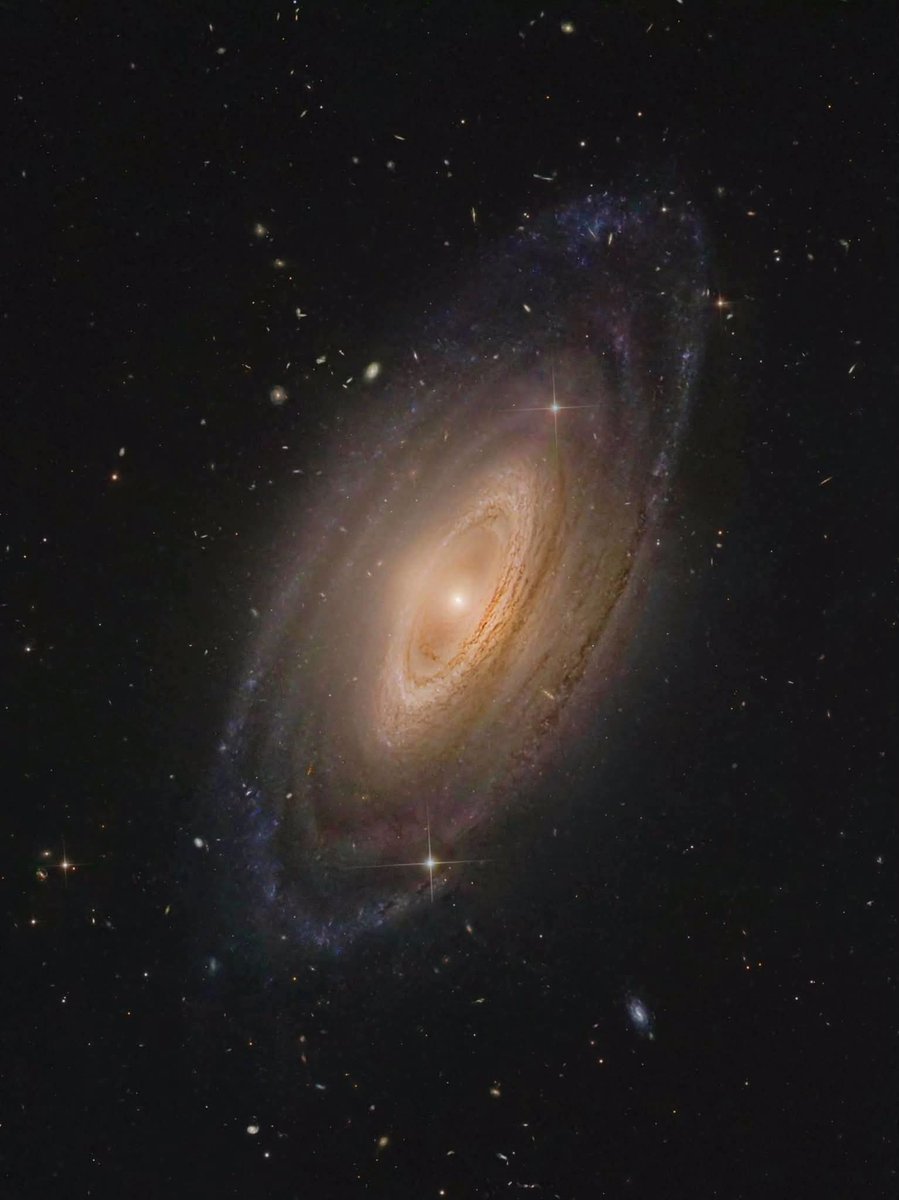
Most likely, in the past the galaxy actively drew in intergalactic gas from its external environment. Because this material arrived at an unusual angle, it formed an inner disk that began rotating perpendicular to the main system. Supporting the hypothesis of an ancient galactic accretion event or collision is a plume discovered by scientists — a short “tail” of atomic hydrogen extending from one side of NGC 4698.
Research on this anomalous system continues as part of a large-scale observing program focused on the Virgo Cluster. The data obtained allow astronomers not only to study individual star clusters and nebulae, but also to better understand how a dense galactic environment affects the evolution of stellar systems and the rate at which new stars are born.
Earlier, we reported on how a globular cluster is falling toward the center of the Galaxy.
According to phys.org