

Astronomers have captured an unprecedented image of a cosmic recycling process taking place right now: debris from a dying star is being shattered, stripped apart, and absorbed into interstellar space.
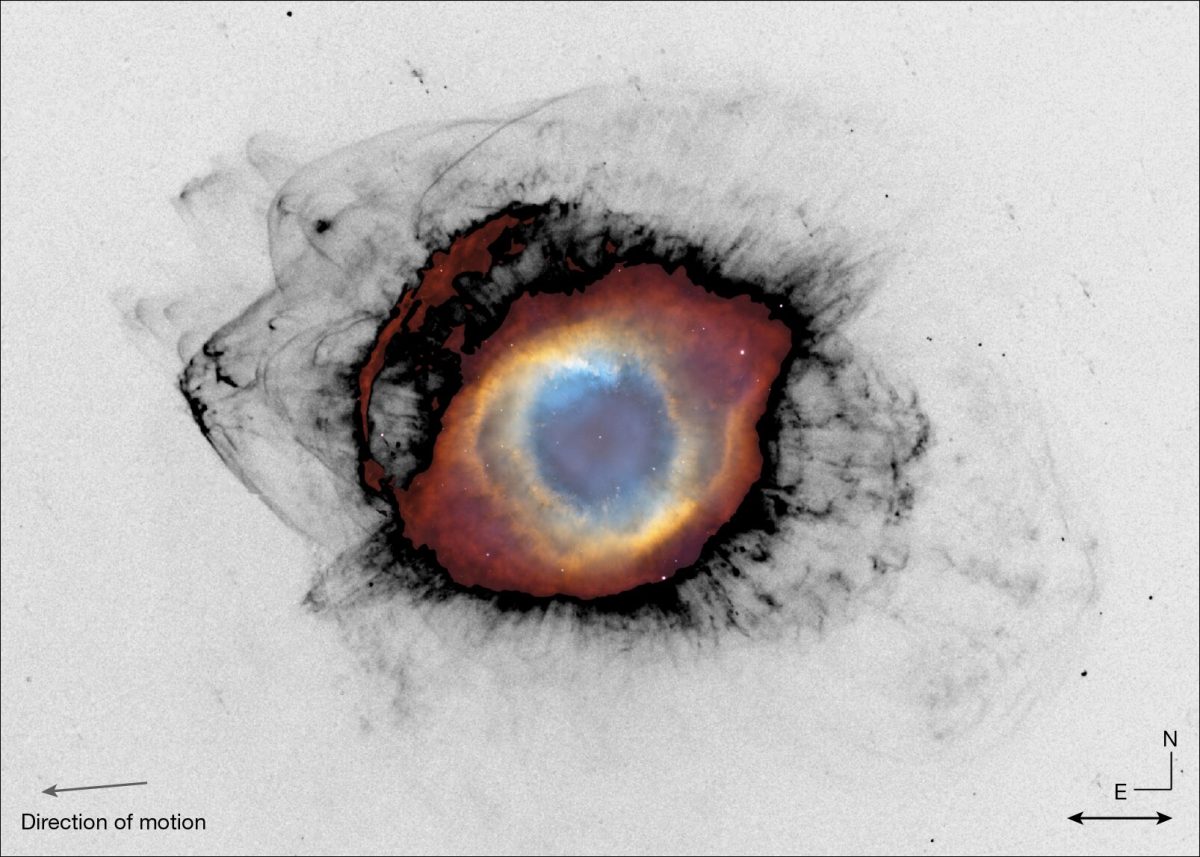
The Cycle of Matter in the Helix Nebula
A team of scientists led by Yale University astronomer Peter van Dokkum made the discovery while imaging the Helix Nebula — a well-studied planetary nebula located about 650 light-years from Earth. The findings were reported by phys.org.
“We are watching material ejected at the end of a star’s life break apart and return to the galaxy,” said van Dokkum, the Sol Goldman Family Professor of Astronomy and Professor of Physics in Yale’s Faculty of Arts and Sciences and the study’s lead author. He is also a member of the Dragonfly Focused Research Organization, a new type of nonprofit organization that aims to build high-impact scientific infrastructure at the pace of a technology startup.
Scientists say that this transition — from recognizable stellar remnants to diffuse gas between the stars — has been extremely difficult to observe. In the distant future, the Sun will undergo a similar process, and its material will enter the same cycle.
Discovery While Calibrating the Telescope
The scientists came across the discovery by accident. They selected the Helix Nebula as an ideal target for calibrating their new MOTHRA telescope, which combines images obtained with hundreds of telephoto lenses to detect and study diffuse ionized gas located between galaxies. MOTHRA (Modular Optical Telephoto Hyperspectral Robotic Array) is being built at the El Sauce Observatory in Chile’s Río Hurtado Valley and, once completed, will consist of an array of 1,140 telephoto lenses.
“We thought we were making a calibration image of one of the best-known nebulae in the sky,” said study co-author Roberto Abraham of the Dragonfly Focused Research Organization and the University of Toronto. “Instead, we discovered this extraordinary network of bow-shaped structures. It was immediately clear that the faint outer part of the Helix Nebula was telling us a story that had largely gone unnoticed until now.”
Shock Waves from Ejected Material
The Helix Nebula is characterized by a bright ring formed from material expelled by the dying white dwarf star at its center. The new observations extend far beyond this bright inner region of the nebula, reaching into its extremely faint outer halo. There, on the eastern side of the Helix Nebula, researchers identified 22 complete or partial bow shocks.
The shape of a bow shock resembles the wave that forms in front of a boat moving through water. In the Helix Nebula, largely invisible clumps of stellar debris are moving rapidly through the thin gas between the stars. The glowing arcs mark the locations where these clumps collide with the surrounding gas.
The nature of the shock waves changes dramatically depending on their distance from the central star. Those closer to the center are large, thin, and sharply defined. Farther out, they become smaller, more diffuse, and increasingly fragmented.
The researchers interpret this phenomenon as evidence that the clumps are gradually being eroded as they travel. They estimate that an individual fragment remains intact for only about 10,000 years after entering the surrounding gas. After that, its material largely breaks down into smaller particles and mixes with interstellar space.
Capabilities of the MOTHRA Telescope
MOTHRA represents a major expansion of the concepts that van Dokkum and Abraham first applied in their earlier Dragonfly telescope. Located in the mountains of New Mexico, that telescope combines images from multiple lenses to detect the faint glow of dim stars and galaxies.
MOTHRA will greatly increase the number of lenses used and will also incorporate new filters and additional computing power.
