

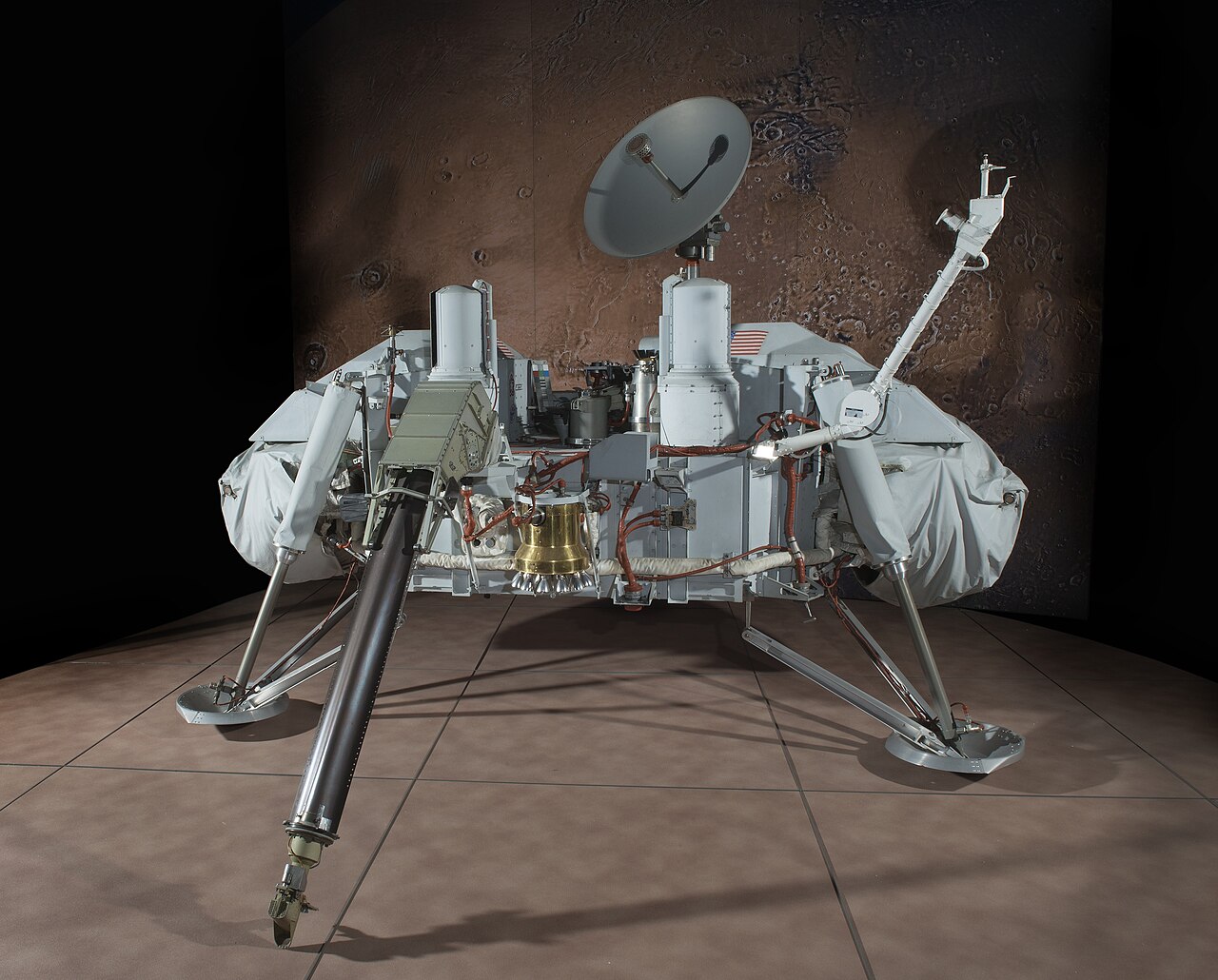
On July 20, 1976, the Viking 1 lander successfully touched down on the Martian surface. While this spacecraft was not the initial man-made vehicle to arrive on Mars, it was the first to accomplish all designated objectives and transmit images of the Martian terrain to Earth.
The first Martian race
Today, the global community is awaiting the commencement of Mars flights. Will Elon Musk succeed in relocating one million individuals to Mars by 2050? Meanwhile, July 20 commemorates a notable anniversary — precisely 50 years ago, Viking 1 achieved the distinction of being the first spacecraft to successfully execute a soft landing on another planet, despite not being the first spacecraft to reach its surface.
Its history dates back to the mid-1960s. During this period, NASA initiated a project known as the Voyager Mars Program, which was characterized by a straightforward plan: to repurpose the lunar lander from the Apollo program, mount it on a Saturn IB rocket, and dispatch it to Mars as an unmanned mission. Nevertheless, in 1965, the Mariner 4 spacecraft conducted a flyby of the planet and ascertained that Mars possessed a very thin atmosphere. Consequently, instead of deploying a single large lander, it was deemed more appropriate to send a smaller lander in conjunction with an orbital spacecraft, both based on the Mariner design. Achieving this objective necessitated simultaneous launches using a significantly more powerful launch vehicle — the Saturn V.
This task was particularly challenging, given that all resources were dedicated to the lunar program. Consequently, the Voyager Mars Program experienced delays until the early 1970s; at that time, it became evident that constructing an additional large rocket for this mission would be impractical, leading to the cancellation of the project.
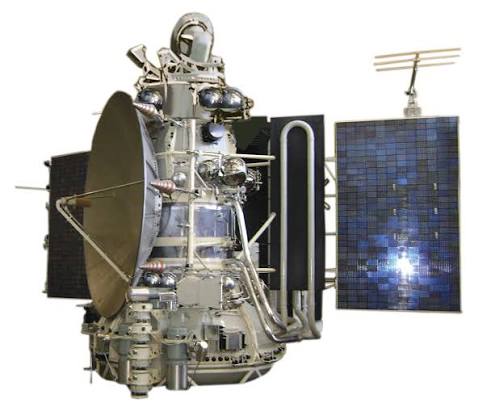
Meanwhile, with the conclusion of the lunar races, the Mars races commenced. Throughout May 1971, four unmanned spacecraft were launched to Mars: two by the United States and two by the Soviet Union.
For further information, please refer to this source; however, in brief summary, despite the incident involving Mariner-8, the United States was nonetheless the first to achieve orbit around Mars. It later emerged that the missions “Mars-2” and “Mars-3” were equipped with landers, thus potentially determining, as early as that time, that the Soviet Union would be the first to land on Mars.
Nevertheless, the USSR experienced a series of catastrophic failures with the Red Planet missions. The Mars-2 module encountered an incorrect reentry angle and ultimately crash-landed, marking it as the first artificial object to reach the surface of another planet. Conversely, Mars-3 made a successful landing and commenced transmitting a historic image before communication was irretrievably lost.
In 1973, the USSR endeavored to establish a leading position in the race to reach Mars by launching a total of four spacecraft toward the Red Planet. The initial two spacecraft did not include landers; “Mars-4” was scheduled to enter Mars’s orbit on February 10, 1974. However, a malfunction within the onboard systems compelled engineers to abort the braking maneuver, resulting in the spacecraft passing the planet without achieving orbital insertion, thereby conducting only a limited number of observations. Nonetheless, just two days subsequently, its sister spacecraft, Mars-5, successfully executed the maneuver, capturing a multitude of photographs of the Martian surface from space.
On March 12, the spacecraft “Mars-6” was launched. This mission included a lander; however, during its transit to the Red Planet, telemetry issues arose, necessitating the transmission of some commands without real-time feedback. Despite these challenges, the separation of the descent module was successful, and it entered the Martian atmosphere, transmitting initial data regarding atmospheric gases to Earth. Nevertheless, during the final descent phase, communication was lost, and it is presumed that the lander impacted the surface at high velocity.
The backup missions for “Mars-6” and “Mars-7” successfully arrived at the Red Planet slightly earlier — on March 9, 1974. However, an error in the calculation of the turn caused the lander to follow an incorrect trajectory, resulting in it passing by Mars without a successful landing.
The Viking-1 design
Four consecutive failed attempts to land a probe on Mars profoundly disappointed Soviet engineers, leading to a suspension of their efforts to explore the Red Planet for an extended period. However, the race had not yet been won by the United States, as engineers were merely in the process of developing a viable mission plan to achieve surface contact with Mars.
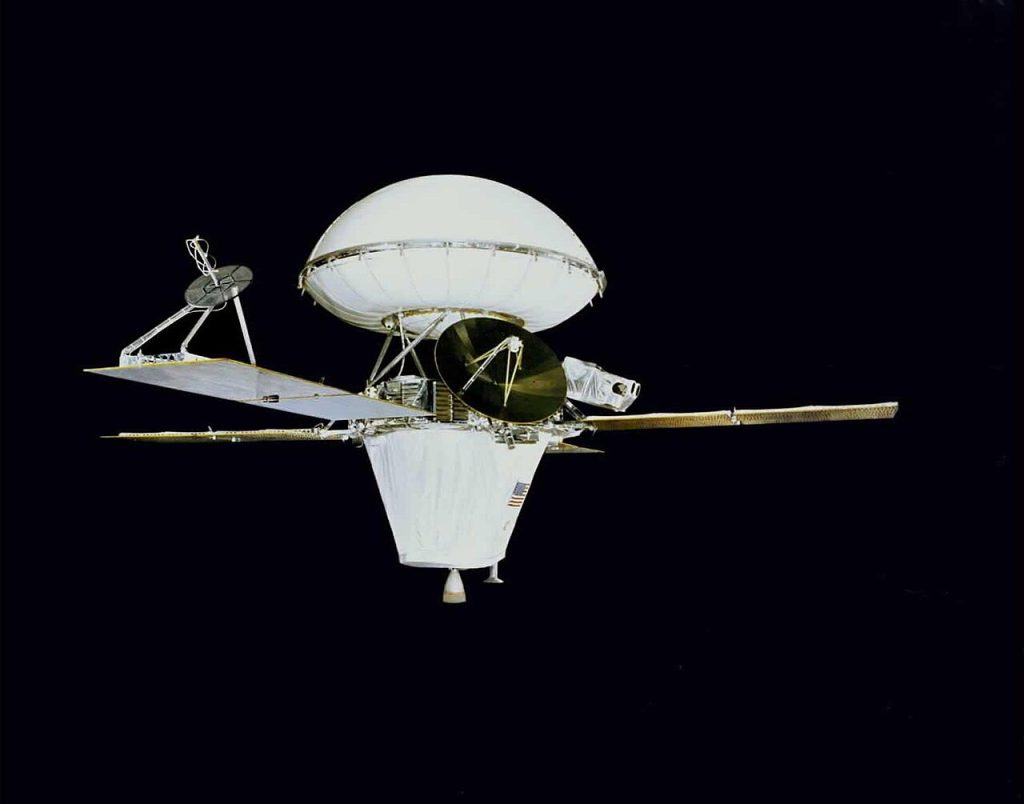
The program was designated Viking, and in numerous respects, it utilized methodologies analogous to those of the “Mars” program, namely, two identical spacecraft launched from Earth within a brief time interval. Each spacecraft comprised an orbital platform and a lander.
The experts elected not to reinvent the wheel and instead chose the proven Mariner design as the orbital component. This included the same octagonal base, identical solar panels protruding in all directions, and a consistent set of instruments.
A landing module was affixed to it, comprising two cameras for image capturing, sensors for measuring atmospheric pressure, temperature, and air density; a mass spectrometer for analyzing chemical composition; a seismometer for detecting surface vibrations; and equipment for the search for microscopic life on the surface.
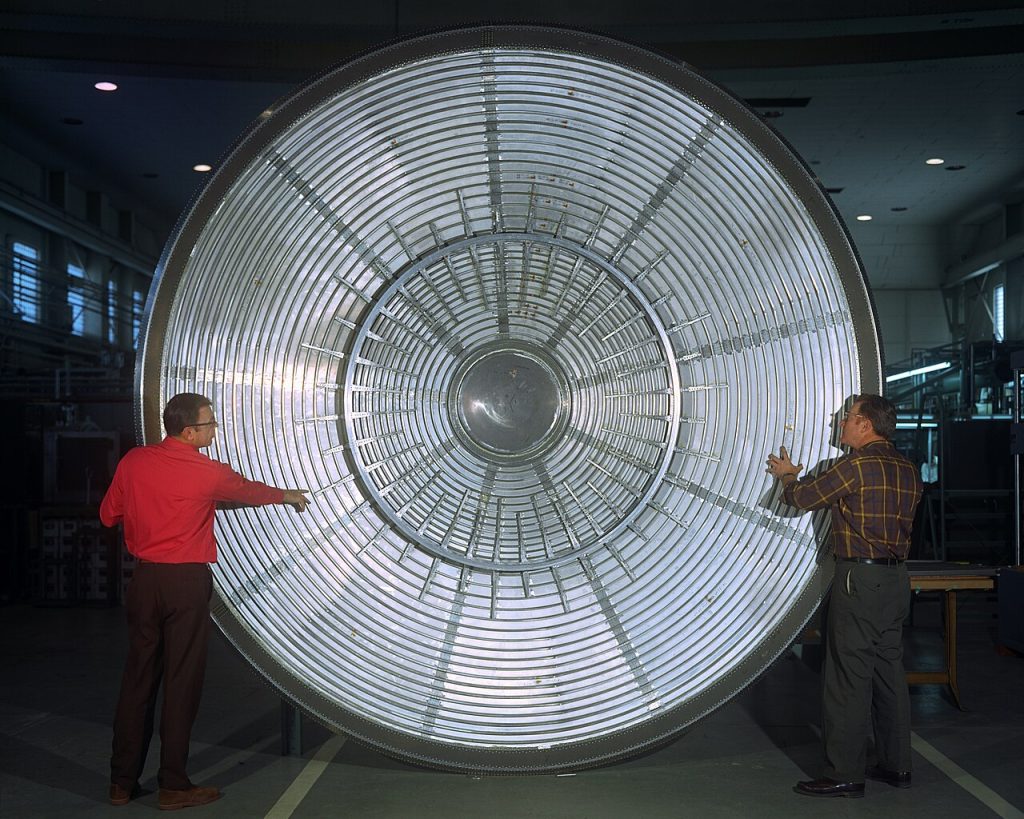
All of this was enclosed within a heat shield designed to protect the spacecraft from combustion during atmospheric reentry. The landing module had an approximate weight of 600 kg, whereas the orbital module weighed approximately 900 kg. Nonetheless, subsequent to its deployment on the trajectory towards Mars, the aggregate mass of the probe was 3,527 kg, owing to, among other components, nearly two metric tons of fuel and oxidizer required for deceleration near the Red Planet and surface landing.
Progress of the mission
Viking 1 was launched from Earth on August 20, 1975, aboard a Titan III-Centaur rocket from Cape Canaveral. Subsequently, its twin, Viking 2, was launched on September 9. Both spacecraft were successfully launched, and on June 19, 1976, the first of these vehicles entered orbit around Mars.
However, he was not in a hurry to immediately abandon the lander, as Soviet spacecraft had previously done. He orbited the planet for a month, documenting it through photographs.

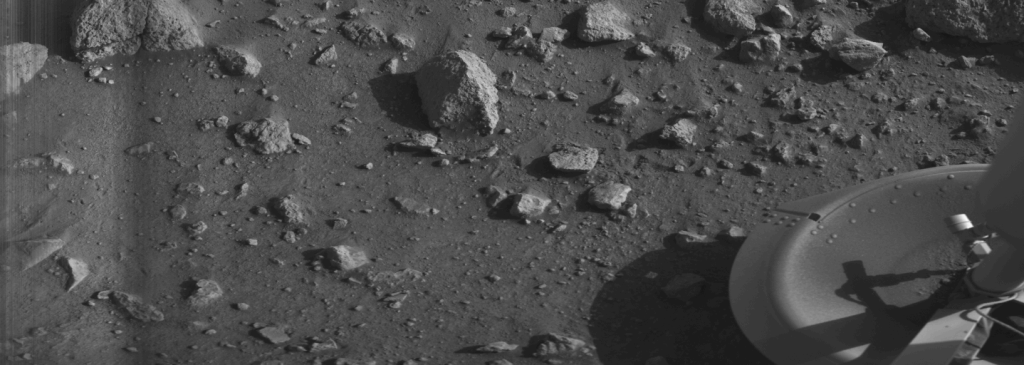
The separation and atmospheric entry occurred on July 20. This date held symbolic significance, as it marked the seventh anniversary of the Apollo 11 lunar landing, thereby serving as a commemoration of continued triumphs over the Soviet Union. The heat shield functioned as designed and was subsequently jettisoned. At an altitude of 6 km, the spacecraft deployed its parachutes, which decelerated its descent to 60 m/s. However, the Martian atmosphere’s thinness rendered reliance solely on parachutes impractical; therefore, at an altitude of 1.5 km, Viking 1 extended its landing legs and activated its thrusters. The spacecraft successfully touched down at 2:53 p.m. Kyiv time on July 20, 1976. Nevertheless, the landing on Mars was not officially declared successful until several hours later, when Viking 1 transmitted a clear image from one of its cameras. This first photograph, taken on another planet, depicts rocks and the spacecraft’s landing leg.
Subsequently, Viking 1 commenced transmitting panoramic photographs, which garnered worldwide acclaim. Overall, the lander remained operational on the Martian surface for a comprehensive period of six years, until November 11, 1982. Contact with the orbiter was discontinued on August 17, 1980 — more than four years subsequent to its orbital insertion. Furthermore, data analyses indicate that it may still be orbiting Mars to this day.
Results achieved
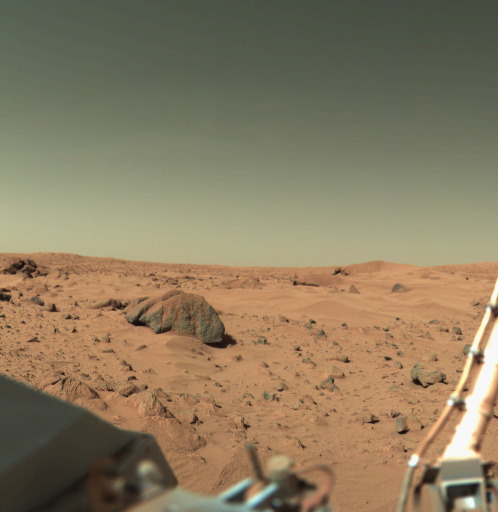
The main result of the Viking-1 mission was that people first saw what the surface of another planet looks like. The first detailed color panoramas of the surface of Mars from the landing site were obtained. They confirmed the ideas that had been formed since the Mariner missions: the Red Planet is a cold, rocky world with an extremely thin atmosphere. Viking 1 also studied in detail the chemical composition of the Martian atmosphere and soil and conducted the first experiments to search for life. The mission did not find convincing evidence of the existence of living organisms, although its results are still the subject of scientific debate.
To verify this, at least three instruments on board were employed to analyze the effects on Martian soil samples when subjected to conditions of adequate sunlight exposure, maintained at a temperature approximating that of Earth, and — most crucially — when liquid water and nutrients were introduced.
The initial experiment aimed to assess how the gas composition surrounding the sample alters when conditions analogous to those on Earth are established. Considering that the majority of terrestrial organisms respire, and some are capable of photosynthesis, the results indicated that such processes are absent in Martian soil.
In the second experiment, the radioactive isotope carbon-14 was introduced into soil samples, and after a certain period, the samples were subjected to high-temperature heating. If living organisms had been present in the soil, they would have absorbed the isotope, resulting in a decrease in its concentration within the samples. However, this outcome was not observed.
The third experiment entailed the introduction of several relatively complex compounds into the samples, which subsequently underwent biochemical reactions that are prevalent on Earth. Their molecules were designated as “labeled” due to the presence of atoms of carbon-14.
If this carbon were later detected in the gas above the samples, it would indicate that the soil had decomposed the organic matter. This was precisely what occurred, much to the astonishment of the scientists. In the end, the outcome was ascribed to a defective experimental design; however, the debate around this matter persists to the present day.
In addition to conducting biological experiments, the mission facilitated the testing of the general theory of relativity in relation to the effect of gravity on the propagation of light. This was achieved by transmitting radio signals from Earth to the spacecraft and receiving responses. When the signal passed close to the Sun — specifically when the Sun was positioned between Earth and Mars — a slight delay was observed. The magnitude of this delay precisely corresponded to the predictions made by the theory.
New Martian race
The landing of Viking 1 signified a decisive achievement for the United States in the space race to Mars, establishing a clear dominance over the Soviet Union. Over the past fifty years, the preponderance of missions to the planet has been conducted by American agencies.

That is precisely why Elon Musk’s plans to resettle a million Earthlings on Mars by 2050 appear highly compelling, despite the fact that experts have held a skeptical view of these initiatives for several years now.
Meanwhile, the notion of Mars as an “American” planet may soon be rendered obsolete. Chinese and Indian spacecraft have already achieved contact with the planet. Consequently, it is entirely plausible that a new phase of space exploration competition is imminent.
