

Four stars have been discovered near the Sun that were missed by every previous survey campaign. Each of them is hidden in the glow of a brighter companion with which it forms a pair. They were detected because of a barely perceptible wobble.
Two Stars Instead of One
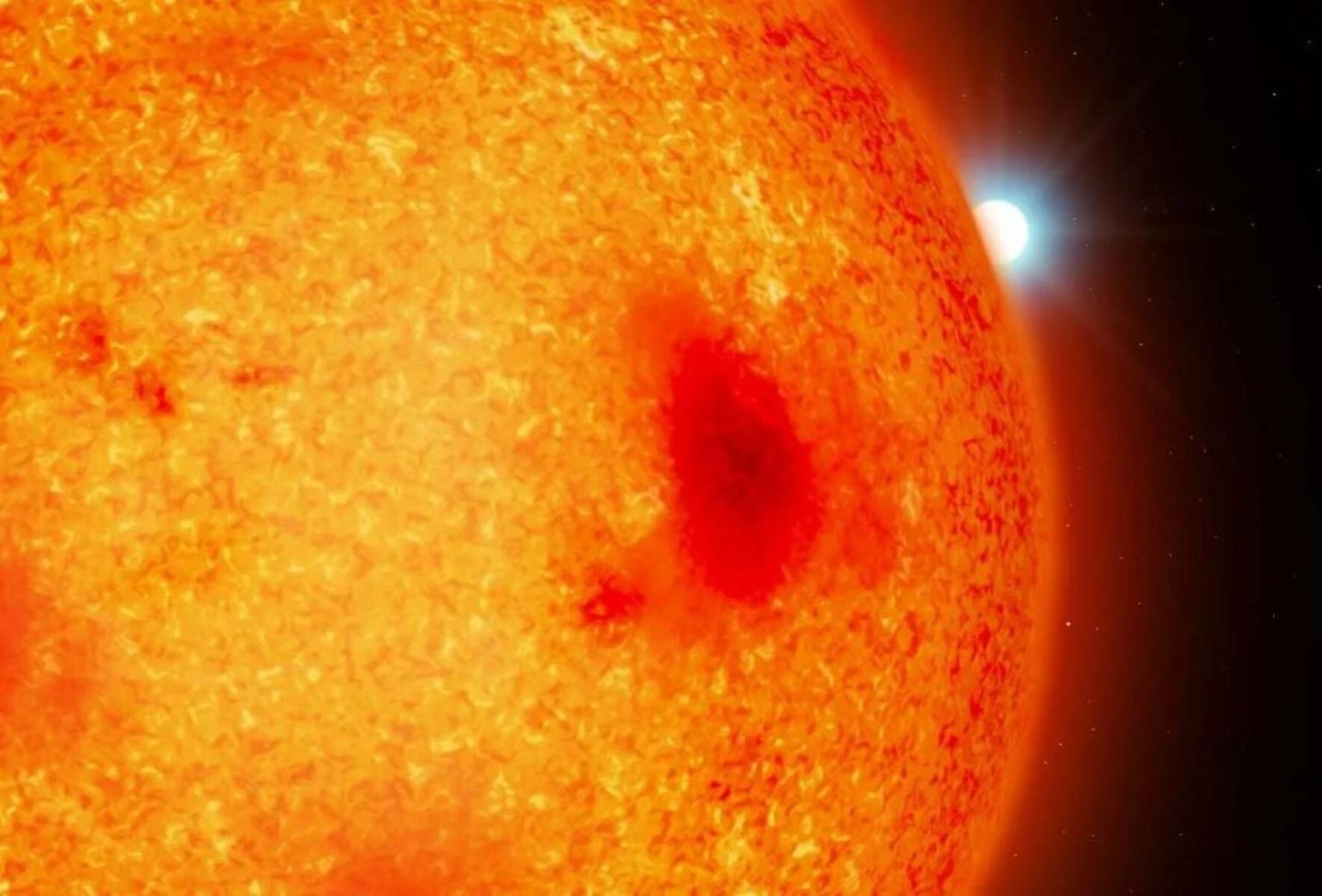
The objects in question are white dwarfs, the remnants of the cores of Sun-like stars that have exhausted their nuclear fuel. Each of the four is in a close binary system with a red dwarf that is significantly larger and brighter.
Because of the difference in brightness, these systems appeared to be single stars for decades, according to Universe Today. Red dwarfs also flare frequently, and the radiation signature of such an outburst may resemble the signal of a compact object.
A Wobble Instead of a Direct Image
Observations in visible light produced no result, so the researchers used a different approach. The white dwarf pulls its companion away from the system’s center of mass, and this motion shifts the lines in the companion’s spectrum.
These shifts were recorded using the STIS spectrograph installed on Hubble. The stars in each pair orbit very close to one another, so their velocities are sufficiently high for the spectral-line shifts to remain detectable even in systems located 65 light-years away.
The best-known white dwarf was also discovered through its influence on a neighboring star. As early as 1844, Friedrich Bessel noticed deviations in Sirius’s proper motion and concluded that it had an invisible companion. The companion was not directly observed until eighteen years later.
A Shed Envelope
All four pairs passed through a common-envelope stage. One of the stars expanded to the stage of a red giant, the future precursor to a white dwarf. Its outer layers grew so large that they enveloped both stars in a common gaseous envelope.
This process usually begins when a giant star fills its Roche cavity—the region of space within which its matter is still held together by its own gravity. If the mass transfer becomes unstable, the gas quickly engulfs both stars, forming a common envelope.
As stars move within this envelope, they lose orbital energy due to friction, causing their orbits to shrink. Eventually, the envelope is thrown back into space, leaving a tight pair at the center—a white dwarf and a red dwarf.
The envelope eventually disperses. The pair remains in a very tight orbit, and it is this configuration that makes the white dwarf almost invisible in visible light.
The Unusual Rotation of the G 203-47 System
One of the newly discovered pairs behaves differently from theoretical predictions. Its red dwarf takes more than 100 days to rotate around its axis, even though it orbits the common center of mass every 14.9 days.
According to David Wilson of the University of Colorado Boulder, with such parameters both stars should be tidally locked. The slow rotation suggests a brief and relatively gentle interaction at an early stage, whereas other similar systems passed through prolonged and violent phases.
How Many More Remain Undetected
Calculations for the solar neighborhood predicted four or five such systems within a radius of 65 light-years, so the discovery confirmed the model. The results were published in the peer-reviewed journal Monthly Notices of the Royal Astronomical Society, with Mairi O’Brien of the University of Warwick as the study’s first author.
The search is far from complete, because only about 30% of the red dwarfs within this volume have been systematically examined. Pierre-Emmanuel Tremblay estimates that another nine or ten undiscovered pairs remain in the Sun’s immediate neighborhood.
