

A new tool for countering jet-powered Shahed drones has appeared in Kyiv: automated turrets equipped with machine vision and a targeting system. The idea seems simple: a camera detects the target, algorithms help track it, and the weapon automatically aims at the drone. But can such a system really provide effective protection against high-speed UAVs, and what are its limitations?
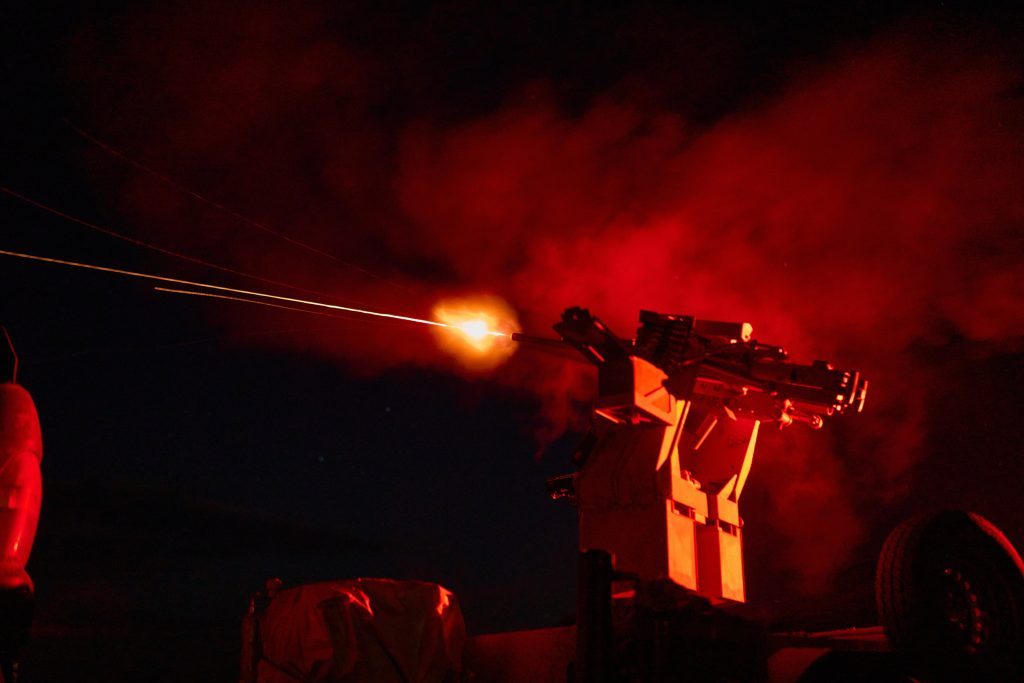
President Volodymyr Zelenskyy announced on October 4 that more than 12 such turrets had already been installed in the capital, with another eight modules for heavy machine guns planned for deployment in Kyiv Region.
Serhii Beskrestnov, the presidential adviser on the development of defense technologies, known as “Flash,” clarified that this is a Ukrainian-developed system combining machine guns with automated targeting and artificial intelligence technologies. According to him, the installations are primarily intended to intercept attack UAVs, including jet-powered Shaheds.
Moreover, the technology has already demonstrated its capabilities in combat. On October 5, Ukrainian Air Force spokesperson Yurii Ihnat stated that robotic turrets had already been used to successfully engage jet-powered UAVs, including Geran-5-type drones. According to him, machine vision helps automate the tracking of high-speed aerial targets and reduce the influence of human factors. At the same time, Ihnat emphasized the system’s main limitation: the short range of its machine guns.
This is a significant point. Turrets are not a complete replacement for surface-to-air missile systems, fighter aircraft, or interceptor drones. Instead, they form another, short-range layer of air defense that can protect individual facilities and approach routes. Because a single installation has limited range, protecting a large area requires a substantial number of these systems.
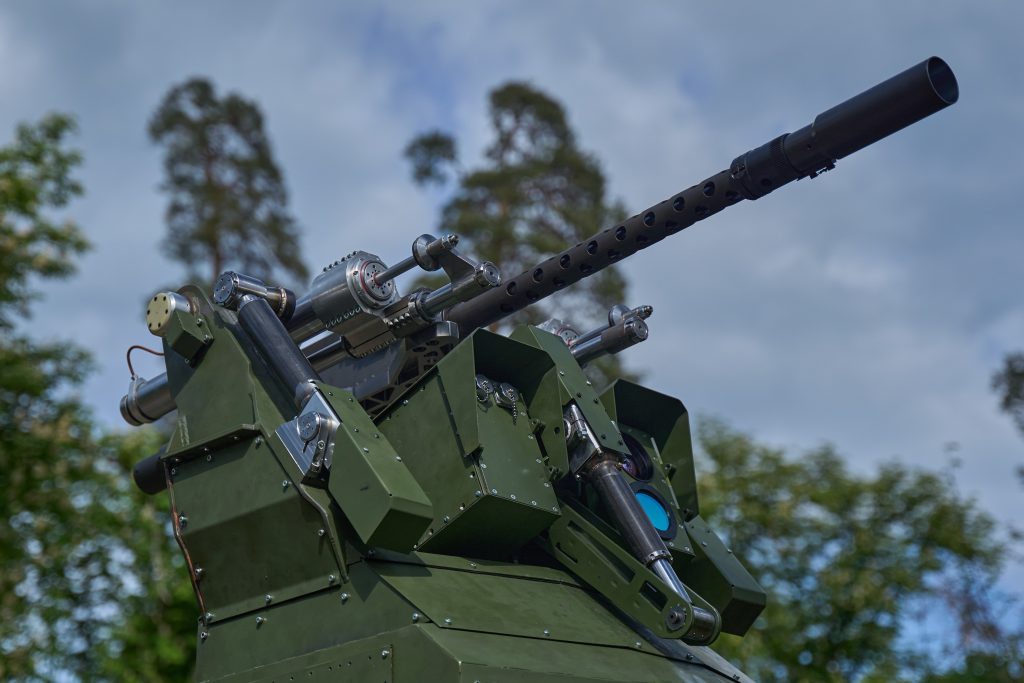
What Do We Know About Its Specifications?
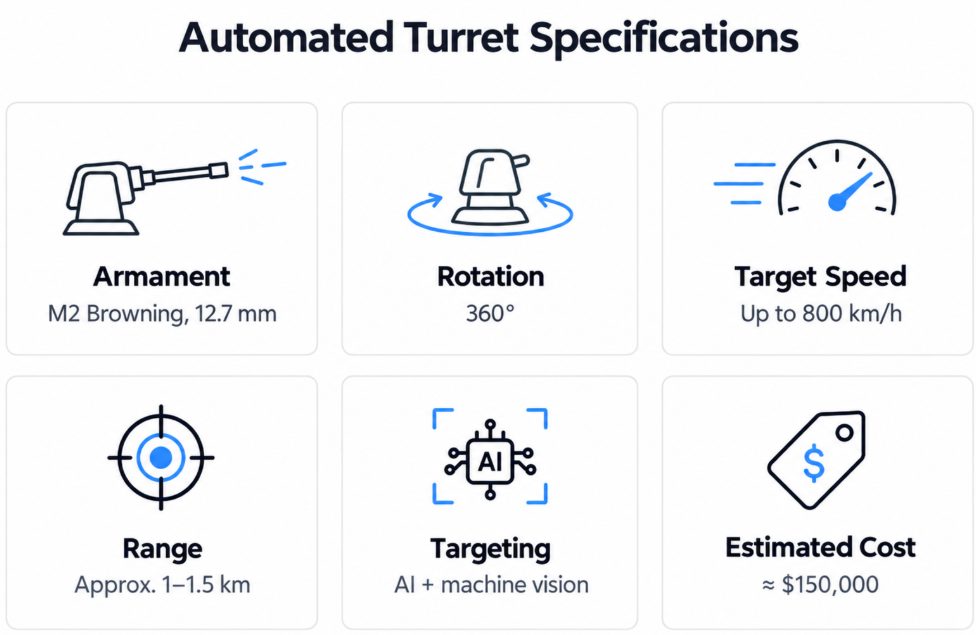
The system is built around a 12.7 mm M2 Browning heavy machine gun and an automated targeting module with machine vision. The turret can rotate through 360°, while its software determines the target’s motion parameters, calculates its trajectory, and determines the lead required for firing. According to previously published information, a Sky Sentinel-type system can engage aerial targets traveling at speeds of up to approximately 800 km/h, theoretically allowing it to intercept jet-powered attack UAVs as well. However, the range of the machine gun remains the key limitation: the practical engagement range against such targets is approximately 1–1.5 km and depends heavily on the drone’s altitude, approach angle, and trajectory. The estimated cost of a single installation is around $150,000.
How Does It Work?
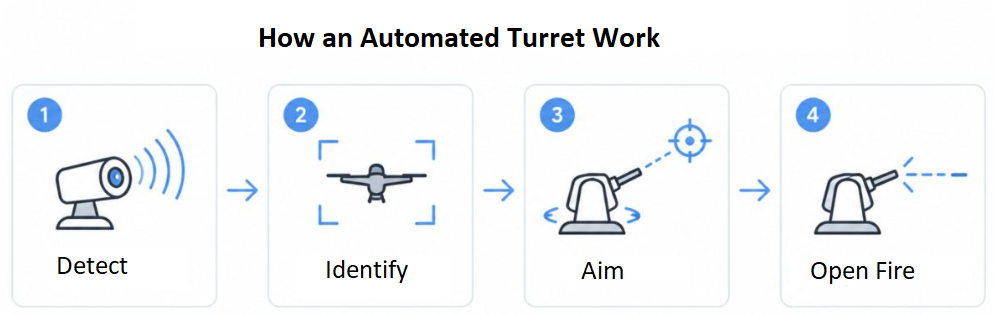
In simplified terms, the system operates like a very fast automated gunner. Sensors detect an aerial object, while the machine vision system analyzes its appearance and movement, helps identify the target, and continuously tracks it. The automated system then calculates the aiming direction, accounting for the drone’s movement, and turns the machine gun mount toward the appropriate sector. This shortens the “detect — identify — aim — fire” cycle, which is particularly important when engaging high-speed jet-powered UAVs.
Machine vision analyzes video from the camera, locates the target within the frame, and tracks its movement between frames. Based on changes in position, the system estimates the direction and speed of movement and continuously adjusts its aim. The camera itself provides an image as an array of pixels, each containing brightness and color values. The algorithm analyzes entire patterns rather than individual pixels: outlines, shape, texture, contrast, motion, and changes between frames.
At the same time, publicly available reports do not yet make clear how autonomous the decision to open fire actually is: machine vision and automatic target tracking do not necessarily mean that a human has been completely removed from the control loop.
Is It Effective?
The main advantage of this approach is the ability to establish a relatively inexpensive short-range air defense layer against drones that are not economical to engage with expensive surface-to-air missiles. Automated targeting also reduces reaction time and may improve firing accuracy against fast-moving targets. However, the system’s effectiveness depends heavily on how well the detection network is configured, the quality of its machine vision, the range of its weapons, and the number of modules deployed. Turrets should therefore be viewed as one component of a layered air defense system rather than a “silver bullet.”
Compared with jet-powered interceptor drones, automated turrets serve a different role. A turret primarily provides short-range air defense: it remains on duty in a fixed position, has a relatively low cost per shot, and can engage targets repeatedly, but its effectiveness is limited by the machine gun’s range and the drone’s flight altitude. A jet-powered interceptor, by contrast, can meet a target much farther from the protected facility, catch up with a high-speed UAV, and operate across a wider range of altitudes. However, each launch expends a separate aircraft and requires a more complex detection and guidance system.
These systems therefore complement rather than replace one another: interceptors can destroy targets on distant approaches, while automated turrets can provide a final line of defense immediately around critical facilities.
The safety of people on the ground is a separate concern. Serhii Beskrestnov urged people to stay away from windows during air raid alerts. This is particularly relevant for machine-gun-based systems because of the risk of falling bullets, drone debris, and other fragments following air defense engagements.
