

On August 12, individuals worldwide will have the opportunity to witness a total solar eclipse. However, viewing it will require being present in Greenland, Iceland, or Spain. In other regions of Europe, including Ukraine, the eclipse will be partial. Consequently, what insights can we anticipate from this celestial event?
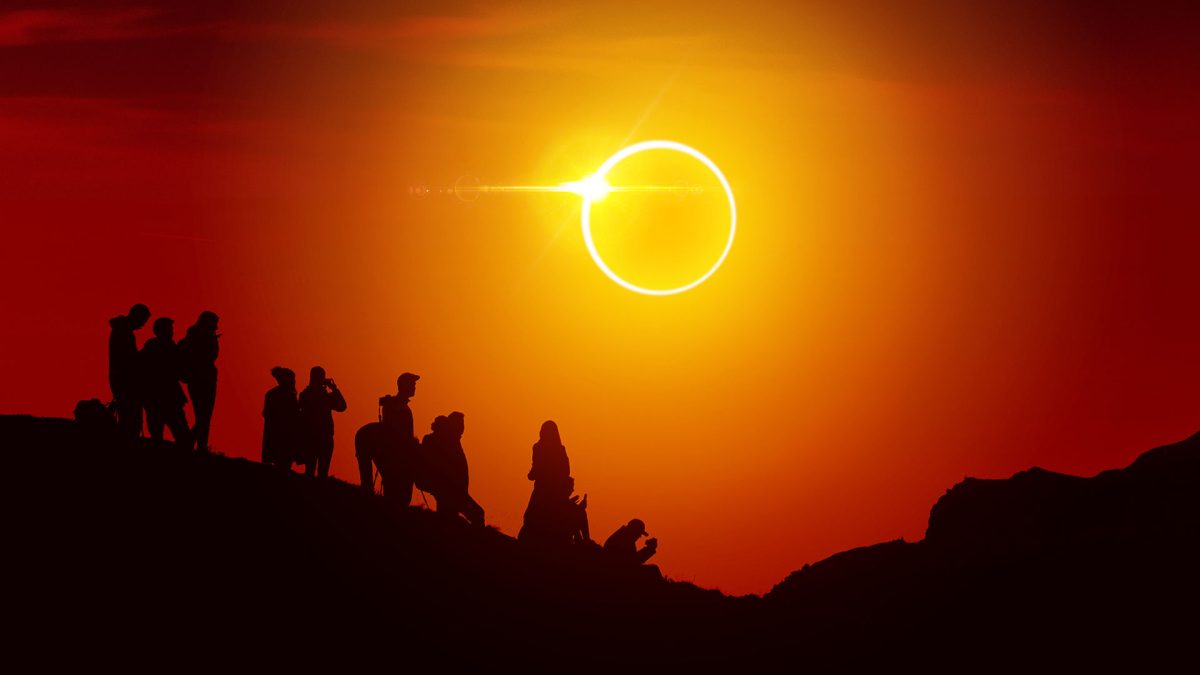
Solar eclipse
Starting tomorrow, individuals will have the opportunity to observe a solar eclipse in the sky. Such phenomena invariably occur during the new moon phase, as it is the moon that obstructs the sun during these events — implying that it must be situated between the sun and the Earth. Consequently, it will be night on the hemisphere of the moon that faces us.
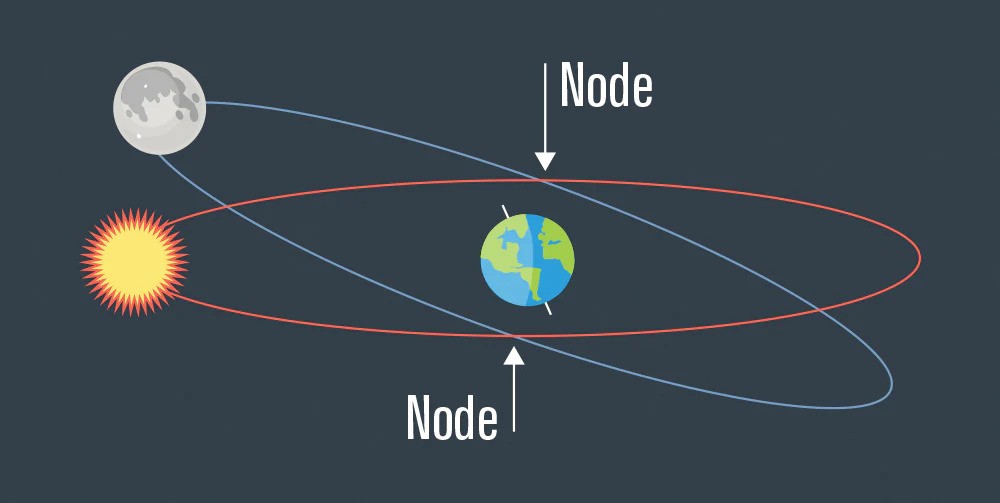
However, why is it that we do not observe a solar eclipse during each new moon? The explanation lies in the fact that the plane of our Moon’s orbit is inclined relative to the ecliptic. Consequently, eclipses take place solely when the Moon is proximate to the intersection point of its orbit with the ecliptic, and such an alignment does not occur consistently.
Given that the Sun considerably exceeds the size of the Moon, the shadow it projects possesses a diameter smaller than that of the Earth. Typically, this shadow passes adjacent to our planet; however, when it does intersect with the Earth’s surface, observers in that particular region witness the Moon’s disk completely covering the Sun. In other locations, only a partially obscured portion of our satellite’s disk is observable.
It is noteworthy that a solar eclipse can solely be observed through the use of specialized glasses, a light filter, a welder’s mask, or another semi-transparent medium that effectively obstructs excessive rays.
What to expect on August 12
On August 12, the Moon’s shadow will ultimately cast upon Earth. This phenomenon will be feasible because the eclipse is scheduled to occur merely two days subsequent to the Moon passing through its perigee: at this point, its disk in the sky will appear larger than that of the Sun, resulting in a total eclipse rather than an annular one. When the Moon is situated at a greater distance from our planet, its apparent disk diminishes in size relative to the Sun’s.
Nevertheless, on this occasion, the path of totality will again traverse the Earth in an unfavorable manner. It will commence over the far northeastern extremity of Russia at 16:09 UTC. Subsequently, it will traverse the uninhabited regions of the Arctic Ocean. Subsequently, at 16:19 UTC, it will pass over the Nord station in northern Greenland. At 16:47 UTC, it will be over Reykjavík, Iceland, and thereafter continue its extensive journey across the Atlantic Ocean.
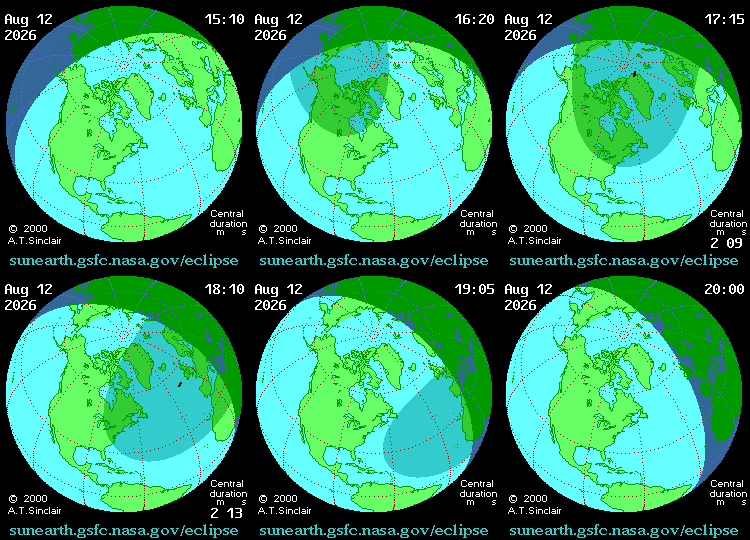
At 5:30 p.m., the path of totality will commence its journey over Spain, and at 5:38 p.m., it will be over the island of Mallorca in the Mediterranean Sea. Shortly thereafter, the eclipse will conclude. It is noteworthy that from Western Europe — even in regions outside the path of totality — the eclipse will remain highly observable. In numerous countries, the Moon will obscure 80–90 percent of the Sun, rendering it similar to a small crescent.
Solar eclipse in Ukraine
Regrettably, residents of Ukraine will not be as fortunate. In the southern, eastern, and central regions of the country, the eclipse will be entirely obscured. Only the outer edge of the eclipse will be observable in the northern area. In the western region, a partial eclipse will be visible, continuing until just prior to sunset. The most optimal location for observation is the Shatsk Lakes in Volyn.
The eclipse is scheduled to commence at 8:15 p.m. It is advisable to consider in advance a suitable viewing location with an unobstructed western horizon, as the Sun will already be positioned low above it.
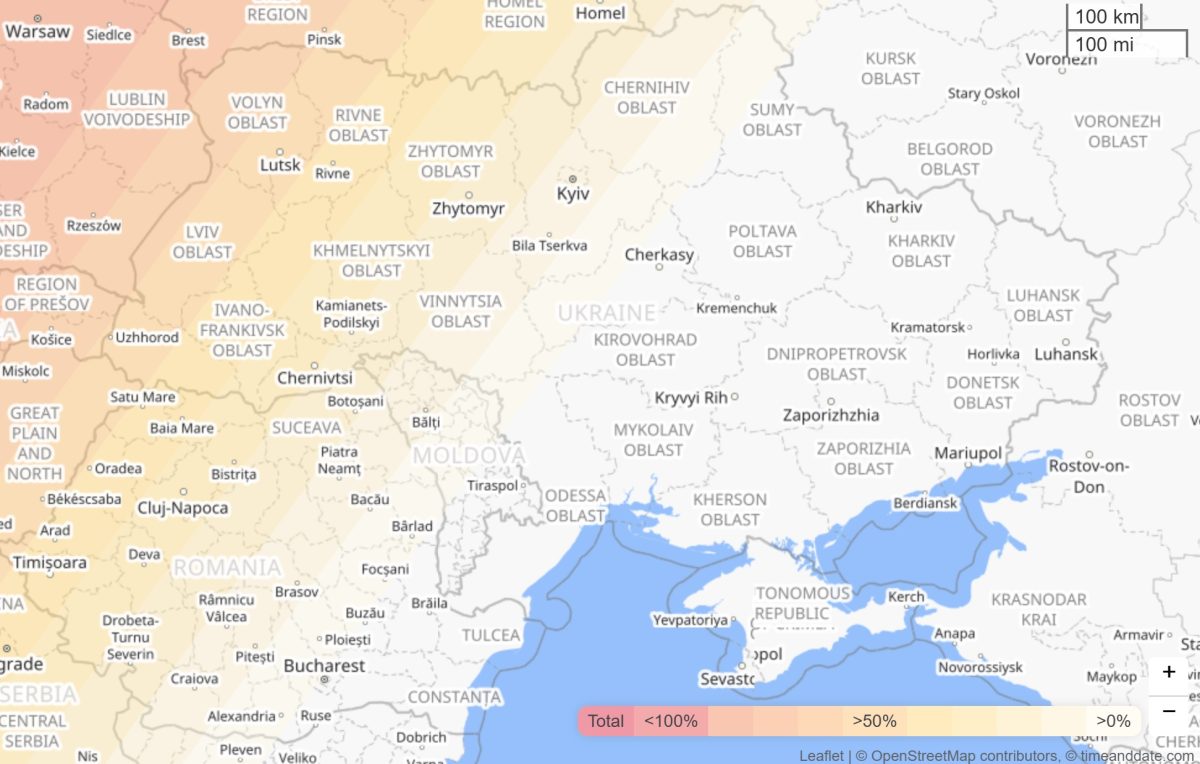
Through a light filter, you will be able to clearly observe how, over the subsequent several tens of minutes, the Moon will progressively pass in front of the Sun. The peak phase, reaching 57% — or slightly more than half of the disk — will occur at 8:50 p.m., four minutes prior to sunset. This astronomical event will conclude after the Sun has set below the horizon throughout the entire territory of Ukraine.
In Kyiv, the eclipse will be barely noticeable at sunset. At its peak, only 2.67% of the disk will be obscured. However, there’s no need to worry about this. After all, on this very day, the interactive event “August Sky: The Perseids and the Solar Eclipse” will take place, organized by Universe Space Tech, the Non-Governmental Organization “Association Noosphere,” and Noosphere Engineering School.
Please follow this link to submit your name (or username), your city, and a wish. Subsequently, on August 12 at 8:30 p.m., a constellation of wishes will illuminate the virtual sky, allowing you to locate your own star. The constellation will continue to expand with new stars and aspirations until August 24.
On August 28, we anticipate a lunar eclipse. This occurrence should not be unexpected, as solar and lunar eclipses typically happen in pairs — an explanation for which is straightforward. As previously noted, these phenomena necessitate the Moon’s proximity to the plane of the ecliptic. Furthermore, in two weeks, during the full moon, the Moon will remain in this position. Consequently, the shadow cast by the Earth will fall upon the Sunlit surface of the Moon.
