

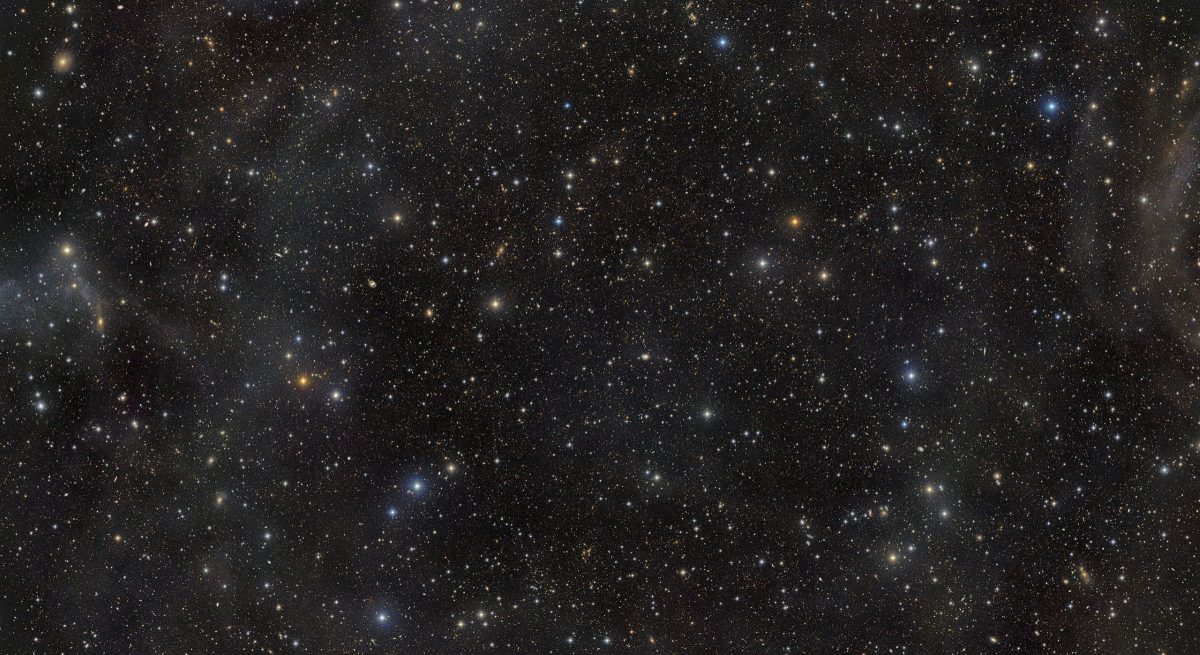
Observational astronomy has taken an important step forward. Scientists have obtained the most detailed image of deep space to date, in which hundreds of thousands of distant galaxies can be seen even across individual pixels. The image was captured using the 3.2-gigapixel, or 3,200-megapixel, LSST Camera—the largest digital camera in the world. The instrument was developed for the NSF–DOE Vera C. Rubin Observatory.
Weighing approximately 3,000 kilograms, the structure is comparable in size to a small car. The camera’s sensor array consists of 189 individual charge-coupled devices mounted on a single platform. The LSST Camera operates together with the 8.4-meter Simonyi Survey Telescope. During its ten-year mission, the system will produce 700 high-resolution panoramic images every night.
Half a Million Galaxies in a Single Panorama
The published image is the result of combining hundreds of individual observing sessions. In total, more than 500,000 galaxies were recorded in the image.
To understand the scale, it is worth remembering that the visible diameter of the Milky Way is approximately 120,000 light-years, while its full extent, including its dark-matter halo, reaches 1.9 million light-years. Most of the objects in the new image are dwarf and distant galaxies. The image provides a sense of the enormous spatial and temporal distances involved, as light from some of these systems traveled for billions of years before reaching Earth.
The COSMOS Field
The photographed region of the sky is known as COSMOS, or the Cosmic Evolution Survey Deep Field. Between 2003 and 2005, the Hubble Space Telescope actively observed this area, and it has since remained one of the most extensively studied regions of the sky.
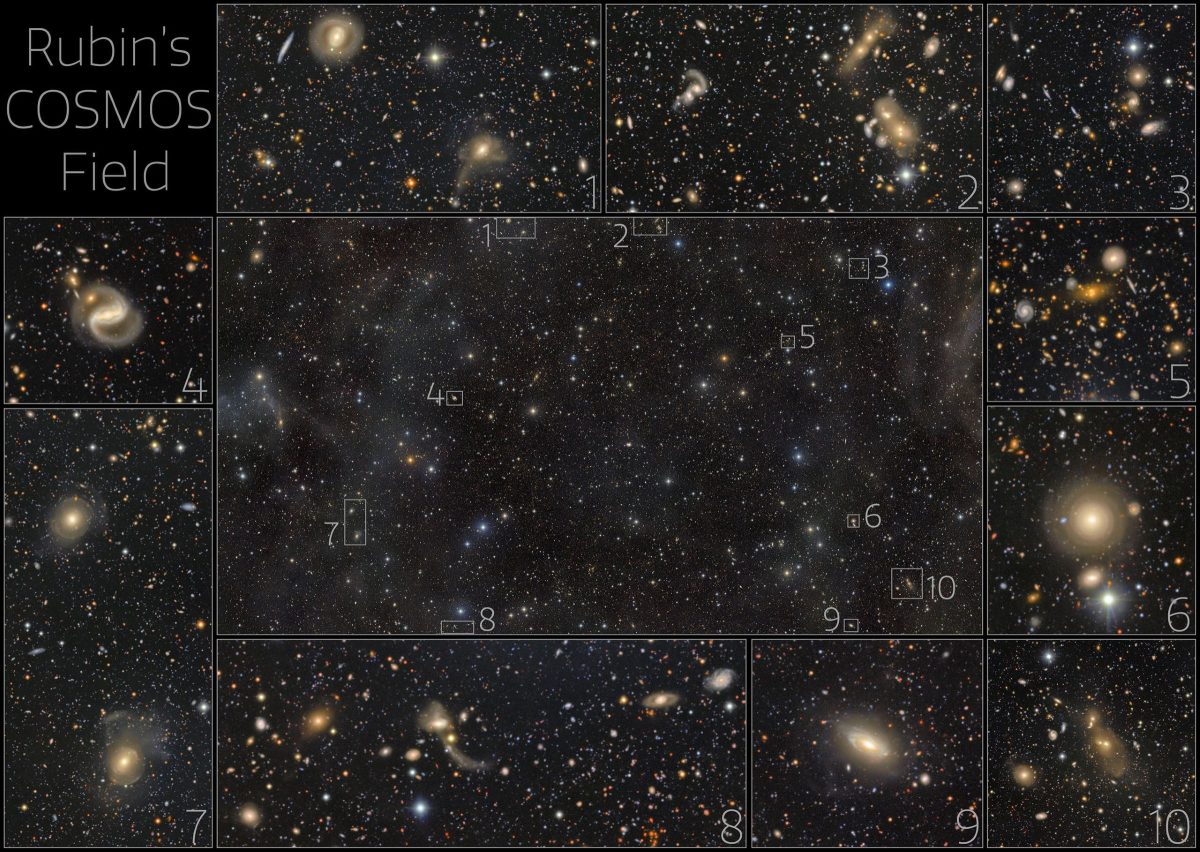
Scientists selected the COSMOS field because more than two million galaxies of every type and stage of formation have already been identified there. The region can be observed equally well from Earth’s surface and from space, making it a benchmark laboratory for testing astronomical hypotheses.
A Dynamic Universe
New data from the LSST Camera will supplement existing catalogs and allow scientists to investigate how galaxies evolve over time. The time dimension is one of the mission’s main priorities: repeated imaging of the same region over many years will help researchers record dynamic cosmic processes.
According to Bob Blum, director of Rubin Observatory operations at NSF NOIRLab, the first deep image of COSMOS is only the beginning. Systematic monitoring will provide researchers with information about thousands of variable objects, including supernova explosions and other explosive phenomena.
Phil Marshall, deputy director of Rubin Observatory at SLAC, adds that the rich observational history of the COSMOS field makes it an ideal testing ground for preparing the scientific community to work with the enormous datasets that will be produced by the LSST.
Earlier, we reported on how the Vera Rubin Observatory launched the most extensive sky survey in history.
According to PetaPixel