

During the first 500 million years after the Big Bang, the Universe was only beginning to awaken. It was barely 3% of its current age, and the very first stars and galaxies were just starting to emerge from the primordial chaos. For a long time, astronomers believed that the space surrounding these young stellar systems consisted exclusively of “pure” hydrogen and helium — the simplest elements formed at the very beginning of the cosmic timeline.
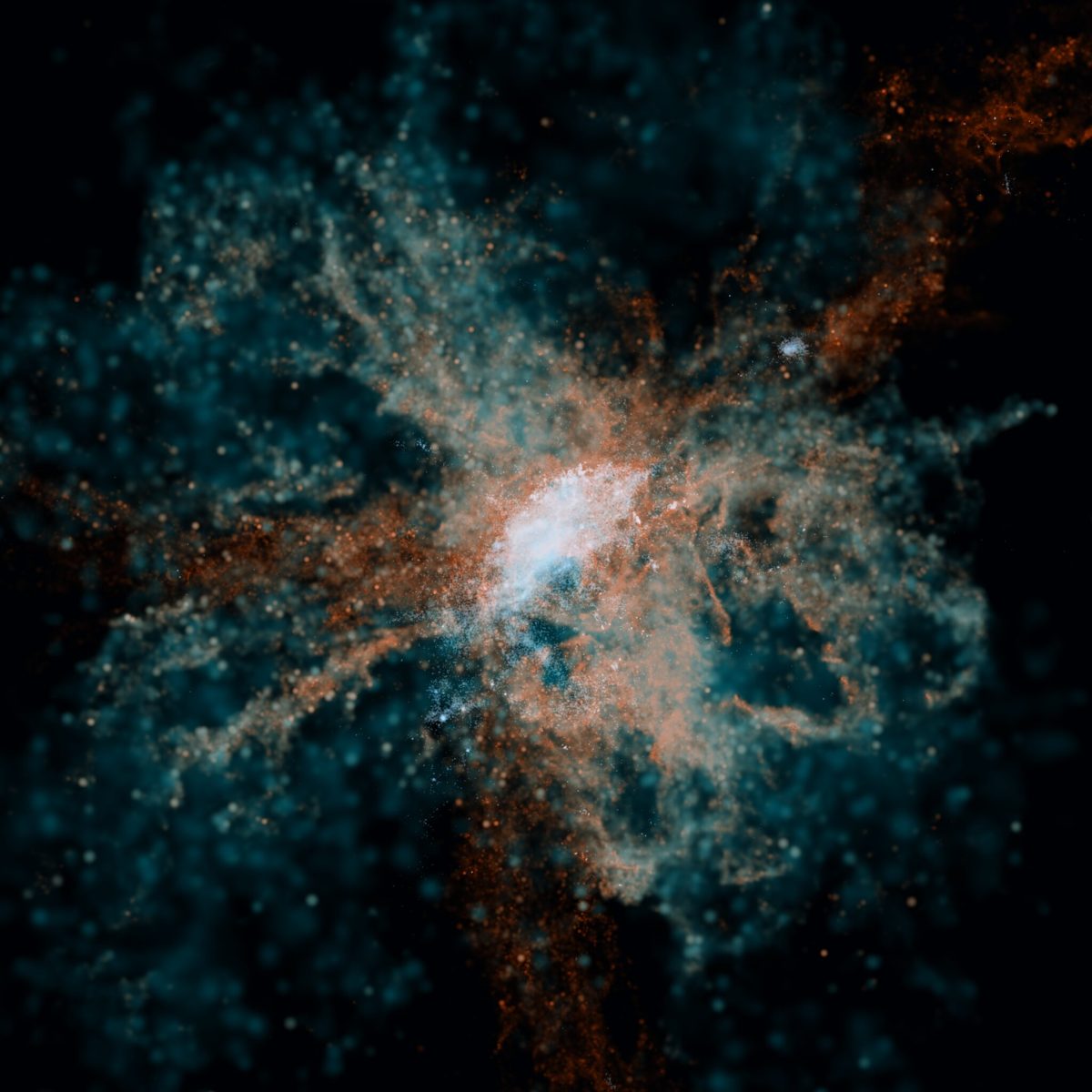
However, a new study by astronomers from the University of Arizona, published in Nature Astronomy, completely overturns these ideas. It turns out that the first galaxies began enriching intergalactic space with heavy elements — oxygen, carbon, and silicon — much earlier than modern science had predicted.
How Stars Forged and Dispersed Chemical Elements
At the very beginning of the Universe’s existence, there was nothing but hydrogen and helium. Over time, gravity compressed these enormous gas clouds, triggering nuclear fusion inside the first stars. It was in these colossal natural reactors that more complex elements were forged from lighter atoms, including oxygen and carbon — the same elements that today make up our bodies and the air we breathe.
When the first stars exploded as supernovae, they ejected the heavy material they had accumulated into open space. However, it remained a mystery to scientists exactly how and when these heavy elements managed to escape beyond their home galaxies and enter the open intergalactic ocean.
Looking Back Through 13 Billion Years
To detect this ancient material, the research team studied three primordial galaxies. Their light traveled to Earth for more than 13 billion years, showing them as they appeared during the Epoch of Reionization. During this period, the first stars gradually “pierced” the fog of neutral hydrogen with their ultraviolet radiation, bringing the Universe’s dark ages to an end.
The faint spectral lines could only be detected thanks to the highly sensitive infrared James Webb Space Telescope (JWST). Scientists used the galaxies themselves as sources of backlighting: as their light passed through the surrounding gas, the elements present left distinctive “shadows” in the spectrum — absorption lines.
After analyzing archival data from nearly 30 hours of JWST observations, the scientists found clear signatures of oxygen, carbon, and silicon in all three galaxies. Moreover, these lines were blueshifted. This means that the gas was not simply sitting nearby, but was being expelled outward from the galaxies at high speed, enriching the intergalactic medium. In terms of their chemical structure, these ancient outflows turned out to be surprisingly similar to those seen in much more mature galaxies billions of years later.
The Disappearance of “Primordial” Stars
Astronomers call this process of matter exchange the baryon cycle. Thanks to it, galaxies do not exist in isolation but form a single ecosystem in which material from dead stars is recycled and used by subsequent generations.
This discovery suggests an answer to one of the biggest mysteries of modern astrophysics: why have we still not been able to find Population III stars? These are the hypothetical first stars in the Universe, which should have consisted of absolutely pure hydrogen and helium without any admixture of heavy elements.
If galaxies began filling the cosmos with such “contamination” as early as 500 million years after the Big Bang, then pristine gas may have disappeared from the Universe very quickly.
As study author Yonda Zhu summarized: “If you have a cup of pure vanilla ice cream and immediately start sprinkling colorful toppings into it, then very soon you simply will not be able to find any completely pure vanilla piece.”
Earlier, we reported on how primordial black holes may have ignited the first stars in the Universe.
Based on materials from Phys
