

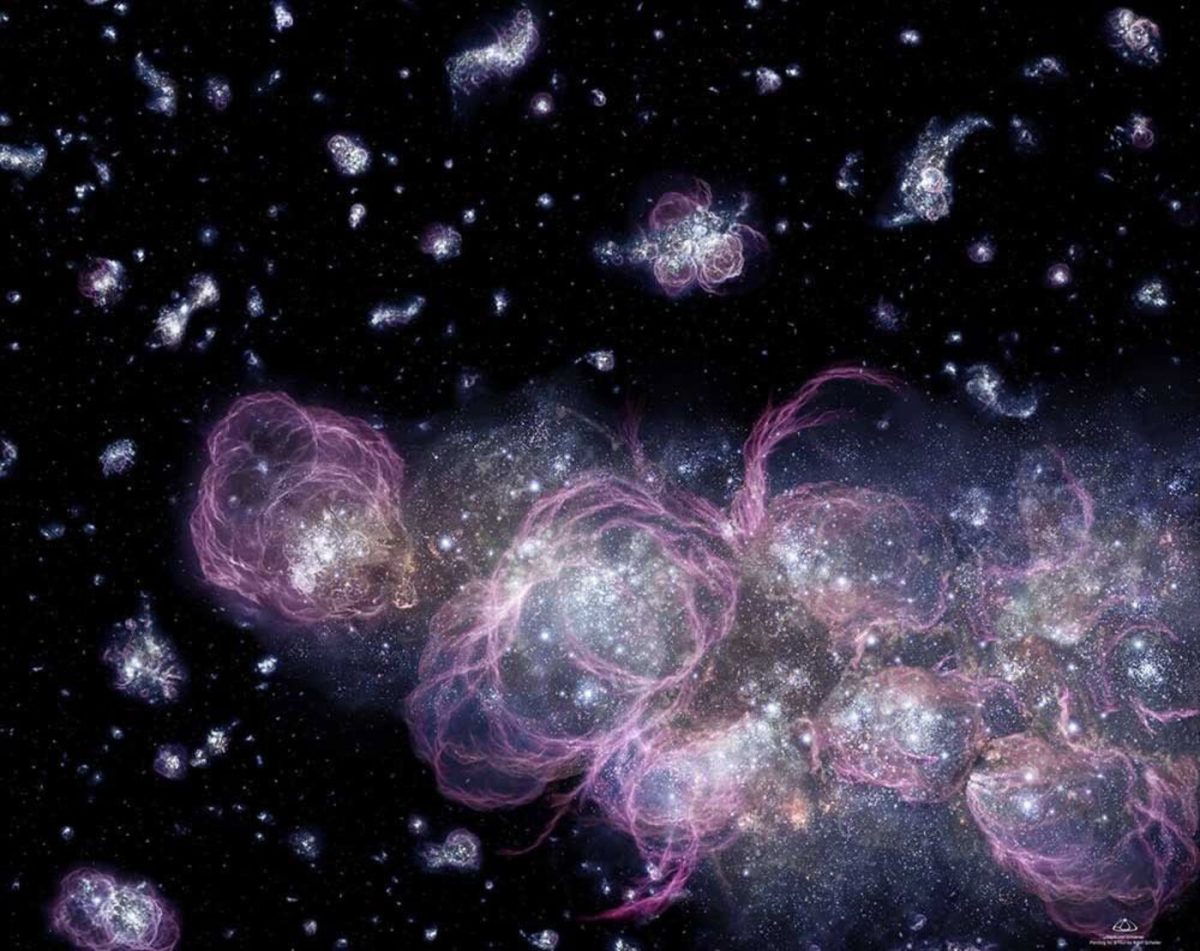
In massive stars that formed in environments poor in heavy elements, the flow of matter from the surface weakens much more sharply than astronomers had predicted. This was shown by observations with the Hubble Space Telescope of the nearest analogs of stars from the early Universe. At the same time, it turned out that the proportion of iron in these objects does not always correspond to standard indirect estimates. Both results will help explain why the first galaxies in James Webb images look so unusual.
A Sharp Drop in Speed
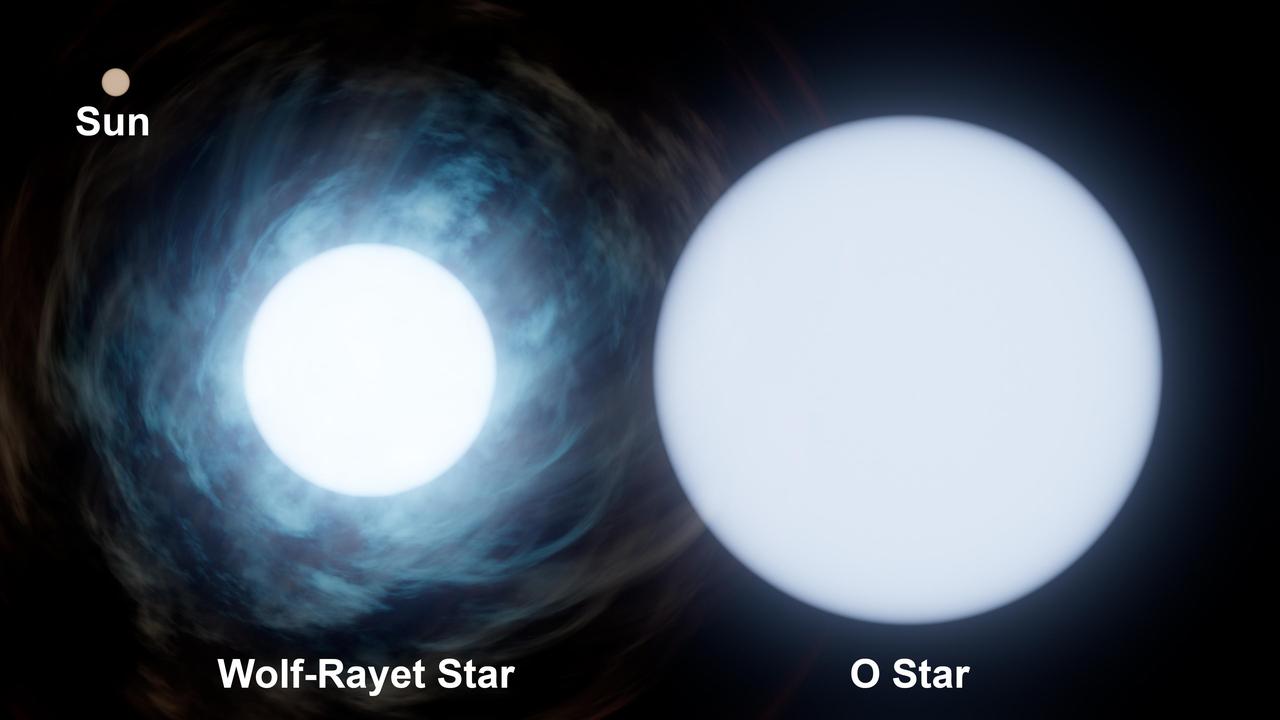
Astronomers use the term metallicity to describe the abundance of elements heavier than hydrogen and helium. It determines the strength of stellar winds, meaning the flow of matter that continuously escapes from the surface of a massive star. Metal ions absorb radiation and accelerate the gas, so at lower metallicity the wind should be weaker.
The observations confirmed the overall trend, but with an unexpected result. When metallicity dropped below approximately 10% of the Sun’s value, the maximum wind speed decreased much more sharply than the data for stars richer in heavy elements had suggested. According to the University of Utah, after a gradual dependence, there is a sudden drop among the most metal-poor stars. Lead author Grace Telford, an assistant professor in the university’s Department of Physics and Astronomy, called the finding a pleasant surprise.
A weaker wind should mean that by the end of its life, an object retains more of its original mass. This changes the star’s subsequent evolution, the nature of its supernova explosion, and its effect on the gas in the galaxy. The team is still planning to measure this parameter.
Nearby Dwarf Galaxies
At the dawn of the Universe, there were far fewer heavy elements than there are today in the Milky Way. Therefore, massive stars near the Sun are poor examples for comparison, and analogs had to be sought among nearby dwarf galaxies. The Treasury of Extremely Metal-Poor O-Type Stars (TEMPOS) program included 29 massive objects in six such systems with metallicities below one-fifth of the Sun’s value.
The spectra were obtained in ultraviolet light using Hubble’s Cosmic Origins Spectrograph (COS). Each of these stars is very faint because of its distance, so observing a single object required up to 35 hours of telescope time, almost a day and a half of continuous exposure. New data for 12 of them were combined with archival observations into a single homogeneous dataset.
Iron and Oxygen
Iron plays an important role in launching stellar winds, the evolution of massive stars, and the supernova explosion itself. However, in metal-poor environments, measuring its abundance is extremely difficult.
For this reason, astronomers usually estimate metallicity from oxygen in interstellar gas because its emission lines are bright and easy to detect. The amount of iron is then assumed to be proportional, although there is no guarantee that such a relationship always holds.
The team measured extremely faint iron absorption in the ultraviolet spectra. In galaxies richer in oxygen, it turned out to be much stronger, while the spread in the values indicates substantial differences in iron abundance among stars with low metallicity. The study was published on September 21 in the peer-reviewed journal The Astrophysical Journal Supplement Series.
A Clue for Models
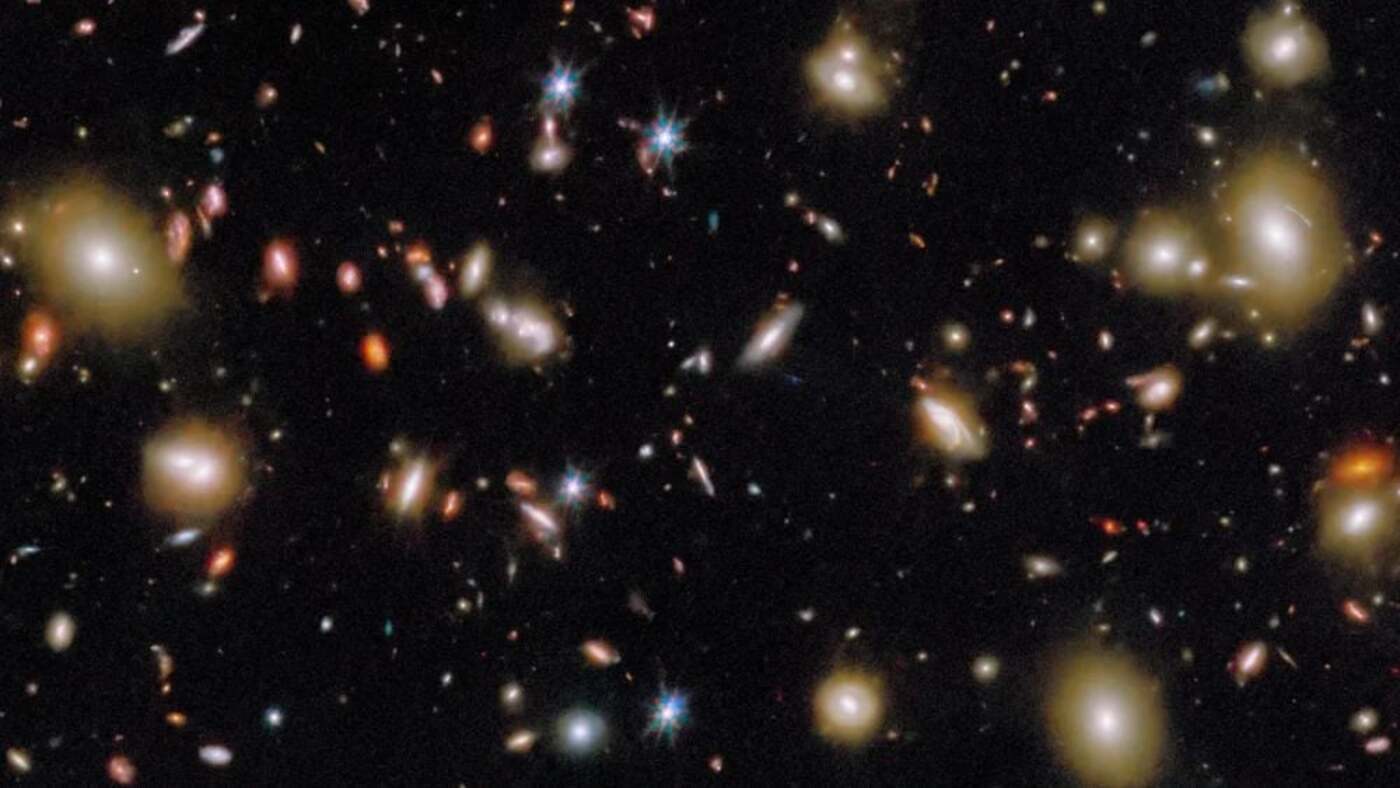
Using the James Webb telescope, astronomers have identified many unexpected properties in early galaxies. As Universe Today writes, interpreting these data requires accurate models of massive stars, because they heat the gas and regulate how much of it remains available for the formation of new stars.
Previously, Grace Telford had calculated the parameters in detail for only three objects from the current sample. No clear patterns can be seen with such a small number, so TEMPOS became the most serious attempt to gather sufficient statistics.
Weak winds at low metallicity have already appeared in explanations of gravitational-wave observations. In 2015, detectors at the LIGO observatory recorded the merger of black holes approximately 36 and 29 times more massive than the Sun. Theorists explained such large masses by progenitor stars from metal-poor environments, where weak winds prevented the stars from losing too much matter.
The Next Step
The researchers are now combining Hubble ultraviolet spectra with visible-light observations from the Keck Observatory in Hawaii. Joint analysis will reveal the chemical composition of the stars and the rates at which they lose mass through stellar winds.
The entire TEMPOS dataset will be made publicly available in the Barbara A. Mikulski Archive for Space Telescopes. Whether this mechanism operates in early galaxies will have to be tested using models built for James Webb data.
