

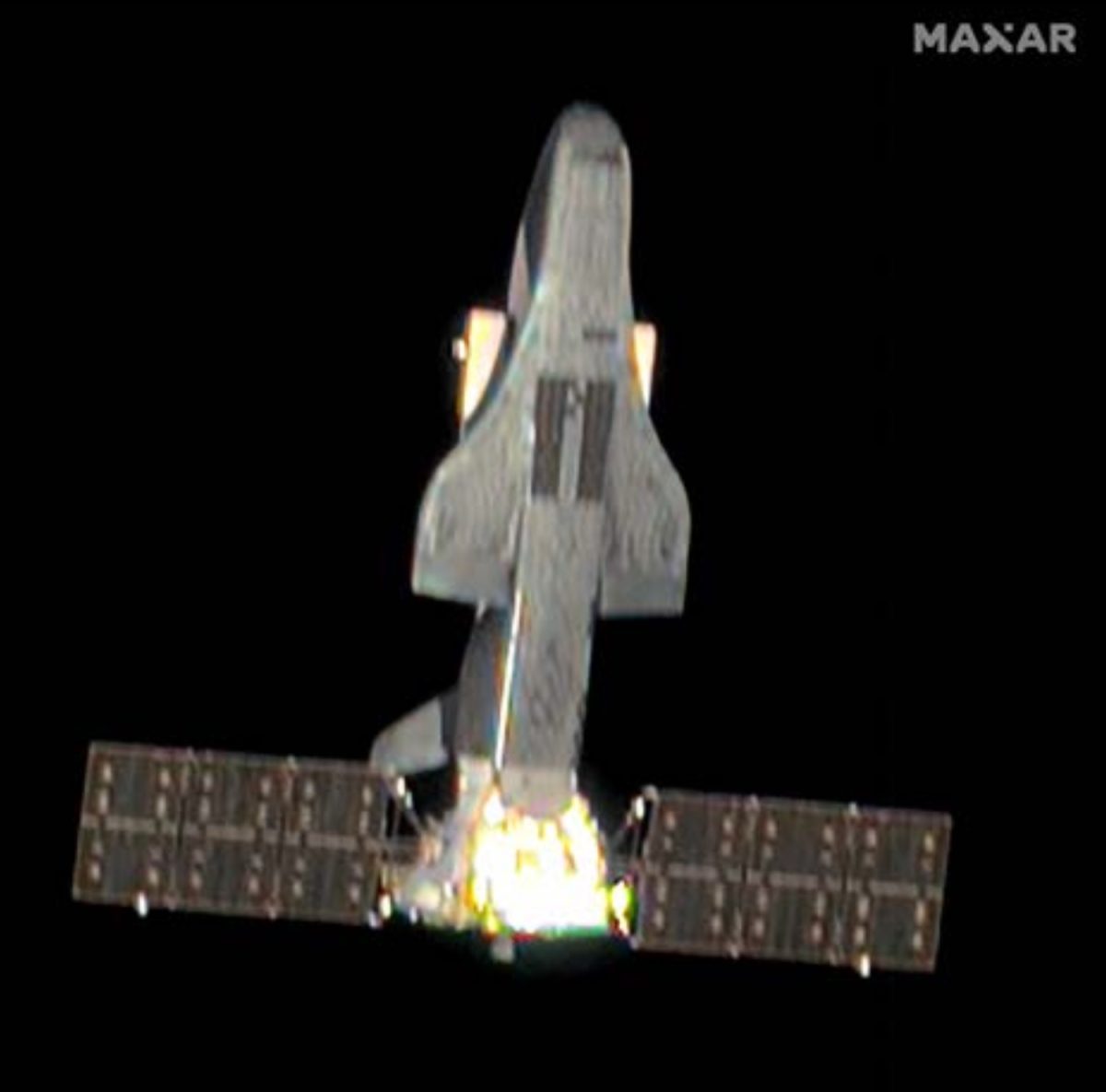
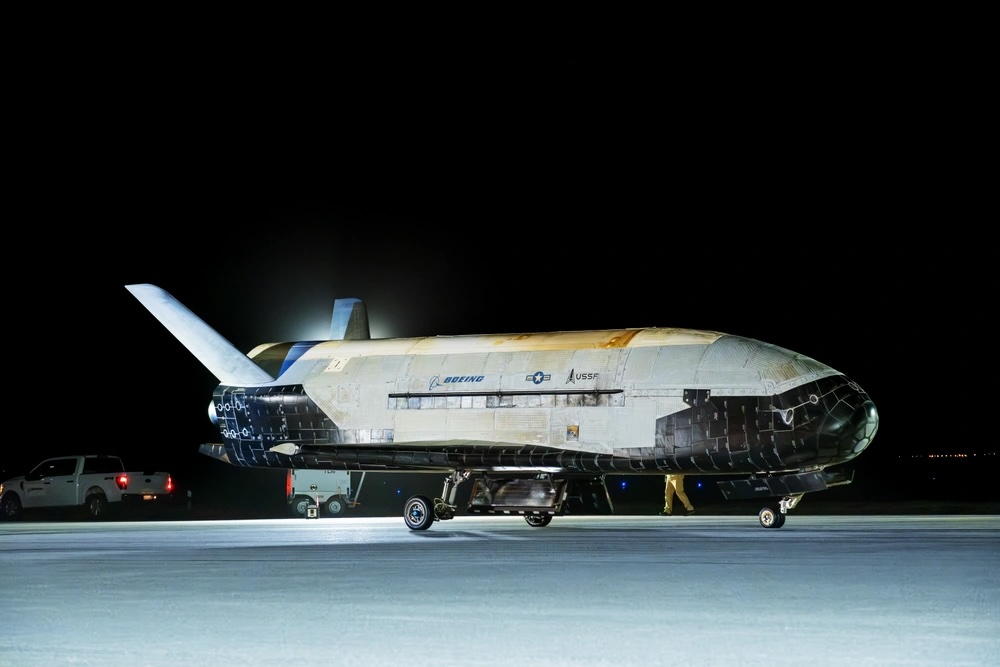
U.S. intelligence has released an image of China’s spaceplane taken in orbit by a commercial satellite in 2024. The spacecraft closely resembles the American X-37B in design. The photograph appeared in an unclassified report on space threats to the United States. The report also suggests that China could deploy directed-energy weapons, including lasers, in orbit within the next few years.
An Image from a Commercial Satellite
The photograph shows delta wings, payload bay doors, a dark heat shield, and a service module with solar panels. The design largely mirrors the X-37B operated by the U.S. Space Force. The image was captured by a satellite belonging to Vantor, which was still known as Maxar in 2024.
The Pentagon released the full-resolution image on Monday, October 26, in a Defense Intelligence Agency report, according to Ars Technica. Vantor’s satellites photograph Earth for the U.S. military, but their telescopes can also be pointed at other objects in orbit when their paths cross. These encounters typically occur at extremely high relative speeds, providing opportunities to observe other countries’ classified spacecraft.
What Is Known About the Spacecraft?
China has not disclosed its official name. In the West, the spaceplane is often called Shenlong, while Chinese state media refer to it only as a reusable experimental spacecraft. Like the X-37B, it launches under the fairing of a conventional rocket, operates in orbit as a satellite, and lands autonomously on a runway at the end of its mission.
Since 2020, China has conducted four such missions, the longest lasting about nine months. The fourth began on February 7, according to Reuters, and remains underway. The longest of the X-37B’s eight flights lasted two and a half years.
Why use such a spacecraft when conventional satellites exist? According to the intelligence assessment, their maneuverability makes spaceplanes better suited to certain tasks. They can also be returned to Earth, prepared, and launched again. During the current mission, the Chinese spacecraft released a small satellite in June and recaptured it in July, possibly using a robotic arm. The procedure was repeated in August and September, according to astrophysicist Jonathan McDowell’s analysis of publicly available orbital tracking data.
Weapons Against Satellites
China’s military likely considers directed-energy weapons an ideal means of targeting satellites because they can disable spacecraft either permanently or temporarily. China already possesses ground-based lasers capable of disrupting or damaging satellites in low orbits. By the end of the 2020s, it could have orbital systems and more powerful ground-based weapons capable of striking targets in higher orbits.
The report also mentions last year’s refueling of a Chinese satellite in geosynchronous orbit, at an altitude of approximately 36,000 kilometers. No other country had previously done this beyond low Earth orbit.
Russia is also developing its own orbital warfare program. In April, it deployed several small spacecraft near a radar satellite operated by the Finnish company ICEYE, which supplies imagery to Ukraine. According to U.S. officials, one of the Russian spacecraft approached within a few dozen meters of the ICEYE satellite in October before moving away.
ICEYE has been familiar to Ukrainians since 2022. That year, money raised by Ukrainians secured full access to one of its satellites for Ukraine’s Ministry of Defense, along with the ability to request imagery from the company’s other spacecraft. Radar satellites can observe Earth’s surface through clouds and at night, allowing military equipment to be tracked in any weather. As we previously reported, Ukraine’s Defense Intelligence identified more than 4,000 Russian targets using this imagery and used some of the images to guide missile and drone strikes.
