

Dark wet streaks along the edge of Pluto’s glacier are most simply explained by liquid rising from below. This is nitrogen that melts beneath the thick layer of ice and seeps outward through cracks. The dwarf planet appears to still have a mechanism that repeatedly covers the outer layer with fresh material.

An Anomaly in Nitrogen Ice
The surface of Pluto never warms above approximately minus 229 degrees Celsius, while nitrogen melts at minus 209.9. A difference of almost twenty degrees seemed sufficient reason to rule out the appearance of liquid on the surface.
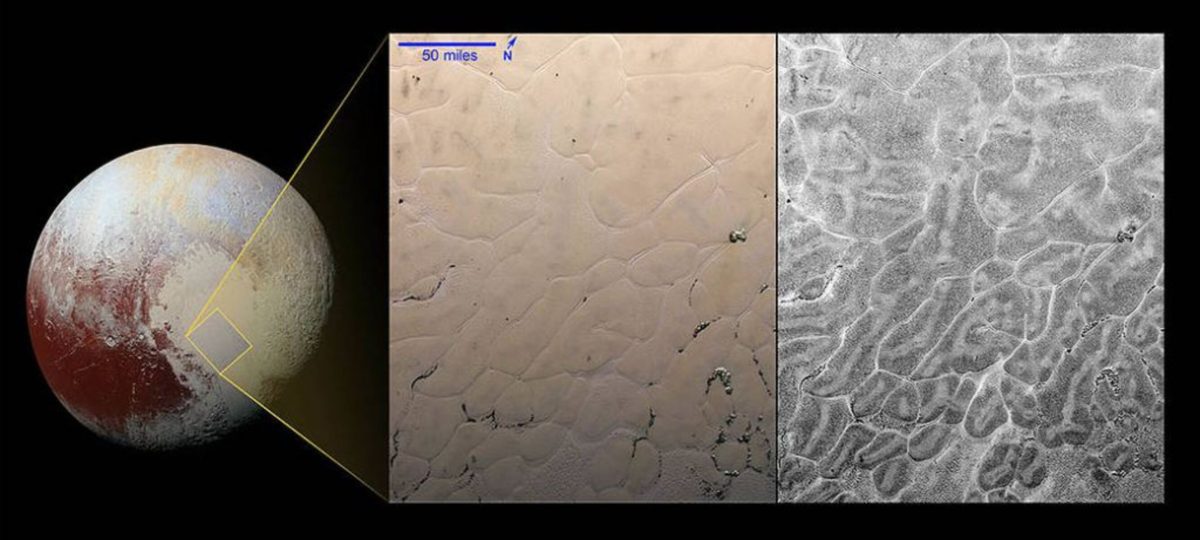
However, in images taken by New Horizons during its 2015 flyby, narrow dark lines along the northern edge of Sputnik Planitia appear wet. Such liquid could not have fallen from above because atmospheric conditions do not allow nitrogen precipitation to reach the surface.
Similarity to Earth’s Glaciers
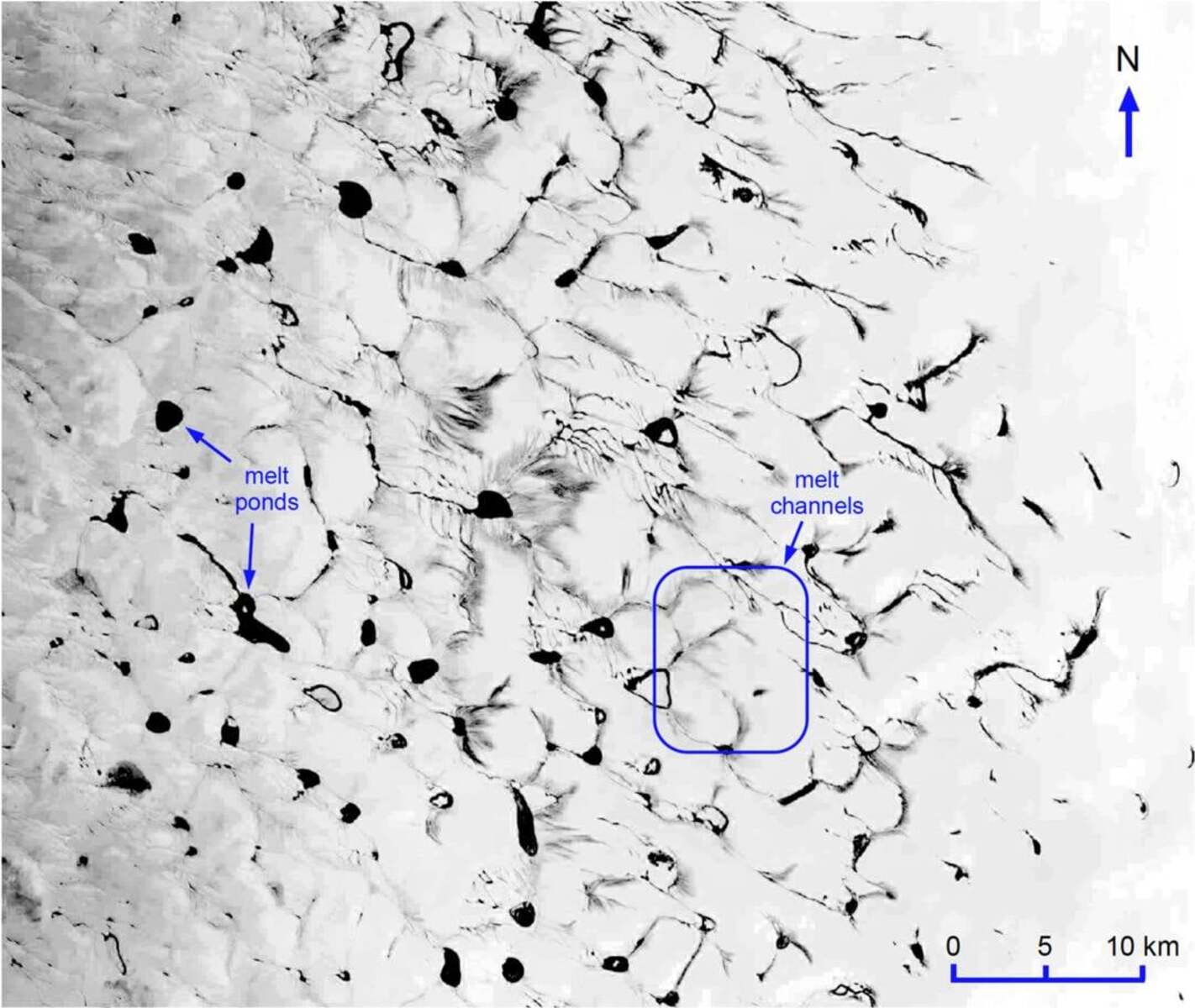
A team led by Alan Stern, principal investigator of the New Horizons mission and vice president of the Southwest Research Institute, compared images of Pluto with Landsat images. For comparison, they selected areas of Greenland and Antarctica where meltwater emerges from beneath the ice sheet and collects in ponds and channels.
The pattern of dark lines on both worlds turned out to be similar, Universe Today reports. On Earth, the ice is melted by geothermal heat or by the pressure of ice layers several kilometers thick.
Subglacial Lake Vostok in Antarctica remains liquid beneath a layer of ice about four kilometers thick precisely because of the combination of these two factors. The water there does not freeze despite the temperature of the surrounding ice being far below zero.
Pressure as a Source of Heat
Even before the flyby, astronomers noted that Sputnik Planitia is one of the brightest regions of the dwarf planet. This indicated a process that repeatedly renews its surface covering.
The researchers identify heating caused by the pressure of glaciers several kilometers thick as the most likely mechanism. Heat from the interior, for example from radioactive decay, may also make a contribution.
Liquid nitrogen can easily pass through solid ice of the same composition, emerge at the surface, and spread across the landscape. In physical terms, this is a close analogue of volcanism, except that instead of lava, the material here is frozen matter.
A Young Surface
The age of the region is estimated at no more than one million years. This result was obtained by modeling the rate at which the upper layer overturns, notes Southwest Research Institute scientist Kelsi Singer.
The dark streaks, accordingly, formed after that point in time. The work was published in the peer-reviewed journal The Planetary Science Journal, while a preprint appeared on arXiv in June 2026.
Clues from Icy Worlds
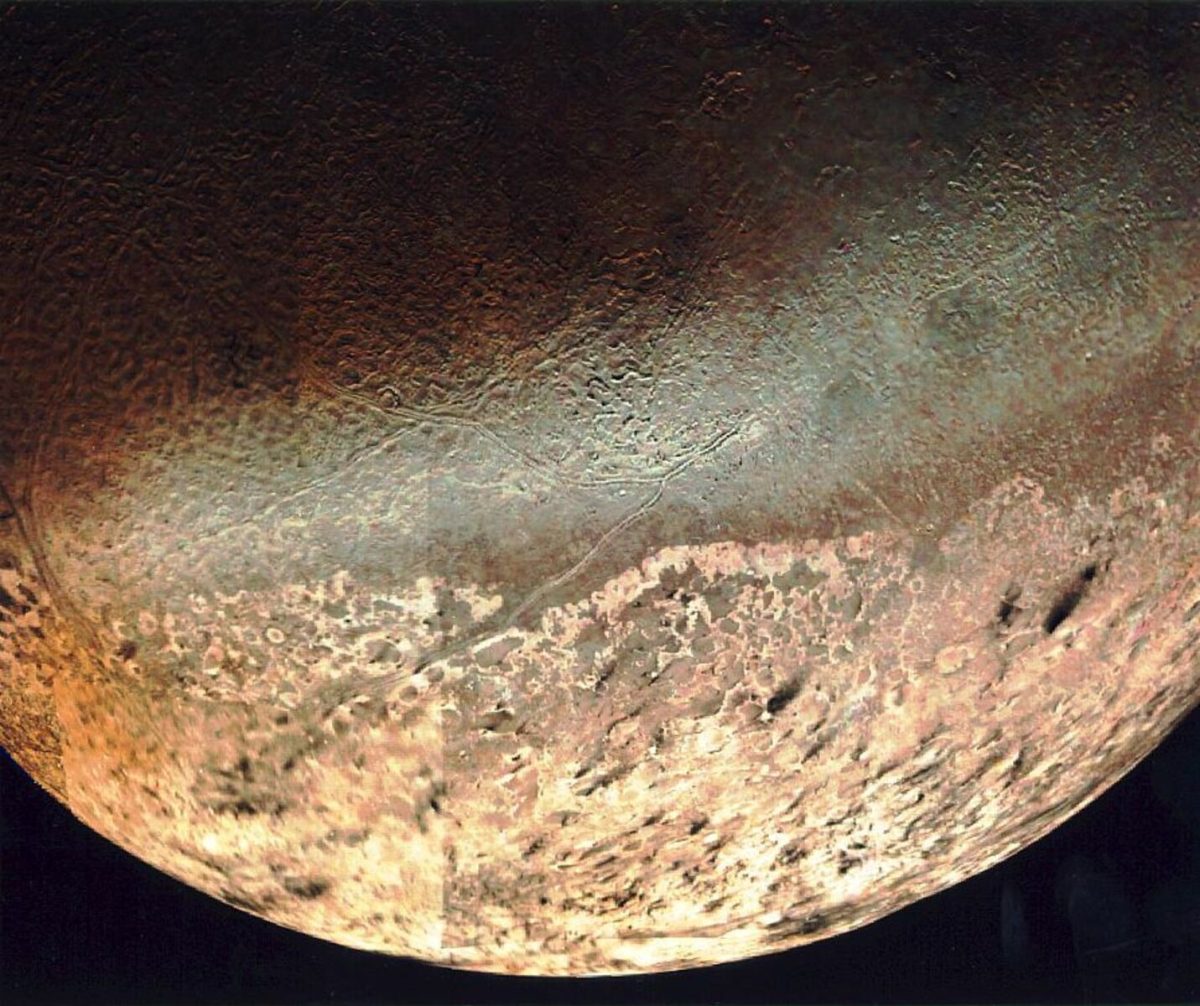
Similar processes may occur on Triton, Neptune’s moon, where nitrogen geysers have been observed. The authors suggest that this moon and the dwarf planet Eris could provide additional clues about the behavior of cryogenic ices under similar conditions.
Computer modeling of melting near the base of Pluto’s glaciers was carried out by Orkan Umurhan of the SETI Institute. According to him, the physics of solid nitrogen under pressure has not yet been studied in the laboratory in sufficient detail. The new data provide a reason to undertake such experiments.