

When main-sequence stars like our Sun exhaust their thermonuclear fuel, they undergo a complex transformation. First, the star expands into a red giant and later enters the asymptotic giant branch (AGB) phase. Powerful stellar winds strip away its outer envelope, forming a planetary nebula. Only a white dwarf remains at the center—an extremely dense object that slowly radiates its residual heat.
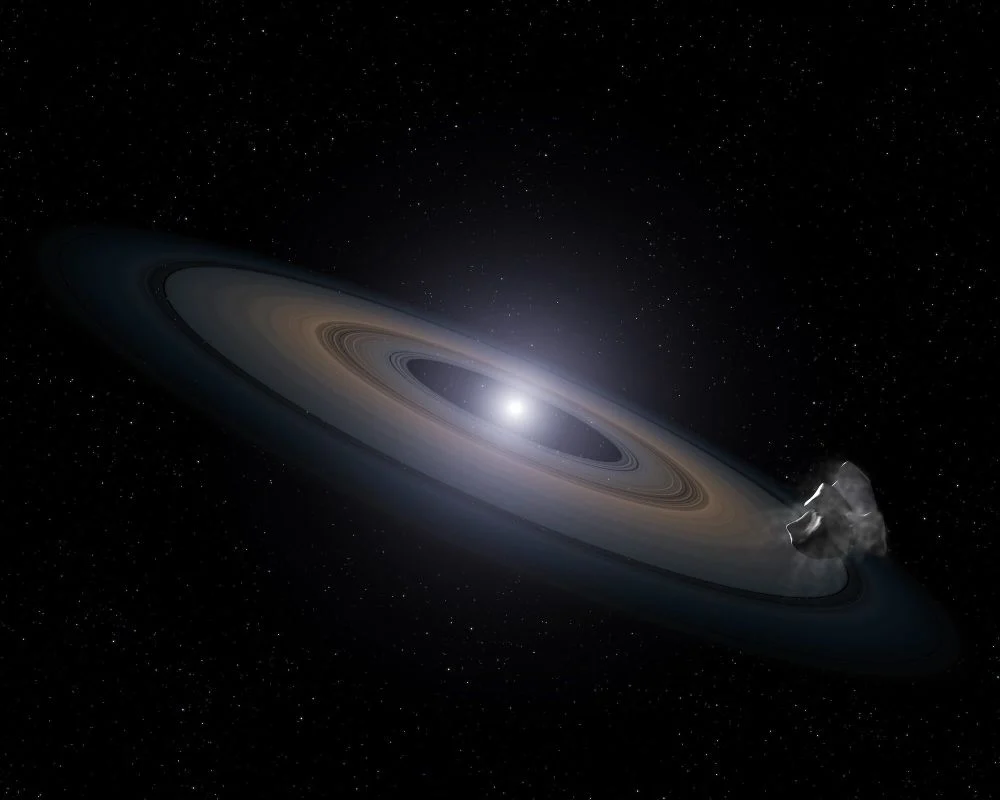
There are billions of such dead stars in the Milky Way. In recent years, astronomers have identified more than 1,700 white dwarfs with traces of metals in their atmospheres. These “metals”—all elements heavier than helium—are remnants of planets and asteroids torn apart by tidal forces during the destruction of their systems. By analyzing their chemical composition, scientists can determine the characteristics of worlds that were destroyed long ago.
A Cosmic Aurora Effect
Traditional astrophysical models were based on the assumption that captured material spreads evenly across the entire surface of a white dwarf. However, a new study by Dung Pham of the University of Colorado Boulder, accepted for publication in The Astrophysical Journal, challenges this approach.
Scientists found that in 10–20% of white dwarfs with magnetic fields, accretion occurs locally. Magnetized plasma is directed along magnetic-field lines straight toward the polar regions. According to the authors, the process resembles an aurora on Earth, where solar particles are focused by the planet’s magnetic field. On a white dwarf, instead of solar-wind particles, material of planetary origin accumulates at the poles.
Photospheric Dynamics and Hidden Metals
At present, two white dwarfs are known to have localized polar concentrations of metals. To estimate how common this phenomenon may be, the team carried out three-dimensional computer simulations. The results showed that once material reaches the poles, it is affected by two processes: convection in the photosphere spreads the spots across the surface, while gravitational settling pulls heavy elements deeper into the star.
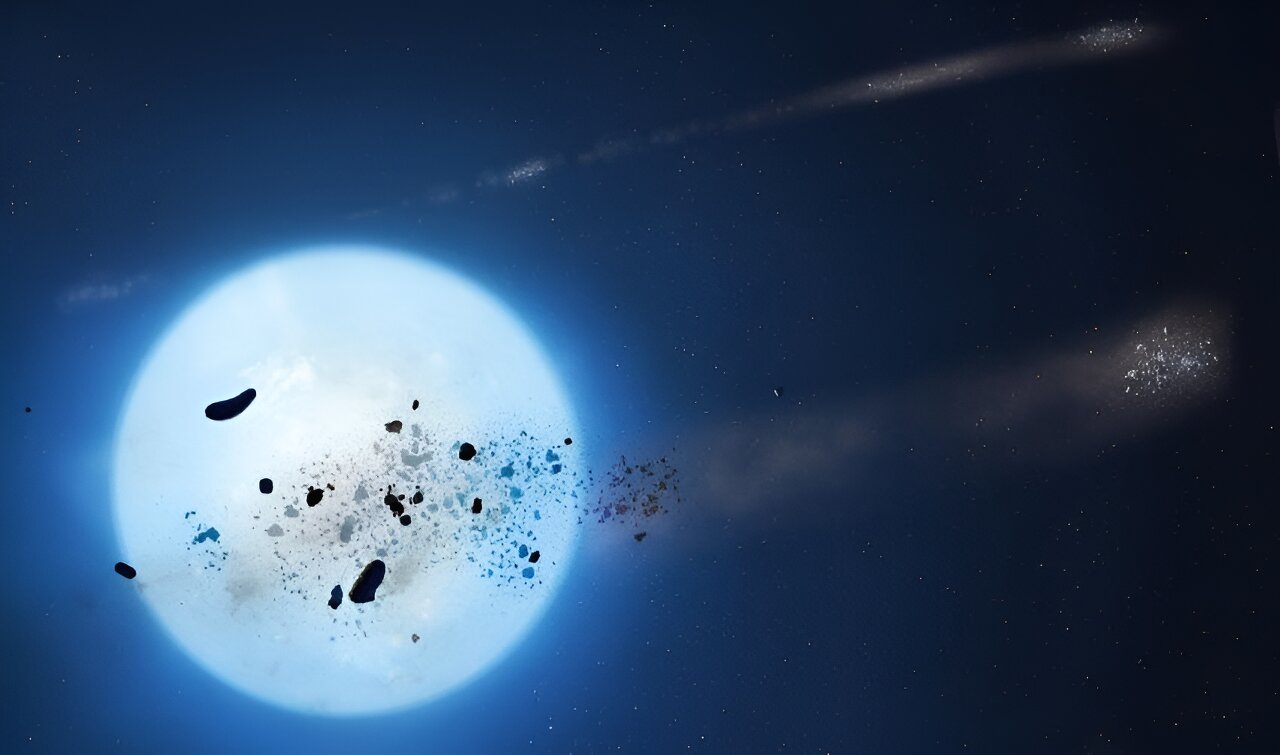
The relative rates of these processes determine the star’s appearance. If the white dwarf’s rotational axis is not aligned with its magnetic axis, an observer will detect periodic changes in its spectrum as the spotted surface rotates.
Reassessing the Scale of Destroyed Worlds
The concentration of material in narrow polar regions creates an optical illusion of cleanliness. When astronomers assume that the pollution is evenly distributed, they significantly underestimate the total mass of the material.
According to study co-author Aster Taylor of the University of Michigan, the actual amount of planetary material falling onto white dwarfs may be approximately 100 times greater than previous estimates.
This confirms that planetary systems remain dynamically active and continue to break apart long after the death of their parent stars. To fully understand these processes, scientists will need more sophisticated three-dimensional models of the atmospheres of magnetic white dwarfs.
According to Universe Today
