

The Institute of Astrophysics of the Canary Islands plans to combine several large telescopes at the Roque de los Muchachos Observatory into a single giant interferometer. To do this, they will use quantum technologies that will make it possible to combine data streams with extremely high efficiency.
A New Interferometer in the Canary Islands
From September 8 to 10, 2026, a working meeting on the LPQI program was held at the IACTEC scientific center in San Cristóbal de La Laguna. The program is aimed at applying quantum computing and technologies in astronomy as widely as possible. This time, specialists not only from Spain but also from Taiwan and Northern Europe gathered to discuss them. This was reported by the website of the Institute of Astrophysics of the Canary Islands.
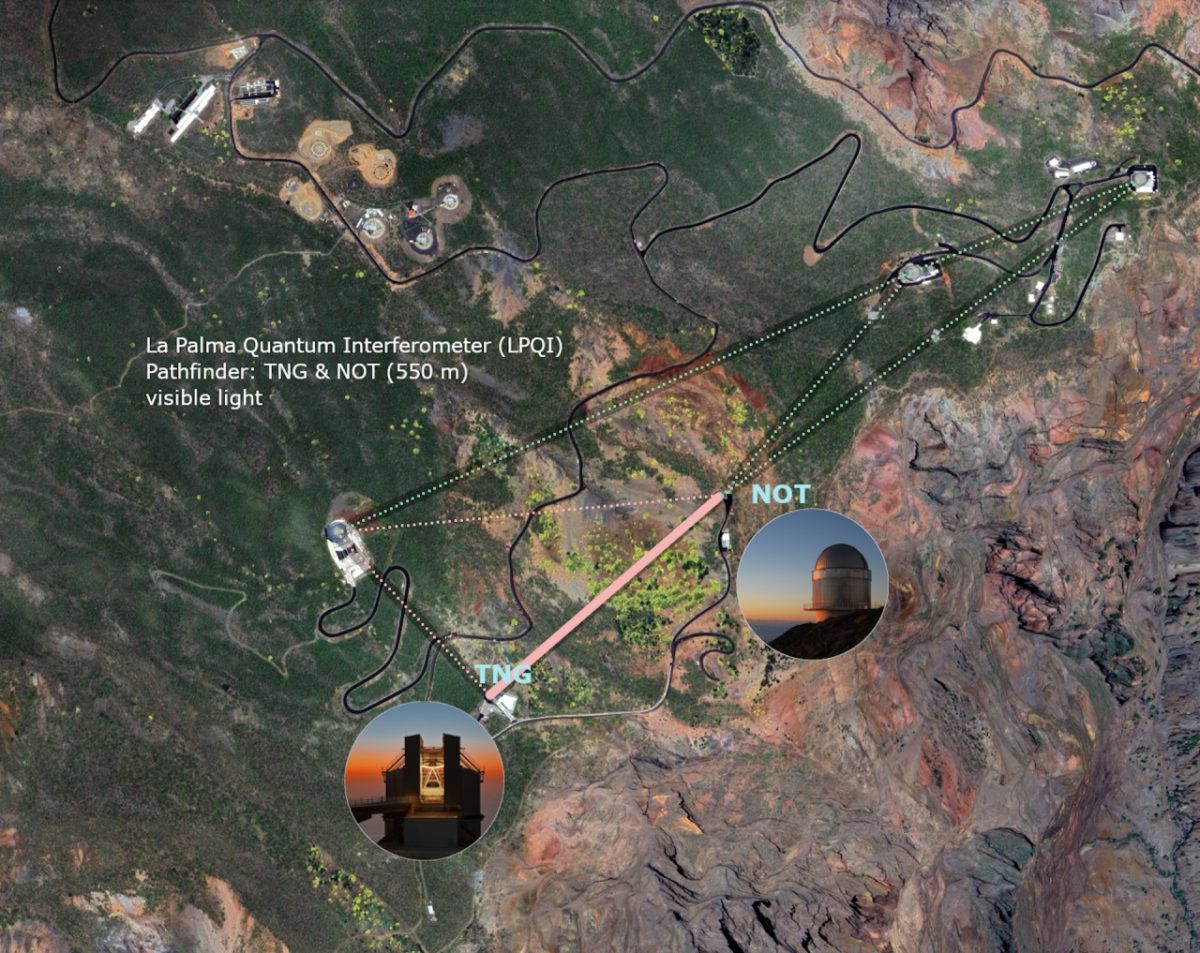
The main topic of discussion was the implementation of the first stage of the program, called LPQI Pathfinder. As part of it, two large instruments at the Roque de los Muchachos Observatory — the Nordic Optical Telescope and the Telescopio Nazionale Galileo — are planned to be combined into a single interferometer.
In general, an interferometer is a device that uses the “combination” of observational data from several different points. This makes it possible not only to amplify signals from certain sources, but also to detect differences caused by tiny variations in the angle from which they are observed.
All of this makes it possible to significantly improve the quality of observations. Therefore, telescope-based interferometers have been built especially intensively in recent years, as broadband digital data transmission has become widely available. In particular, the famous Event Horizon Telescope, which was the first to obtain an image of a supermassive black hole, is essentially an interferometer, and telescopes in the Canary Islands also participated in it.
Quantum Technologies in the Canary Islands
The Canary Islands occupy a special place in global astronomy. The combination of high volcanic mountains with very rare clouds and precipitation makes them one of the best places in the world for observing the stars. This is why there are so many telescopes there and why the Institute of Astrophysics of the Canary Islands itself exists.
However, combining data streams from two large telescopes, even though they are located relatively close to each other at a distance of 550 meters, is not such a simple task. Data from every photon must be processed literally on the fly, while delays of millionths or billionths of a second already introduce their own corrections. And this is precisely where quantum technologies, based not on electromagnetic transitions but on changes in the states of elementary particles, perform particularly well. In particular, scientists plan to use so-called SPAD sensors.
The first stage of the LPQI program is expected to be implemented fairly soon. The new interferometer is scheduled to begin operating in the spring of 2028. It is expected to have a resolution of 160 microarcseconds, meaning that this parameter will be approximately 1,000 times better than that of the Hubble telescope.
In addition, participants in the meeting hope that some of the equipment required to implement the project will not only be used but also manufactured in the Canary Islands. This, in turn, will provide an impetus for the development of the local high-tech industry.
