

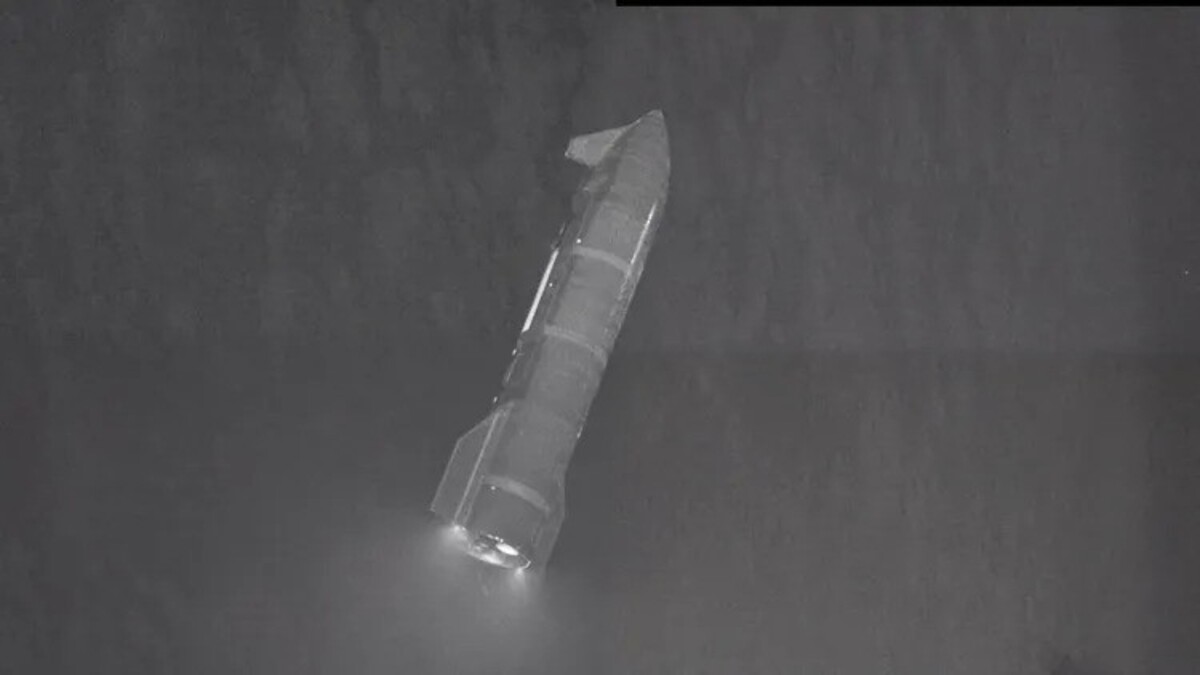
We have just received an incredible new view of SpaceX’s Starship, captured by one of the next-generation Starlink satellites. A video combining images from four satellite cameras shows the final stage of the flight and details of the spacecraft’s engine operations.
Incredible Images of the World’s Most Powerful Rocket
Starship, the largest and most powerful rocket ever built, launched on its 13th test flight from South Texas last Friday, July 24. The suborbital journey was similar in many respects to previous Starship test missions, with one major exception: this time, the spacecraft deployed a group of operational next-generation Starlink internet satellites into space, www.space.com reports.
Six of these Starlink V3 spacecraft were equipped with cameras so that SpaceX could obtain detailed images of the heat shield on Starship’s upper stage, also known simply as Ship. The satellites accomplished this task and more, capturing remarkable views of Ship as it moved away from them high above Earth.
SpaceX shared one such view on the social media platform X on Friday evening, July 31. The 65-second video combines images captured by four different cameras installed on a single Starlink V3 satellite.
The video begins with a close-up of the gleaming, 171-foot-tall, or 52-meter, spacecraft. More of the vehicle becomes visible as the camera angles change and the two spacecraft move farther apart. By the end of the video, Ship can be seen in full, along with signs of its activity: three of its six Raptor engines are operating, while small plumes of white vapor indicate that the spacecraft is using its thrusters for precise control.
The Starlink V3 Satellite Constellation
Like every previous Starship test mission, Flight 13 followed a suborbital trajectory. As a result, the 20 Starlink V3 satellites—the first of their kind to reach space—did not remain there for long. They returned to Earth approximately 20 minutes after deployment.
Their successors will travel higher, and there will be many of them. According to documents filed with the U.S. Federal Communications Commission, SpaceX plans to operate a megaconstellation consisting of 100,000 Starlink V3 satellites.
Starship will play a key role in building and maintaining this constellation, which will require numerous launches of the powerful, fully reusable rocket. SpaceX currently operates a constellation of nearly 11,000 Starlink satellites, but these V2 spacecraft are considerably smaller than the 2,000-kilogram V3 version.
An Overall Successful Mission
Ship appears to have completed all of its objectives during Flight 13. After deploying the satellites and successfully restarting one of its Raptor engines in space, it made a targeted splashdown in the Indian Ocean off the coast of Western Australia approximately 65 minutes after launch.
The spacecraft survived its hazardous reentry through Earth’s atmosphere intact and, as far as is known, remains intact today. SpaceX recently shared a photograph showing the vehicle floating in the Indian Ocean five days after its landing.
However, Starship’s giant first-stage booster, known as Super Heavy, encountered several problems during Flight 13. For example, its landing sequence used only five of the planned 13 Raptor engines, and the booster struck the waters of the Gulf of Mexico at a higher speed than intended. Super Heavy has a total of 33 Raptor engines, all of which operate during liftoff.
Starship remains under development, but SpaceX intends to bring the megarocket into operation as quickly as possible. It is scheduled to fly as part of NASA’s crewed Artemis III mission to low Earth orbit in mid-2027 and to land a crew near the Moon’s south pole during Artemis IV in late 2028.
