

Japanese and German scientists studied prestellar cores — relatively small concentrations of matter from which stars later form. They concluded that matter drifts inside these cores, changing their structure and affecting magnetic fields.
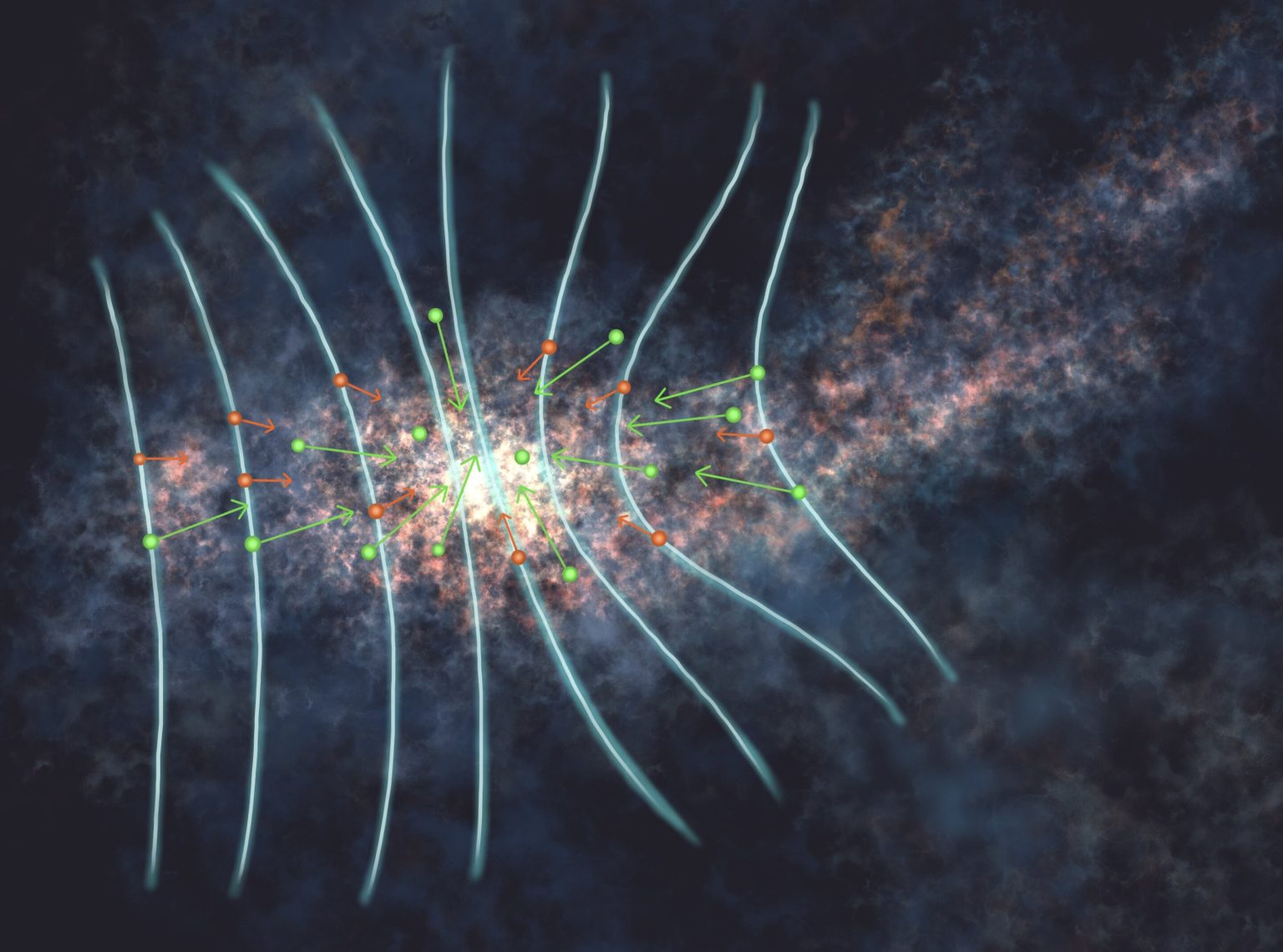
Studying the magnetic fields of prestellar cores
Publishing their results in the journal Astronomy & Astrophysics, researchers from Kyushu University and the Max Planck Institute for Extraterrestrial Physics have obtained direct observational evidence for ambipolar diffusion in a pre-stellar core for the first time. During this process, neutral gas gradually separates from the magnetic field, weakening its ability to resist gravitational contraction. As a result, the core begins to collapse, which ultimately leads to the birth of a young star – a protostar. The new results help to better understand the very first stages of star formation and, ultimately, the formation of stellar and planetary systems. This is reported by phys.org.
Stars like our Sun are born from the collapse of pre-stellar cores—cold, dense clumps of interstellar gas and dust. Although many questions remain about the exact mechanisms of star formation, modern radio telescopes are increasingly revealing the internal structure of such objects and the processes that precede star birth.
“Prestellar cores are fascinating stellar structures. They are dense and cold and are the source of numerous complex chemical processes. The cold environment allows molecules to combine into more complex compounds, such as the precursors of prebiotic organic molecules,” explains first author Doris Arzoumanian, an associate professor at Kyushu University’s Institute for Advanced Study.
One of the questions studied by the researchers was the role of magnetic fields in star formation. Strong magnetic fields penetrate prestellar cores. If this field is too strong, it can delay gravitational collapse and therefore delay star formation. Astronomers wanted to study how prestellar cores reduce the strength of their magnetic field.
Using the 30-meter telescope of the Institute for Radio Astronomy in the Millimeter Range (IRAM), the research team focused on L1544, a prestellar core in the Taurus molecular cloud, one of the star-forming regions closest to Earth.
Ions and neutral gas as indicators of the magnetic field
In molecular clouds, the gas is only partially ionized. Charged particles are strongly bound to the magnetic field, while neutral molecules interact with it only indirectly, through collisions with ions. Comparing the motion of ionized and neutral molecules allows us to estimate how the magnetic field affects the evolution of the stellar core. However, this process is not easy to observe. Due to the extremely low temperatures, most of the common molecules settle on the surfaces of dust grains and almost cease to radiate, which makes them difficult to detect with radio telescopes.
“We chose the diazenylium-d1 ion (N₂D⁺) and para-monodeuterated ammonia (para-NH₂D) — a neutral molecule — as our tracers because they are usually found in similar high-density regions inside prestellar cores,” explains the paper’s second author, Silvia Spezzano, a group leader at the Max Planck Institute for Extraterrestrial Physics. “We therefore collected spectral data from the core and modeled the velocities of these two molecules.”
Particle drift inside the core
Scientists have found a clear difference in the speed of ionized and neutral molecules – about 0.05 km / s. They interpreted it as the first direct evidence of ambipolar diffusion – the relative drift of neutral gas relative to charged particles. As the dosor core densifies, its central regions are increasingly better shielded from cosmic radiation, so the degree of ionization decreases. Because of this, neutral molecules interact less with charged particles, which remain bound to the magnetic field. As a result, neutral gas begins to move faster towards the center of the core under the influence of gravity, while ions continue to follow magnetic field lines.
It is this difference in motion that causes the small difference in speed between neutral and ionized molecules, which was recorded by radio telescopes.
“This process is known as ambipolar diffusion. Until now, observing this phenomenon in a prestellar core has been a major challenge,” Arzoumanian notes. “As ambipolar diffusion continues, the strength of the magnetic field decreases. Eventually, gravity becomes the main driving force in the core, leading to its gravitational collapse into a protostar.”
More detailed maps will help verify the drift
The team hopes to further confirm its findings by observing other prestellar cores and obtaining data with higher angular resolution in order to map the velocity drift of ions and neutral molecules more precisely.
“These results were made possible by interdisciplinary collaboration between experienced observers and theorists in the fields of gas dynamics, astrochemistry, and dust physics,” Arzoumanian concludes. “Understanding the process of star formation allows us to answer the fundamental question of the origin of life in planetary systems and helps us better understand the universe as a whole.”