

Astronomers are studying a hot “super-Earth” orbiting a K-type star. This lava world may have an atmosphere, giving scientists hope of finding clues about how our own planet formed and how it retains its gaseous envelope.
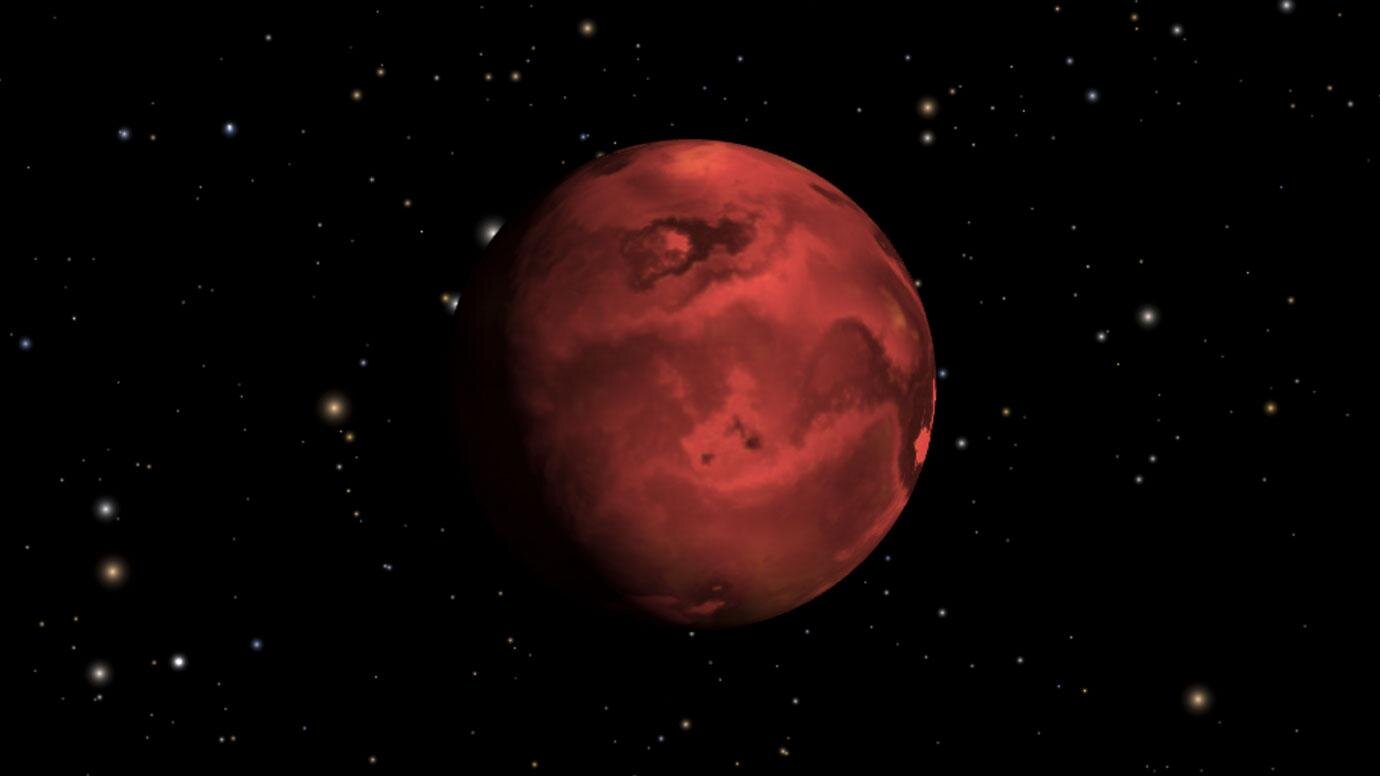
Hot “Lava World” HD 3167 b
In the search for extraterrestrial life, it makes sense to focus first on rocky planets with atmospheres similar to Earth. Without an atmosphere, a planet cannot have surface water. However, of the more than 6,300 exoplanets cataloged to date, the vast majority are not rocky, and only a few rocky worlds appear to have atmospheres.
As phys.org reports, in a study published in The Astrophysical Journal Letters, a team led by University of Chicago scientist Brandon Park Coy reports another discovery: a rocky super-Earth located 154 light-years away in the constellation Pisces. Called HD 3167 b, this extremely hot “lava world” orbits its star in just one Earth day.
“What is so strange is that the closer a rocky planet orbits its star, the harder it should be for it to retain an atmosphere, because it is bombarded by stellar wind and receives more high-energy photons from the star. But many of these lava planets seem to do so,” explained Edwin Kite, associate professor of geophysical sciences at the University of Chicago and co-author of the study. “These planets are far too hot for life, but by studying them, we can learn something about processes that are important for other rocky worlds.”
Why Do Astronomers Study Hot Exoplanets?
One of the key questions scientists are trying to answer using the James Webb Space Telescope is whether planets orbiting stars much smaller than the Sun have atmospheres. It appears that most such Earth-like planets do not — they are simply bare rock.
But surprisingly, we have found evidence that most “lava worlds” — similar in composition to Earth and Venus but much, much hotter — may have atmospheres. Five terrestrial planets in which atmospheres have been detected, including the one described in this study, have turned out to be extremely hot.
However, this planet is the coolest lava world discovered so far that shows signs of an atmosphere. This is interesting because scientists are trying to understand the temperature transition between planets with atmospheres and those without them. The goal of the program, which is studying 10 ultra-hot lava worlds, is to determine whether there is a critical temperature above which planets with atmospheres begin to appear.
Determining the Presence of an Exoplanet Atmosphere Using the “Secondary Eclipse” Method
At present, directly observing Earth-like planets in search of signs of life is impossible. Instead, we can use the James Webb telescope to detect light in the mid-infrared range in order to estimate the temperatures of exoplanets, allowing us to determine whether they may have atmospheres.
There are two main ways to study exoplanets. One is called a “transit” — when a planet passes in front of its star. The other is a “secondary eclipse,” and this is the method used in this study. It occurs when the planet passes behind its star, allowing us to measure how much light is lost. This difference indicates how much mid-infrared radiation is coming from the planet itself, which essentially allows us to determine how hot the planet is.
If a planet has no atmosphere, its dayside, facing the star, should be as hot as theoretically possible based on the reflectivity of its surface and its distance from the star. But an atmosphere would help redistribute heat from the dayside to the nightside. We observe this on Venus — there is almost no difference in surface temperature between the day and night sides, or between the poles and the equator.
If a planet has an atmosphere, it may have clouds that reflect starlight and cool the dayside. Therefore, if the planet’s dayside is cooler than the maximum possible temperature, this likely indicates the presence of an atmosphere. The object studied here, HD 3167 b, is noticeably cooler than the expected maximum value, which is strong evidence for the presence of an atmosphere.
The exoplanet’s atmosphere is believed to consist of gases evaporated from silicate rocks. However, the exact composition of this atmosphere currently remains unknown.
Why Are the Results of This Study So Important?
Because the four other lava worlds in which atmospheres have been detected are in the ultra-hot regime, this raises the question of whether there is a critical transition temperature at which silicate atmospheres begin to become very dense. Is there a temperature at which layers of silicate clouds form on these planets, reflecting incoming radiation back into space and cooling their daysides? This relatively cooler planet helps us better characterize and define this transition.
Although these planets are uninhabitable, we are also interested in studying them because we believe that early Earth was probably very similar to a lava world.
Scientists believe that at the very beginning of the Solar System’s history, when the terrestrial planets were forming, they were extremely hot because of the energy released during collisions between planetesimals. Earth was in the stage of a so-called magma ocean, with a completely molten surface. This study gives us an opportunity to learn what conditions on Earth may have been like during the first few million years of its existence.