

Spectroscopic studies had previously shown that the exoplanet GJ504b is shrouded in a pink haze. However, since then, scientists have been unable to learn anything about this ancient and extremely cold world. But now, using the James Webb Space Telescope, they have managed to detect salt clouds there.
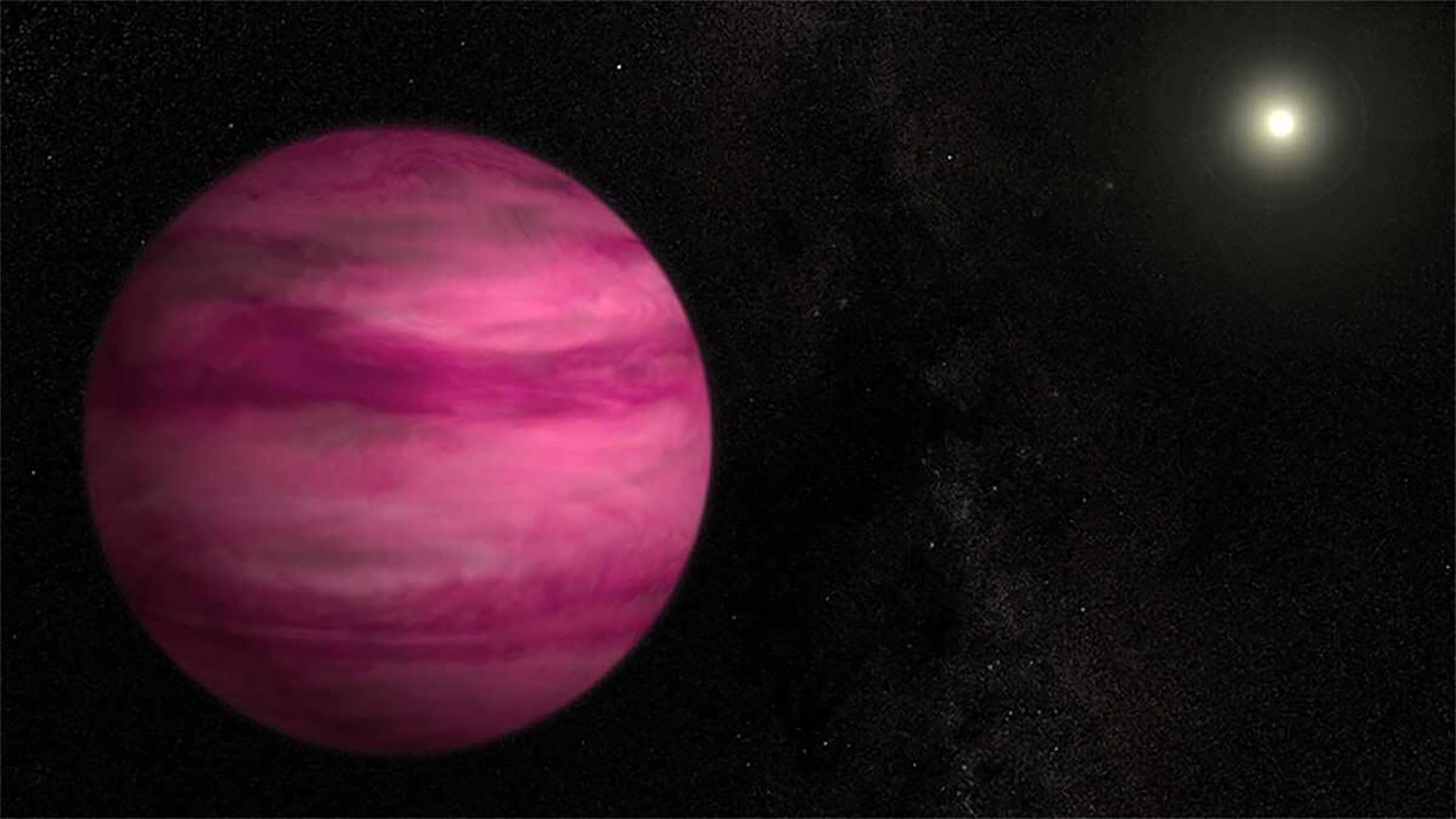
Mystery of the “Pink Planet”
Scientists from Northwestern University in the U.S. recently published a study on the so-called “Pink Planet,” which contains new and interesting data on what it looks like. In fact, ever since the 2013 publication confirming the existence of the object GJ504b, scientists have remained uncertain whether it is actually a gas giant or a brown dwarf orbiting a star in the constellation Virgo.
In fact, doubts about the nature of this object—located 57 light-years away from us—stem from its mass, which is 25 times that of Jupiter. Scientists simply do not know for certain what such an object should look like. Theoretically, it should still be a brown dwarf. However, its temperature is not 1,000 K, as is usually the case with such “under-massive” objects, but only 500 K.
If GJ504b is a brown dwarf, then it is very old and a record-breaker in terms of coldness for its class. Its age ranges from 2.5 to 4 billion years. However, aside from the fact that it is shrouded in a pink haze, nothing else has been discovered about this object. Ground-based telescopes simply have not been able to produce high-quality spectrographic data all these years. GJ504b is often called the “pink planet” because of its characteristic purple hue in processed infrared images.
James Webb Data
The scientists then decided to bring in the James Webb Space Telescope. Its observation session lasted not an entire night, as in previous attempts to study GJ504b, but only a couple of hours. And despite this, it managed to determine the planet’s chemical composition. It turned out that the “pink planet” consists of water vapor, methane, carbon dioxide, ammonia, and a number of other substances.
This was exactly what the scientists had expected to find. However, there was something else in the spectrograms that they couldn’t make sense of. Everything fell into place only when they hypothesized that these were salts of various substances present in the atmosphere. Observations are best consistent with the existence of clouds of condensed salts. Under those conditions, they should form actual clouds suspended in the atmosphere.
Now scientists are eager to use this technique to study other objects that lie on the boundary between gas giants and brown dwarfs. For example, Jupiter also has clouds of solid compounds, but in that case, they consist of ammonia ice. However, it is possible that on more massive planets, the composition might be different.
According to phys.org
