

Some black holes in the Universe did not form after the deaths of massive stars. They arose from the merger of two smaller predecessors. Scientists were able to distinguish between these two origins by examining their rotation speeds. It turned out that such repeated collisions occur in the Universe far more often than previously believed.
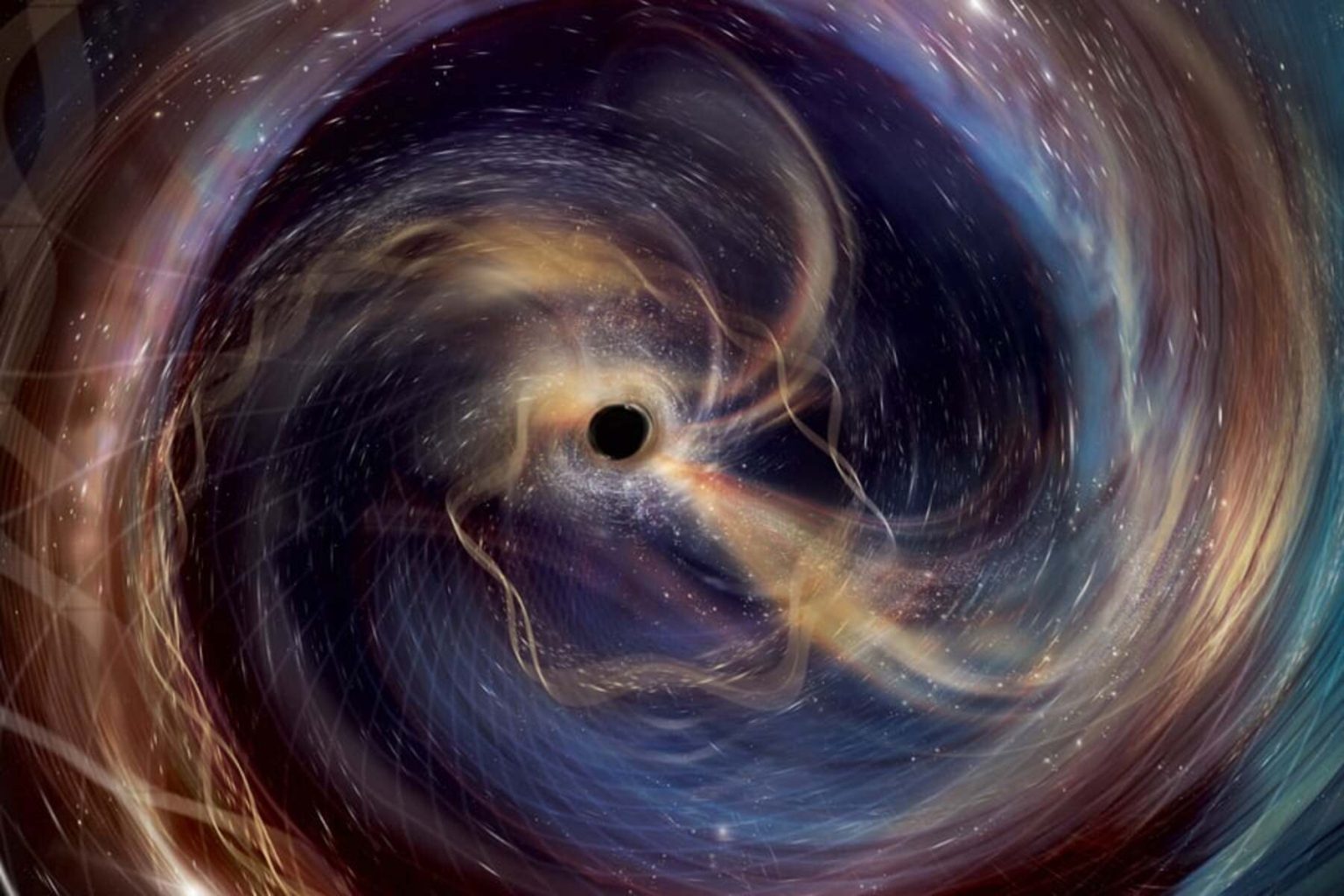
A Trace in the Rotation Speed
The history of a black hole can be reconstructed from the characteristics of its rotation. After a supernova explosion, a compact object is left with almost no intrinsic spin because its progenitor star has already lost most of its matter together with its angular momentum. This was reported by Universe Today.
A completely different picture emerges when two such objects collide. The energy of their orbital motion is converted into the angular momentum of the final black hole, causing it to spin at approximately 70% of the maximum possible rate. A sharp contrast between the rotation speeds within a pair indicates that one of the components has already undergone a previous collision.
Dense Star Clusters
Hierarchical mergers require a special environment. They are possible only where stars are packed extremely closely together, primarily in dense clusters.
Massive stars in such systems explode and leave behind compact objects that continue moving within the shared gravitational field. Mutual gravitational capture brings them together into pairs, and after a subsequent collision, the process can repeat. According to Kaylin Plunkett of the Massachusetts Institute of Technology, in a sufficiently dense environment, there is no fundamental limit to the number of such cycles.
Wobbling of the Orbital Plane
The evidence was sought in the Gravitational-Wave Transient Catalog, GWTC-4.0, compiled during the fourth observing run of the LIGO, Virgo, and KAGRA observatories. The most informative moment proved to be the period immediately before the collision, when the two components spiral toward one another.
When the spin axes are perpendicular to the orbital plane, the inspiral proceeds evenly. At a different inclination, the plane begins to wobble, and the nature of this motion reveals the relationship between the masses and angular momenta of the pair.
Calculations by Kaylin Plunkett, Thomas Callister of Williams College, Michael Zevin of the Adler Planetarium in Chicago, and Salvatore Vitale of the Massachusetts Institute of Technology showed that approximately 14% of the black holes in the detected events had undergone such a merger at least twice. The study was published in the peer-reviewed journal Physical Review Letters.
A Gap in the Mass Distribution
The mass distribution supports this picture. Objects with masses of approximately 10 and 30 times that of the Sun most likely formed after supernova explosions, whereas values of 20 and 40 solar masses and above are associated predominantly with the second generation.
The theory of stellar evolution predicts that the explosion of a very massive star should not leave behind a compact remnant heavier than approximately 45 solar masses. Nevertheless, such objects have been detected.
The best-known example was provided by the GW190521 event in 2019, when gravitational waves revealed the collision of two black holes with masses of approximately 85 and 66 solar masses, producing an object with a mass of 142 Suns. The heavier component of that pair fell within a range inaccessible through ordinary stellar collapse, and the hierarchical-merger scenario explains its origin without requiring revisions to models of stellar death.
