

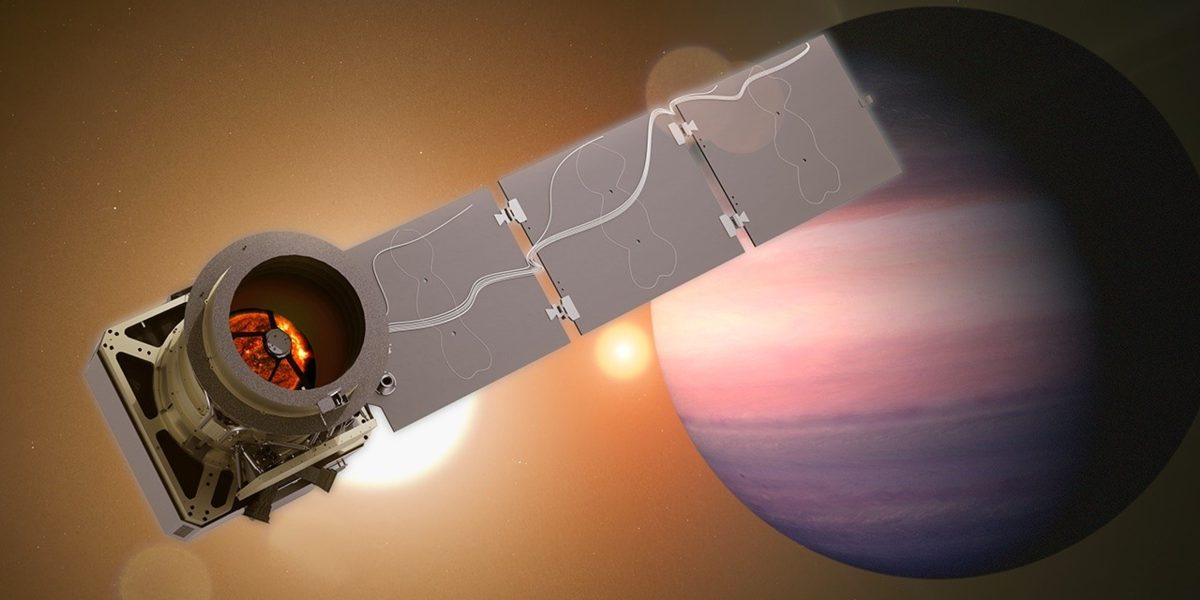
Using the new Pandora space telescope, scientists have begun studying the atmospheres of planets beyond the Solar System. The main task is to separate the chemical signatures of a distant world from the influence of radiation from its host star. Because of this confusion, it has so far been difficult to determine the composition of such atmospheres with confidence. The spacecraft has already completed system checks and moved on to scientific observations.
A Fast and Inexpensive Program
The small Pandora satellite became the first spacecraft launched into orbit under the Astrophysics Pioneers program. Its concept is based on small missions with short development cycles and modest budgets, while accepting a higher-than-usual probability of failure.
The launch took place on January 11, 2026, from Vandenberg Space Force Base in California, and the spacecraft was placed into a Sun-synchronous Earth orbit aboard a Falcon 9 rocket as part of a rideshare mission carrying nearly four dozen other payloads. The scientific program began after all instruments had completed their checks, NASA reports.
The mission is led by Elisa Quintana of NASA’s Goddard Space Flight Center. According to her, data from the new mission should fill an important gap, because there is currently no certainty about how strongly stellar radiation distorts atmospheric measurements.
Video about the Pandora mission, which will study exoplanet atmospheres. Source: NASA’s Goddard Space Flight Center
Why Starlight Gets in the Way
The atmosphere of a distant planet can be studied during a transit, when the planet passes in front of its star. Some of the light traveling toward us passes through the gaseous envelope. Molecules leave characteristic absorption lines in the spectrum.
The problem is that instruments record radiation from the entire visible stellar disk, not only from the thin region through which the light has passed. A star’s surface is nonuniform: it contains hotter, brighter regions known as faculae and darker, cooler areas similar to sunspots. These features change in size and position as the star rotates.
This effect became particularly noticeable in the TRAPPIST-1 system, where the spotted surface of the red dwarf complicated interpretation of the spectra of its planets. It was precisely because of this that some claims of water vapor detection in the atmospheres of those worlds were later revised.
“Water is one of the most important molecules we use to determine the composition and physical conditions of an exoplanet atmosphere. But features on the stellar surface distort the water signal we are looking for,” said Benjamin Rackham of the Massachusetts Institute of Technology.
An Aluminum Mirror
At the heart of the mission is a telescope about 45 centimeters in diameter, made entirely of aluminum. The instrument was manufactured by Corning Specialty Materials and developed jointly with specialists from Lawrence Livermore National Laboratory.
Two detectors operate simultaneously: one measures the star’s brightness in visible light, while the other records its spectrum in the near-infrared. The infrared detector for the new mission came from the spare units originally built for James Webb.
Long Observation Sessions
During the first year of the primary program, scientists plan to study at least 20 exoplanets. Each of them will be observed ten times, with each individual session lasting an entire day and necessarily covering a transit.
“The advantage of Pandora is its ability to observe targets for long periods at several wavelengths simultaneously, something heavily scheduled flagship missions such as James Webb cannot do regularly,” said Nicole Colon, a project scientist at NASA’s Goddard Space Flight Center.
The results from both spacecraft are expected to be combined in order to characterize stellar surface properties and reliably separate their signals from planetary ones. The scientific data are being sent to NASA’s open exoplanet archive.
