

White dwarfs in a close binary complete a full orbit in just a few minutes. Matter from one star falls directly onto the surface of the other, so the X-ray emission arrives in short bursts. Astronomers have found that the orbit is rapidly shrinking because of energy loss. This rate makes the system one of the most prominent sources of gravitational waves among binary stars.
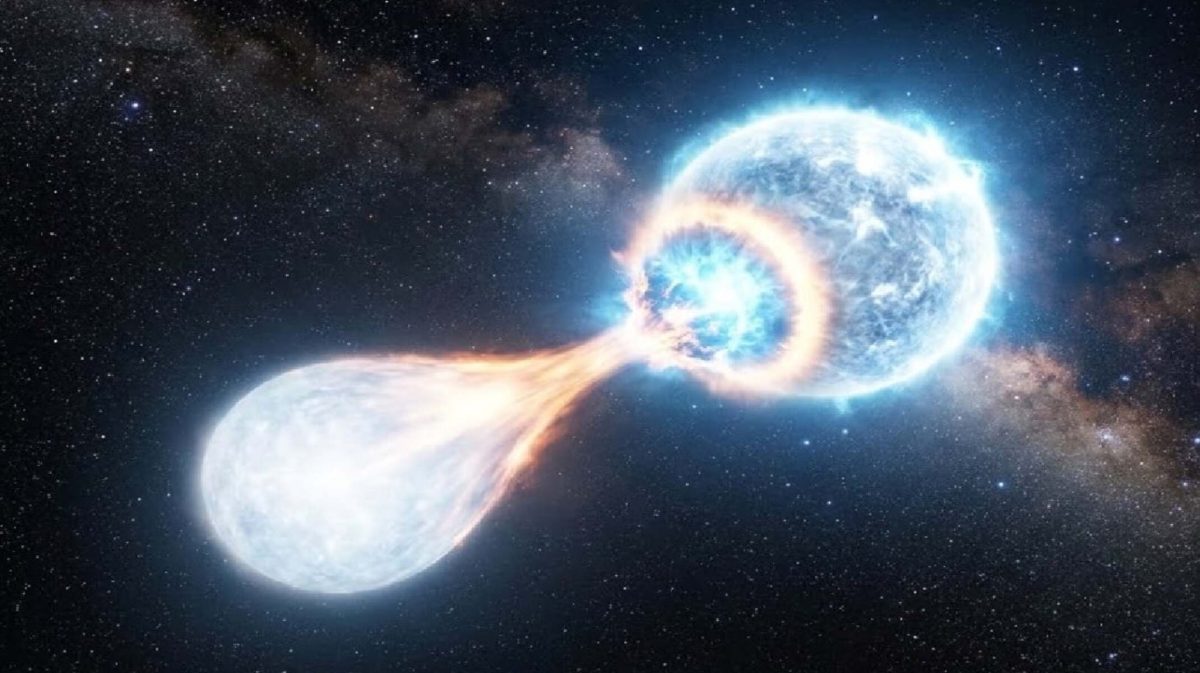
Artist’s impression of the white dwarf binary system eRASSU J0608. Credit: Inter-University Centre for Astronomy and Astrophysics
A Source of Short Bursts
The X-ray source eRASSU J0608 flares every 374 seconds, slightly less often than once every six minutes. Such regular periodicity almost always indicates orbital motion.
Pulsars produce regular pulses because of the rotation of a neutron star. Variable stars often become fainter because the components of a binary system eclipse one another.
Neither of these scenarios was obvious for the new object. To understand the mechanism, the researchers turned to X-ray observations.
Two Dwarfs Without a Disk
Data from the Neutron Star Interior Composition Explorer (NICER) aboard the ISS and the Einstein Probe X-ray observatory showed that the bursts come from a close pair of white dwarfs. They orbit so close to each other that matter lost by one star falls directly onto the surface of the other.
An accretion disk does not have time to form around such a system, which would otherwise produce a more steady glow, as Universe Today reports. The overheated material becomes visible only when the binary is turned toward observers on Earth at the right angle, so the radiation arrives in separate bursts.
Rapid Orbital Shrinkage
The new measurements were compared with archival observations from the XMM-Newton observatory, allowing the system to be tracked for more than three years. The orbital period was found to be getting progressively shorter, and the rate of this change is consistent with energy losses caused by the emission of gravitational waves.
Similar orbital shrinkage has been observed many times before, but in this case it is among the fastest known. As a result, the system ranks among the strongest gravitational-wave emitters among binary stars.
The combination of the masses of the two stars, which determines the strength of the signal, is estimated at 0.43 solar masses. The results were published in the peer-reviewed journal The Astrophysical Journal Letters.
Unknown Distance
The X-ray data do not make it possible to determine how far away the binary is, and the expected signal strength depends directly on that distance. The farther away the system is, the weaker the wave that will reach a detector.
The authors hope that a third nearby star may be found, allowing the distance to be measured. Until the distance is known, the expected amplitude of the gravitational wave cannot be calculated.
A Target for Future Observations
Existing detectors are not sensitive enough to detect ripples in spacetime from binary stars and currently record only mergers of black holes. Detecting weaker signals requires instruments in space, and the leading candidate for this role is the Laser Interferometer Space Antenna (LISA).
The LISA project was formally approved by ESA in 2024, and the launch of three spacecraft separated by 2.5 million kilometers is planned for the mid-2030s. If the white dwarf pair turns out to be close enough, its signal could serve as a convenient reference source for calibrating observations of other systems.
