

From school, we know that one rotation of Earth around its axis takes 24 hours. More precisely, 23 hours, 56 minutes, and 4 seconds. In reality, however, the planetary clock does not operate with perfect precision. The speed of Earth’s rotation is constantly changing under the influence of a whole range of factors — from the atmosphere to ocean currents.

Depending on the timescale, different forces affect Earth’s rotation. While short-term fluctuations are controlled by the atmosphere and oceans, and tidal interaction with the Moon unfolds over millions of years, medium-term changes lasting several decades remained a mystery for a long time. A new study published in Nature sheds light on this deep internal mechanism.
A Trio from Deep Inside Earth
Scientists Huifeng Zhang and Mathieu Dumberry from the University of Alberta in Canada analyzed observational data from the past six decades using statistical modeling. They found that long-term changes in the planet’s rotation rate originate deep inside Earth through interactions between the core and the mantle.
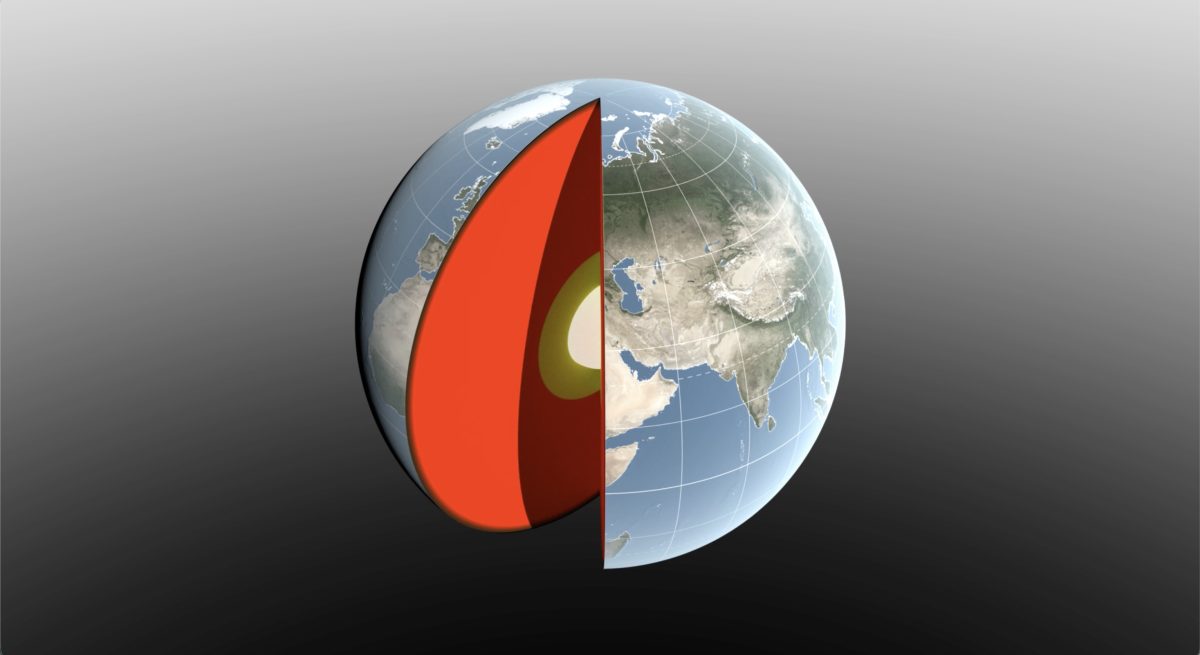
Three main mechanisms compete in the exchange of angular momentum between Earth’s layers:
- Gravitational coupling — the gravitational attraction between the inner core and the mantle;
- Electromagnetic coupling — the influence of the conductivity and thickness of a special layer at the base of the mantle;
- Topographic coupling — relief irregularities along the boundary between the core and the mantle.
The researchers found that gravitational “torque” plays the decisive role in speeding up or slowing down Earth’s rotation, while the other two mechanisms act as a kind of counterbalancing buffer that restrains these fluctuations.
Millisecond Mysteries
Analysis of the data shows that from the early 1970s through 2021, these processes changed the length of an Earth day by several milliseconds. Although this value may seem negligible, it is extremely important for science.
Studying such tiny deviations allows geophysicists to better understand the physical properties of Earth’s internal layers, which are located thousands of kilometers beneath our surface and are inaccessible to direct observation. The authors are continuing their work to determine whether the same mechanisms also affect six-year cyclical variations in the length of the day.
Earlier, we reported on how Earth’s rotation set a new record in modern history.
Based on materials from Gizmodo
