

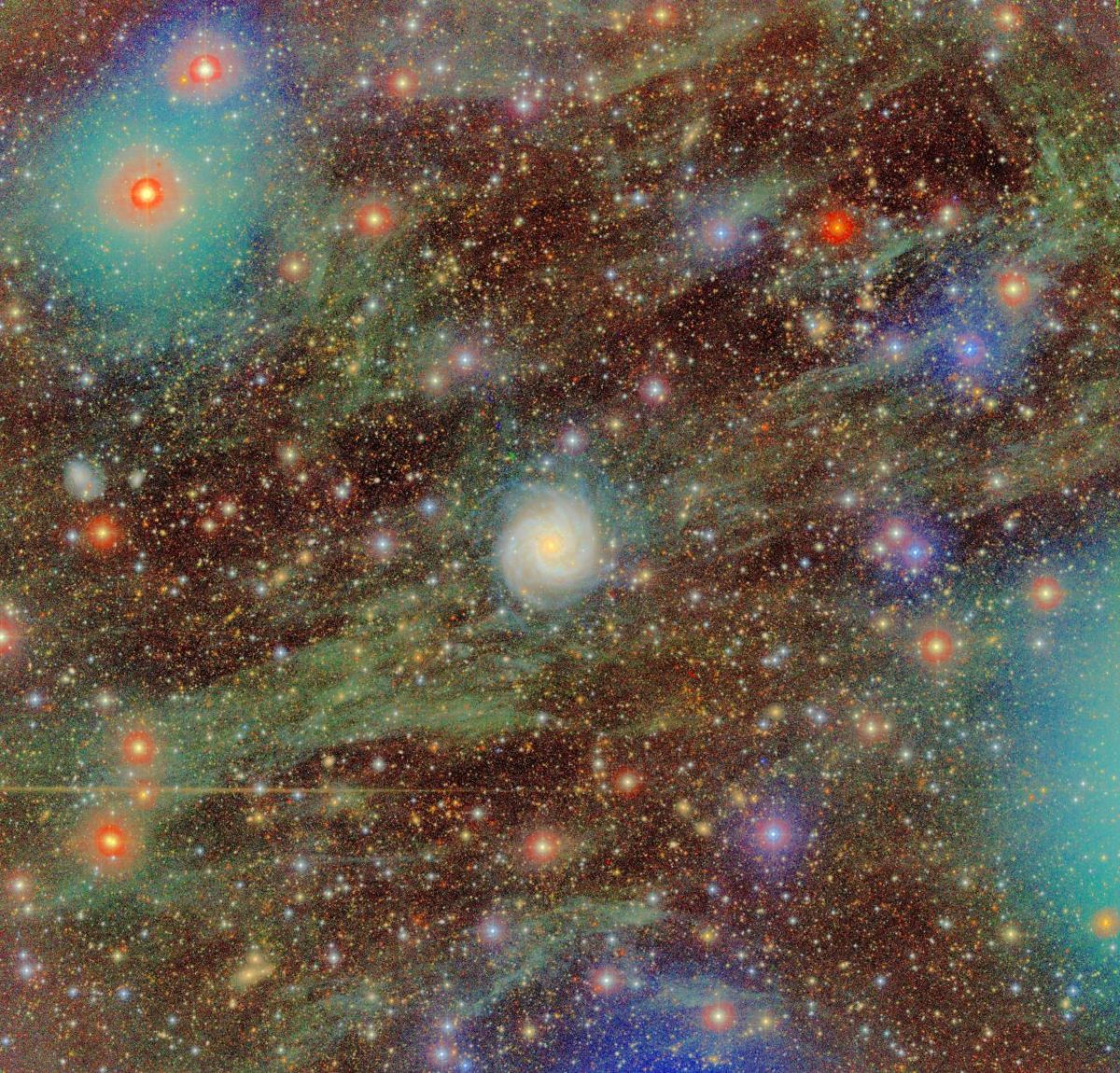
The spiral galaxy Messier 74 has turned out to be twice as large as astronomers had believed for decades. Around its familiar disk, Spanish researchers detected a barely visible structure made up of young blue stars. It became visible thanks to a new one-meter telescope in the Canary Islands. By cosmic standards, it formed extremely quickly. The cause may have been a close flyby of a neighboring galaxy.
A Trace of a Close Flyby
The team links this growth to the galaxy UGC 1176, located approximately 400,000 light-years away. Such close encounters can disturb cold gas in the outskirts of a galaxy and trigger star formation there.
According to Ignacio Trujillo, a researcher at the Instituto de Astrofísica de Canarias and a co-author of the study, the close flyby occurred about a billion years ago. Indirect evidence comes from the neutral hydrogen of Messier 74 (M74), which extends far beyond the previously known disk.
The asymmetries in this gas and its complex features had remained unexplained for decades. Now they fit the scenario of an ancient interaction.
A Disk Twice as Wide
In ordinary images, the stellar disk of the galaxy extends roughly 45,000 light-years from the center, almost like that of the Milky Way. The newly detected blue structure reaches nearly 100,000 light-years, or about twice as far.
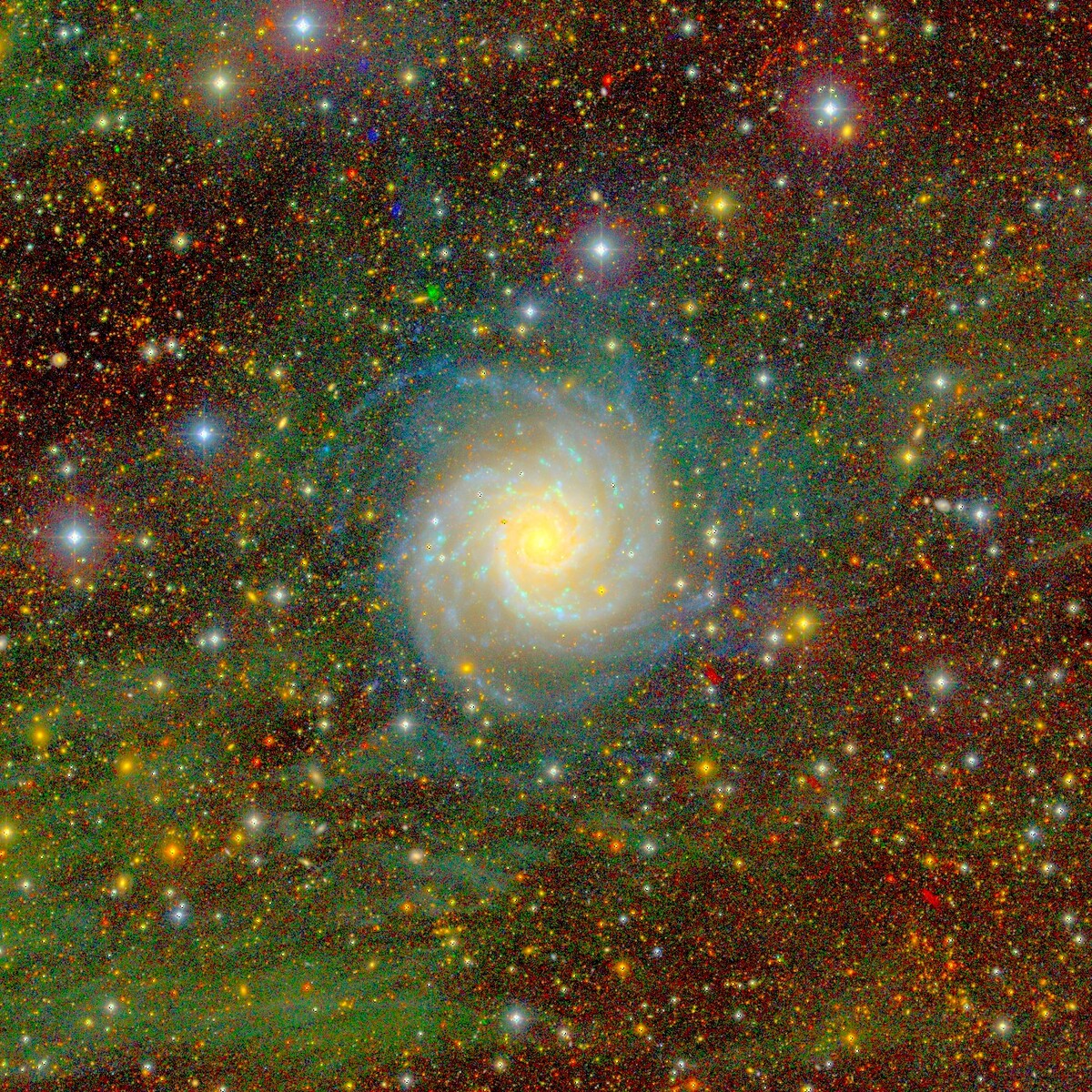
The average age of the stars in this outer region is only 640 million years. That is a tiny fraction of the galaxy’s lifetime, meaning that its size doubled in less than a billion years. The study was published in the peer-reviewed journal Astronomy & Astrophysics.
Why the Structure Had Gone Unnoticed
The new images reveal objects approximately ten times fainter than those visible in major sky surveys, including the well-known Sloan Digital Sky Survey (SDSS). Equally important was the image-processing method itself, which was designed to preserve extremely faint features.
“The data available before this were unsuitable for searching for structures this faint, both in terms of depth and the way they were analyzed,” explains Ignacio Trujillo. That is why a separate observing strategy was required.
The spiral galaxy Messier 74 (M74) is often shown in textbooks as a classic example of a spiral galaxy. It has been photographed repeatedly by the world’s largest observatories, including James Webb. Despite all this attention, half of the galaxy’s true extent remained invisible.
A One-Meter Telescope Versus the Giants
The discovery was made using the new robotic Transient Survey Telescope (TST), which operates at the Teide Observatory. Its mirror is only one meter in diameter, and it is operated by the Canary Islands company Light Bridges.
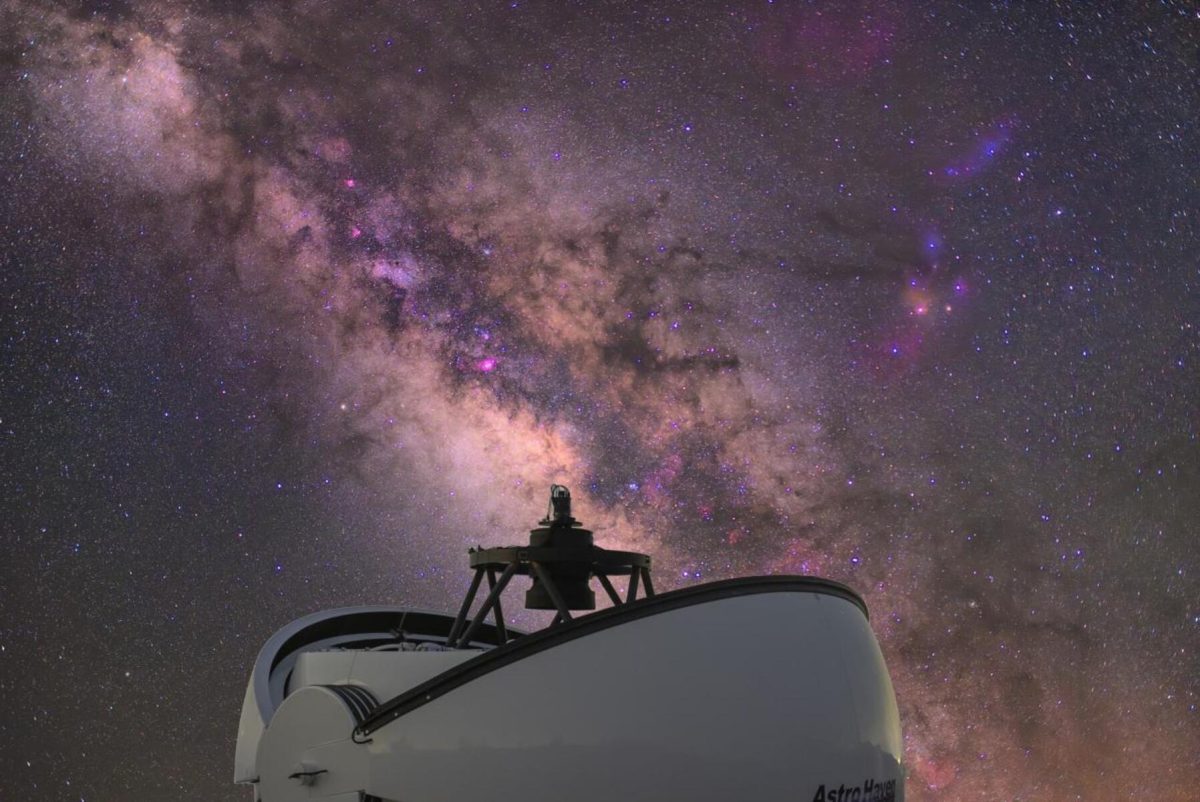
A wide-field camera combined with careful image processing provides a depth that ordinary instruments with larger mirrors cannot achieve. Miquel Serra-Ricart, a co-author of the study and technical director of the program, sees this as proof that aperture is not everything — a well-designed approach to data collection can be decisive.
Is This an Isolated Case?
The result changes our understanding of how quickly galaxies can grow. Instead of gradually accumulating gas over billions of years, galaxies may undergo short episodes in which their size doubles in a sudden jump.
Ignacio Trujillo suggests that Messier 74 is probably not an exception; rather, similar outer disks may simply have remained invisible in shallower images. Further observations of the northern sky with TST and the southern survey being prepared by the Vera C. Rubin Observatory in Chile should test this idea.
