

When physicists at the ARC Centre for Transformative Meta-Optical Systems (TMOS) needed a key component for their terahertz experiments, they encountered a frustrating problem — they required tiny optical devices known as wire-grid polarizers, but each one cost thousands of dollars. The scientists decided to solve the problem themselves.
The Importance of Polarizers in Science and Technology
Polarizers are important for controlling terahertz radiation, which underlies technologies that make it possible to see inside or through opaque materials such as clothing and packaging without the cellular damage caused by X-rays. This was reported by phys.org.
Although polarizers are expected to become a foundation of future communications beyond 6G, they are already widely used in spectroscopy, imaging, and materials research. Instead of spending thousands of dollars on these polarizers, the researchers asked whether they could simply make one themselves.
Using an ordinary sheet of aluminum kitchen foil and a nanosecond laser with precisely controlled pulses, the team found that it was possible to cut a delicate metal grid directly from the foil in just 15 seconds — without clean rooms, specialized manufacturing facilities, or even the outdated wire-winding methods required for traditional devices.
A Bold Experiment
The idea for the technology emerged during TMOS’s internal “Shark Tank” competition last year, where researchers were asked to present ideas with commercial potential.
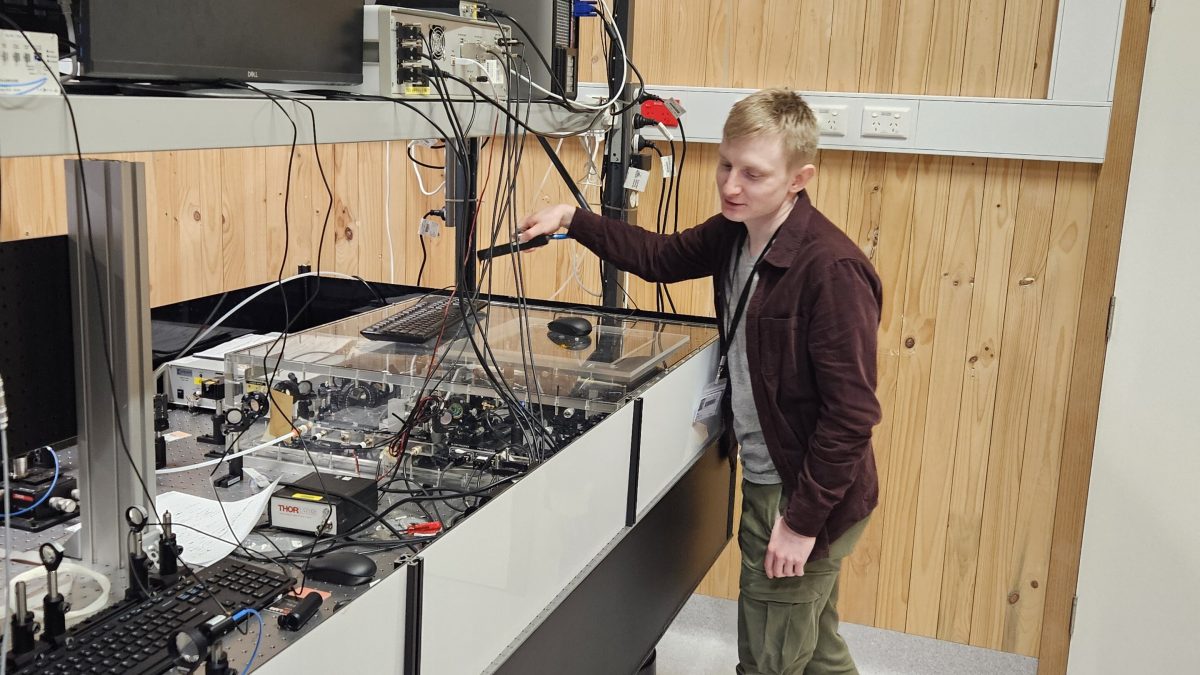
“We started thinking about what we could make that could realistically become a product,” says Stephen Doolittle, a professor with TMOS at the Australian National University. The device design was led by PhD student Aaron Scholz, while fabrication was carried out by Dr. John Smith, both also with TMOS at the Australian National University.
“This was just our first experiment with the simplest material, which we then supplemented with more industrial materials, including tungsten,” Scholz says. “We simply took kitchen aluminum foil and made our polarizer out of it. It costs almost nothing.”
Replacing Old Technologies
The technology came together once the team understood exactly how to control the laser parameters. The process is extremely delicate: if there is too much energy, the microscopic wires bend; if there is too little, the foil is not cut.
After months of experiments, the team found the optimal setting that allowed microscopic metal grids to be cut without destroying them. The result is a free-standing polarizer, without supporting glass or plastic underneath, that can be manufactured in seconds rather than through complex multi-stage processes.
The researchers also developed methods for producing larger devices from different metals in one or two minutes.
Conventional manufacturing often relies either on complex lithography in expensive clean rooms or on precision machines that wind microscopic tungsten wires one by one.
Both approaches — lithography and wire winding — are expensive and difficult to scale.
This Is Only the Beginning
Although aluminum foil is cheap and easy to process, it is not strong enough for commercial products. The team is now experimenting with stronger materials such as tungsten and copper, seeking the optimal balance between manufacturing cost, durability, and efficiency.
“We have solved the fabrication problems,” Scholz says. “Now we are trying to find a compromise between the mechanical stability and the optical properties of the polarizer.”
The scientists say their team aims to make polarizers not only cheaper, but even better than those currently available on the market.
