

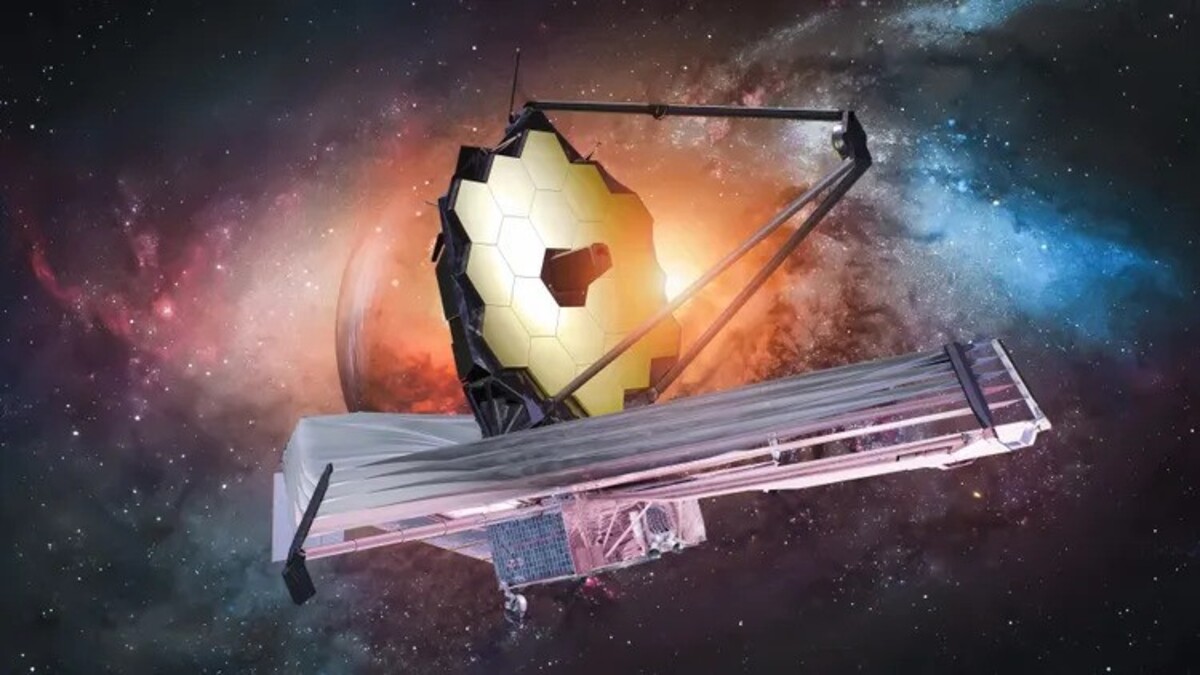
Scientists have once again spotted, in an image from the James Webb Space Telescope, a supermassive black hole that is far too large for its epoch. This time, it is located inside a “galactic filament” containing several stellar systems.
A Black Hole Far Too Massive for Its Galaxy
Using the James Webb Space Telescope, astronomers have obtained one of the clearest views yet of how an early supermassive black hole may grow within a network of young galaxies. The compact active galaxy, seen as it appeared only one billion years after the Big Bang, lies beside a 12,000-parsec-long filament containing several galaxies. They are expected to merge into a single system within a few hundred million years.
The findings suggest that astronomers are observing a short-lived phase in the evolution of black holes that are rapidly gaining mass, as well as the formation of the first massive galaxies in the early Universe.
Since James Webb began operating, astronomers have discovered a population of compact galaxies containing actively growing black holes within the first billion years of the Universe’s existence. Many of these black holes have proved far too massive for their host galaxies: some are 10 to 100 times more massive than current models predict.
This particular black hole, located in the galaxy known as GN-77652, is observed at a redshift of 5.23.It has a mass of about 11 million solar masses, while the stellar mass of its galaxy is only 170 million solar masses. This makes the black hole about 300 times more massive than would be expected based on the ratio between the masses of supermassive black holes and their galaxies in the nearby Universe.
A Group of Five Galactic Sources at Different Stages of Evolution
Led by Giulia Tozzi of the Max Planck Institute for Extraterrestrial Physics, the team used the NIRSpec integral-field spectrograph aboard James Webb as part of the BlackTHUNDER program, together with deep NIRCam imaging, to map the region around GN-77652 in detail.
The turbulent environment was found to contain four additional galaxy-sized concentrations of gas and stars, designated B, C, D, and E. All of them are located at approximately the same redshift. These concentrations lie along the filament at distances ranging from about 2.4 to 11.6 kiloparsecs from GN-77652.
Interestingly, GN-77652 is not the most massive galaxy in the group. Sources B and D each contain approximately ten times more stellar mass. Galaxies B and D are about 10 times more massive than it in terms of stellar mass. Gas throughout the structure appears to be converging toward source B, located near the center of the complex, suggesting that the entire system may eventually merge into one galaxy.
The five sources differ by as much as an order of magnitude in stellar mass, star-formation rate, and chemical enrichment, indicating that each component is at a different stage of evolution.
GN-77652 itself shows a shallow but noticeable velocity gradient consistent with a small rotating gas disk. The team explains in the paper that this distinctive feature, confirmed so far in only a few similar compact black-hole hosts, is “consistent with gravitational domination.” The same pattern is observed in ordinary star-forming galaxies at these redshifts, suggesting that GN-77652 behaves more like an organized galaxy than a severely disturbed system.
A Possible Second Black Hole
The most revealing result comes from source B, located only 2.4 kiloparsecs away from GN-77652 in projection. Diagnostic emission-line ratios indicate that the gas there is being ionized by something more energetic than starlight alone.
To test whether this ionization might simply be caused by radiation from GN-77652 reaching and illuminating the gas in B, the team calculated how much ionizing radiation would be required.
They found that the necessary incident luminosity was more than two orders of magnitude greater than the GN-77652 black hole could realistically provide. This rules out GN-77652 as the source and points to a second, separate black hole in B. If confirmed, it would be one of the few known pairs of black holes located so close together at such an early stage in the history of the Universe.
The team also examined whether the GN-77652 black hole could have formed through “direct collapse,” a process in which a dense gas cloud collapses directly into a massive black-hole seed, bypassing the intermediate stage of star formation. By measuring the radiation field produced by the surrounding filament, the researchers found that it was slightly weaker than the intensity required for such a process.
They note that the radiation may have been stronger in the past or that other explanations remain possible, including the possibility that GN-77652 is a primordial black hole or one that was ejected from a neighboring galaxy through gravitational interactions.
The Future Merger of the Galaxy Group
Based on the separations and masses of the components, the team estimates that the entire galaxy group should merge into a single system within approximately 150–440 million years. By modeling how the black hole and the stellar mass of the merged system may grow during that period, they found that the ratio between them would stabilize much closer to the values observed in typical galaxies today.
The team concludes that the compact and excessively massive appearance of GN-77652 probably represents a short-lived evolutionary phase. This is consistent with the broader trend that such objects become rarer at lower redshifts as the Universe ages.
The researchers say that further James Webb spectroscopy, targeting a larger number of emission lines at higher resolution, will be required to confirm the presence of a second black hole in source B and to trace the development of this system more accurately over time.
