

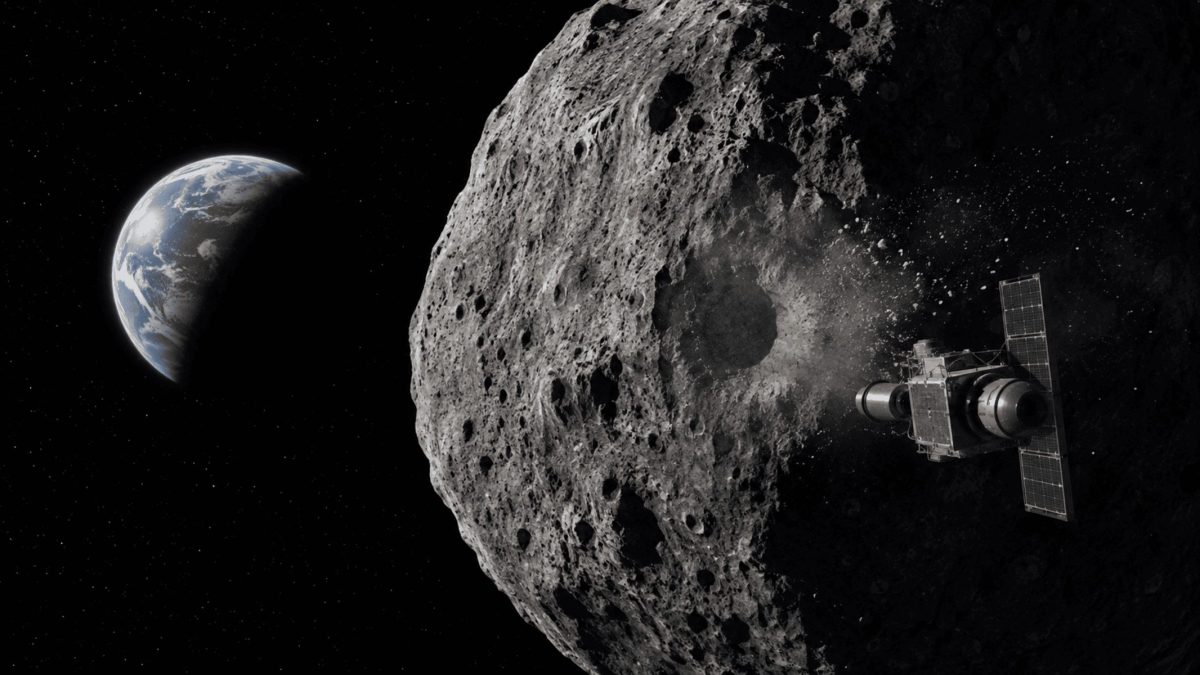
What should be done if an asteroid is detected only a few days before it collides with Earth? The answer turned out to be close to the plot of the movie Armageddon. A nuclear charge really can knock a dangerous body off course, but an explosion near the surface provides too weak a push. Chinese engineers calculated another method. First, a deep crater is punched into the asteroid, and then the charge is detonated inside it.
Very Little Time for Preparation
Among known near-Earth asteroids, more than ten thousand have diameters greater than 140 m. None of them is currently on a collision course with Earth. But planetary-defense specialists emphasize that a great many similar objects have still not been detected.
The interval between the discovery of such a body and its impact could be just a few days. In that amount of time, neither a gravity tractor nor a slow orbital shift would produce results. Only one method remains — transferring the maximum amount of energy in a single attempt.
Two Approaches to Choose From
Both options were developed by specialists from the China Academy of Launch Vehicle Technology together with colleagues from the Beijing Institute of Technology, the China Academy of Engineering Physics, and the University of Auckland. The work was published in the peer-reviewed journal Space: Science & Technology, while a brief summary is provided by Phys.org.
The first approach is the simplest. A spacecraft carrying a warhead would have to crash into the side of the asteroid and detonate the charge at a precisely determined moment. Microsecond-level accuracy would be required, and the structure would have to withstand impacts from fragments traveling at enormous speeds.
The problem is that in this case it is impossible to select an optimal point for the explosion. The amount of energy transferred into the rock would be relatively small. A significant portion of it would simply dissipate into space.
First a Hole, Then an Explosion
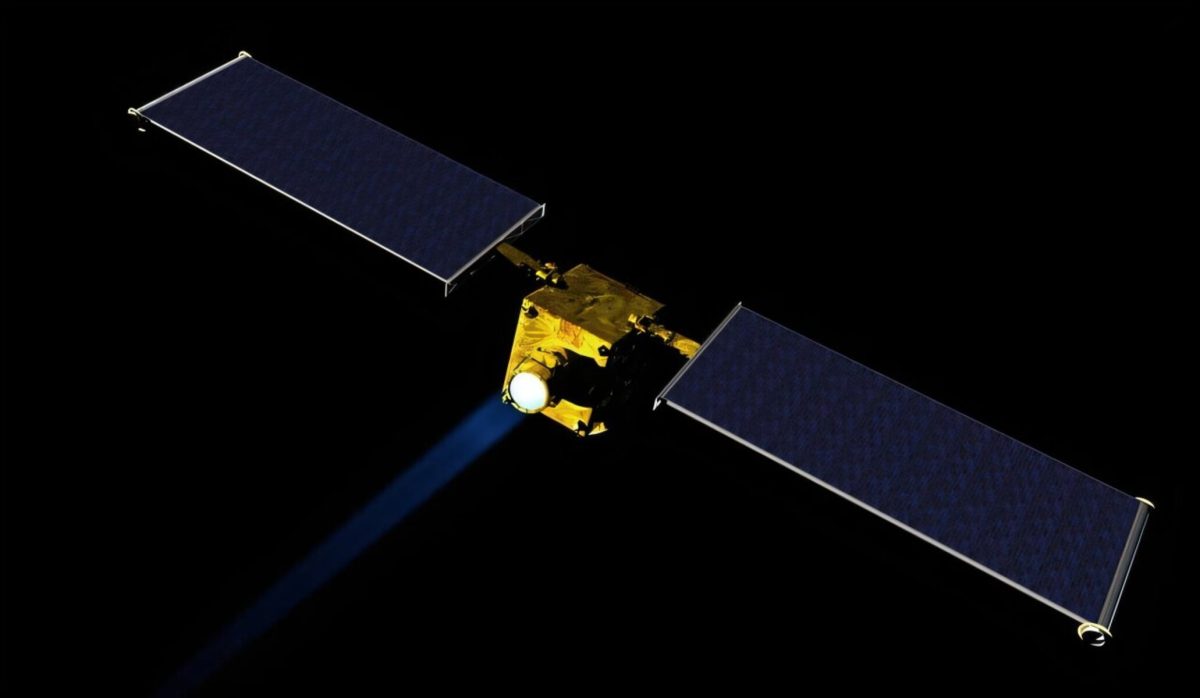
The second scenario is more complicated and develops a method tested in practice in 2022. At that time, the spacecraft of the Double Asteroid Redirection Test (DART) mission crashed into the asteroid Dimorphos and slightly changed its orbit. The main consequence of the impact was a crater on the surface.
It was this crater that suggested the idea. If a conventional impact leaves a depression, several consecutive impacts at the same point would make it much deeper. For this purpose, a tandem impactor with two metal rods would fly toward the target. They would strike the same point one after another and punch a hole significantly deeper than an ordinary crater. The nuclear charge would then be lowered into it.
The simulations showed how much more effective this would be. For an asteroid one kilometer in diameter, detonating a three-megaton charge in a shallow pit on the surface changed the body’s velocity by only 9.2 cm/s. The same warhead in a crater 30 m deep produced more than 30 cm/s. The deeper the explosion occurs, the smaller the fraction of energy that escapes into empty space.
What Remains Unknown?
The authors based their calculations on a solid basalt monolith. Real hazardous bodies are most often piles of rocks held together by weak gravity. The simulations do not show how such a structure would behave under a nuclear explosion.
The engineering side also remains unresolved. The launch vehicle would have to enter a trajectory close to the target’s orbit, survey the surface, plan two consecutive impacts, and deliver the warhead precisely into the resulting hole. All of this would have to be done through a cloud of debris created by the previous impacts.
Even if the technology were ready, a legal obstacle would remain. The 1967 Outer Space Treaty, signed by both the United States and China, prohibits placing in Earth orbit or stationing in space any objects carrying nuclear weapons.
Detection Is More Important Than the Weapon
All of these schemes make sense only if the threat is detected in advance. A kinetic push is sufficient if years remain before impact. The nuclear option is considered a last resort for kilometer-scale objects.
The specialized NEO Surveyor spacecraft, which NASA is building specifically to detect near-Earth objects, is planned for launch in September 2027. It will operate in the infrared range, allowing it to see dark bodies that reflect almost no sunlight.
