

The boundary of the largest known galaxy has been reliably measured for the first time. Astronomers wanted to determine how large such giants can become in the modern Universe. The deepest images obtained show that IC 1101 is even larger than previously thought. The faint glow around it indicates that its growth is still continuing.
The Size of the Giant
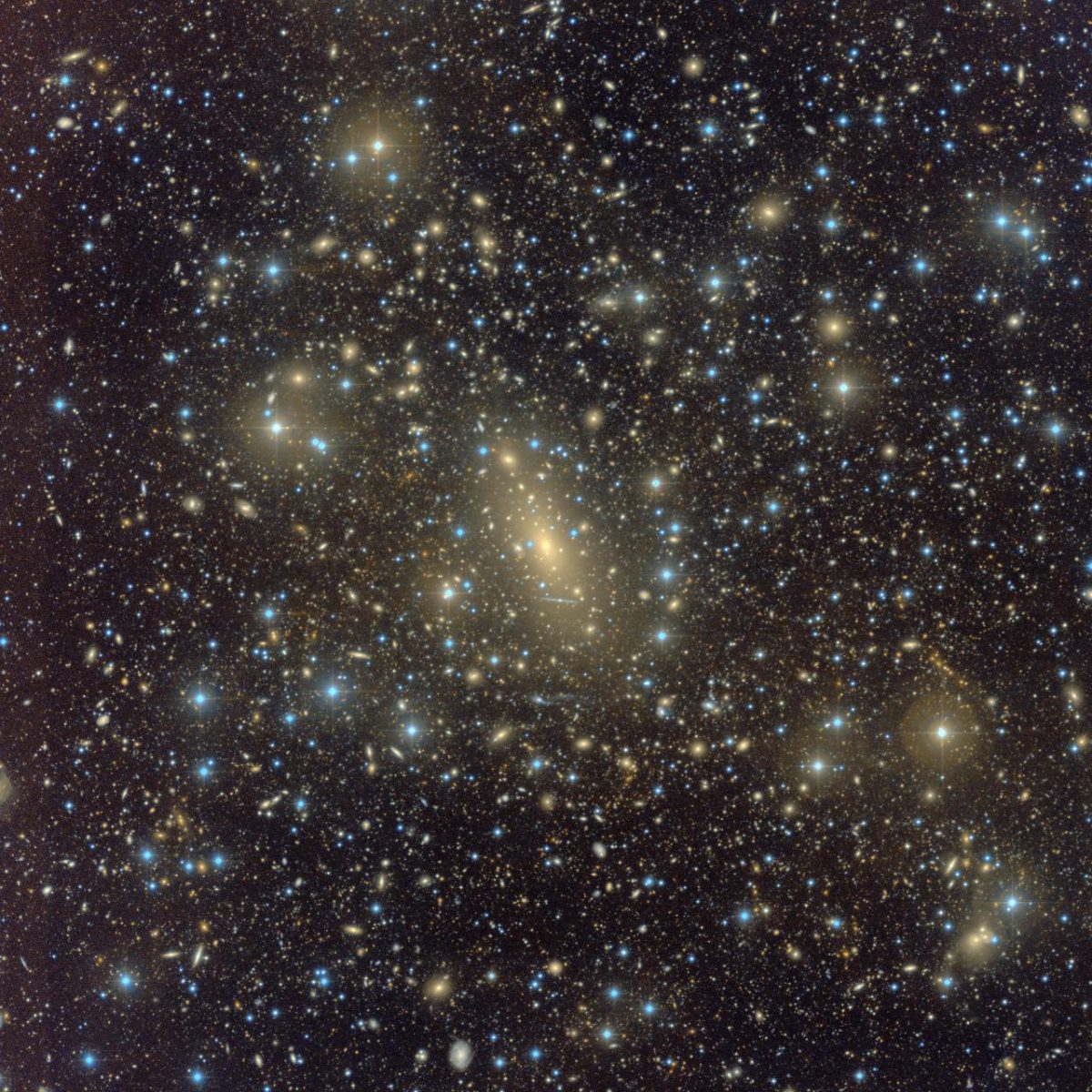
The main body of the galaxy IC 1101 reaches approximately 1.7 million light-years across. This is ten times larger than our Galaxy, whose diameter is currently estimated at between 100,000 and 200,000 light-years. The measurement results were published in the peer-reviewed journal Astronomy & Astrophysics.
The total mass of stars within the measured boundary is about 3.4 trillion solar masses. This is approximately 70 times more than in the Milky Way, where the combined mass of all stars reaches about 50 billion solar masses.
Where the Galaxy Ends
The galaxy IC 1101 is located at the center of the Abell 2029 galaxy cluster, about one billion light-years from Earth. The light reaching Earth today left there at a time when life on our planet existed only in water in the form of microorganisms and the first algae. The exceptional size of this object has been known for decades, but scientists could not determine exactly where its main body ended.
Lead author Carlos Marrero-de la Rosa of the Institute of Astrophysics of the Canary Islands explained that the team wanted to determine the limit of galactic growth in the present-day Universe. To do this, they used images from the Isaac Newton Telescope at the Roque de los Muchachos Observatory with an exposure time of more than four hours. These images revealed outer regions that were invisible in previous sky surveys.
A galaxy does not have a sharp edge like a solid object. Stars become more sparse with increasing distance from the center. The boundary was taken to be the point where the ordered structure transitions into the diffuse light of the cluster. Study co-author Ignacio Trujillo clarified that this is where stars begin to lose their gravitational connection to the galaxy.
Growth Continues
Beyond the boundary of the main body, the images reveal extremely faint irregular structures extending about 2 million light-years from the center. These are likely remnants of smaller galaxies destroyed by the gravitational field of IC 1101 and the Abell 2029 cluster.
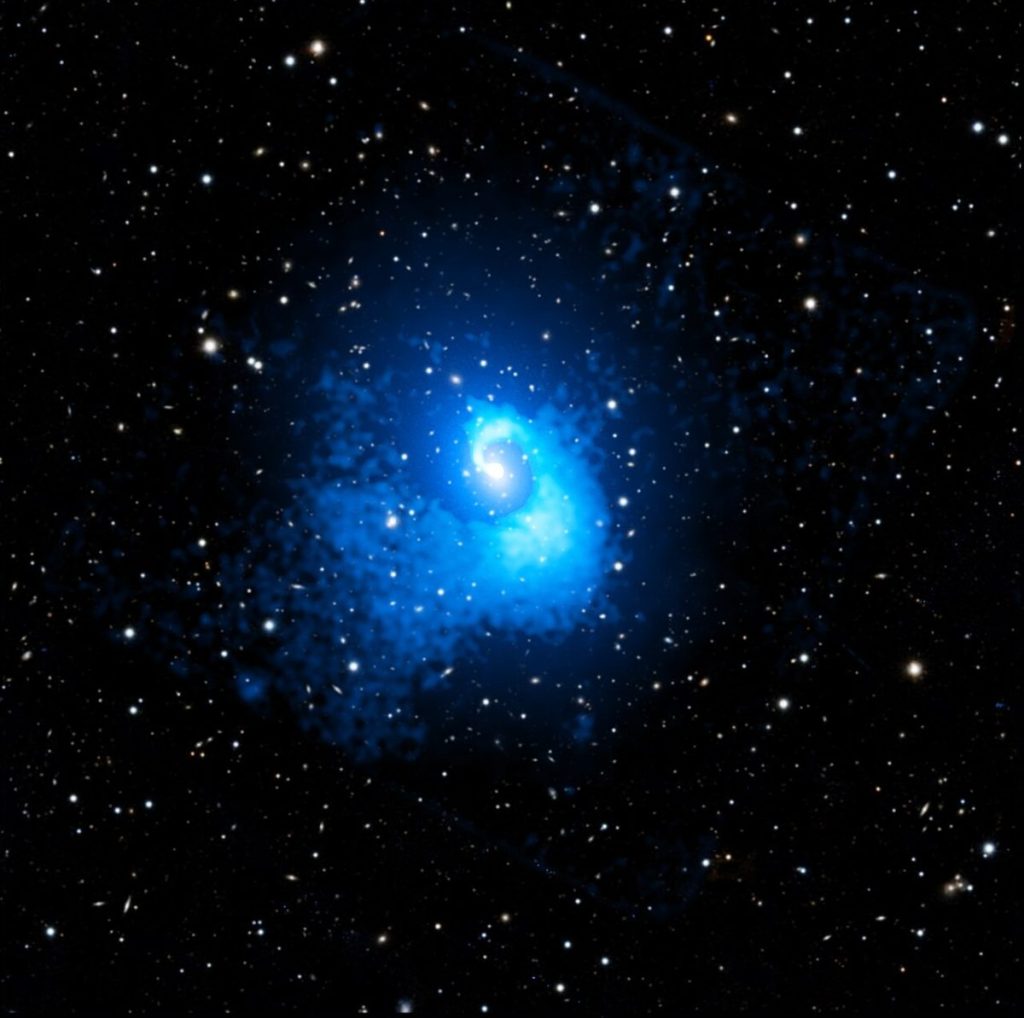
The authors compared the situation to a city whose boundary moves outward as new neighborhoods appear on its outskirts. The main body of the galaxy can now be measured, while its outer regions continue to accumulate matter.
A Challenge for Models
It took 13.7 billion years — essentially the entire age of the Universe — to form a system of this size. For this reason, the authors consider IC 1101 a natural laboratory for testing modern theories of galactic growth.
According to the hierarchical model, galaxies grow through mergers and the accretion of smaller systems. In the case of IC 1101, this process appears to have been especially efficient, so the galaxy may show what other massive galaxies can eventually become. Cosmological simulations will now have to reproduce such an object within the time available since the Big Bang; otherwise, they are likely missing part of the growth mechanism.
