

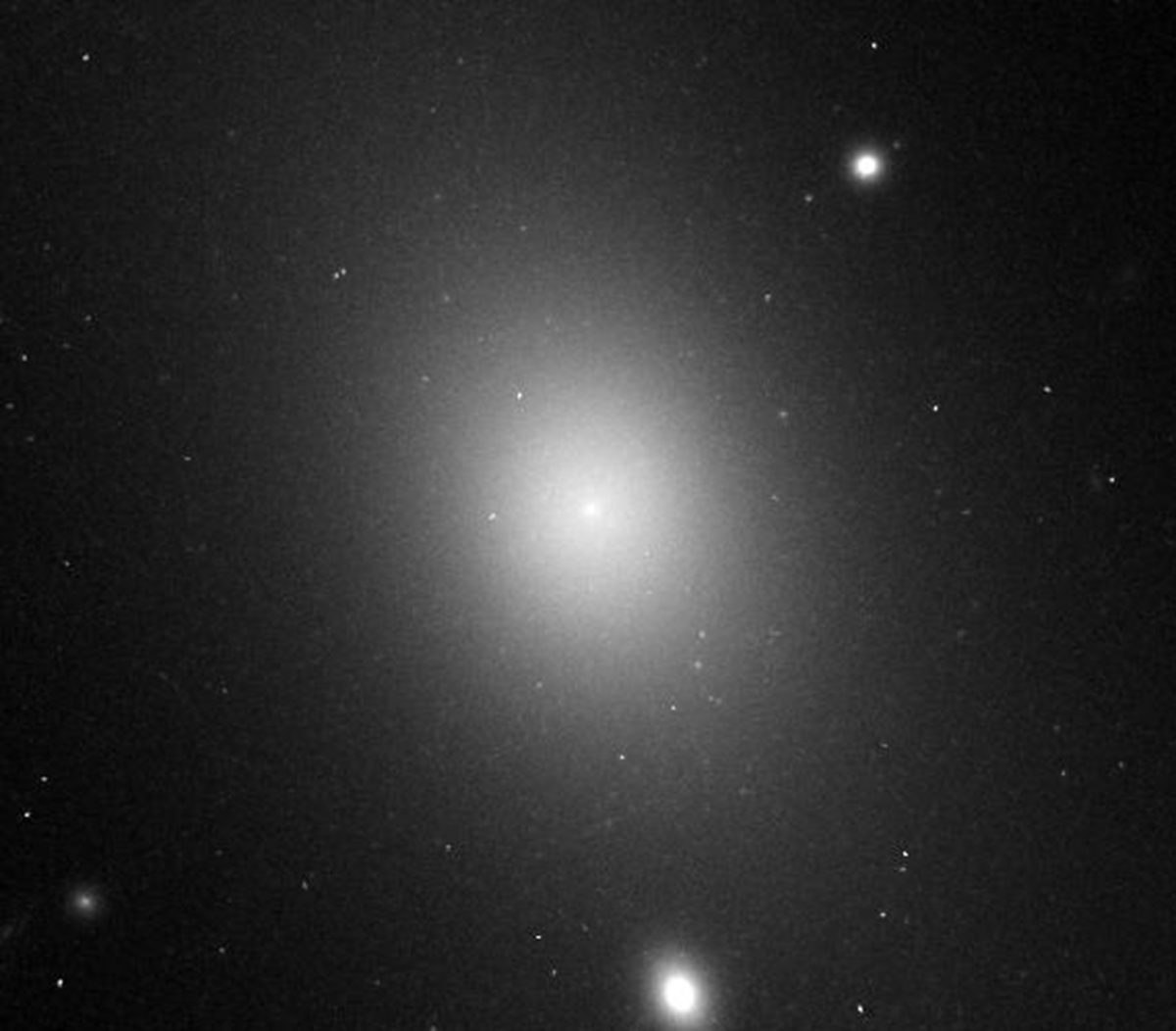
Researchers have obtained the deepest images of IC 1101 ever taken, allowing them to determine the galaxy’s outer boundary for the first time. The observations confirmed it as the largest known galaxy, extending approximately 520 kiloparsecs, or about 1.7 million light-years, and containing roughly 3.4 trillion solar masses in stars.
Galaxies That Are Difficult to Define
The largest galaxies, known as brightest cluster galaxies (BCGs), are the result of hierarchical galaxy formation. They grow by absorbing smaller galaxies over billions of years. Their faint stellar halos gradually merge into the intracluster medium—the diffuse gas and stars filling the space between galaxies within a cluster, phys.org reports.
This blending is precisely what makes BCGs so difficult to measure. Their outskirts contain evidence of past mergers in the form of tidal tails and stellar halos that overlap with the surrounding intracluster light, making it difficult to determine where the galaxy ends and the rest of the cluster begins.
A team led by Carlos Marrero-de-la-Rosa of the Instituto de Astrofísica de Canarias selected one of the most extended stellar systems ever observed: the BCG at the center of the Abell 2029 galaxy cluster. Its stellar extent had previously been measured at 607 kiloparsecs. Using ultra-deep images from the Wide Field Camera on the Isaac Newton Telescope (INT), the astronomers set out to identify the edge of this galaxy.
Determining the True Size of IC 1101
Measuring a galaxy’s true boundary requires detecting extremely faint starlight and separating it from an unwanted source of contamination: scattered light from foreground stars, which can spread a weak glow across an image and obscure the very faint regions astronomers are trying to detect.
The team created a detailed model of the telescope’s point spread function using dozens of calibration stars of different brightness levels. They then used this model to subtract scattered light from more than 250 stars in the final image, revealing faint structures.
Radial profiles—showing how starlight changes with distance from the center—place the edge at a radius of 260 kiloparsecs. This gives the galaxy a confirmed diameter of approximately 520 kiloparsecs, making it the largest galaxy known to date.
The measured edge radius of IC 1101 remains among the largest ever recorded for an individual galaxy, corresponding to a projected diameter of about 520 kiloparsecs. Its total stellar mass is estimated at approximately 3.4 trillion solar masses, depending on exactly where the boundary is drawn.
For comparison, the Milky Way extends only about 30 kiloparsecs. IC 1101 is approximately 17 times wider. Its stellar mass alone also exceeds the Milky Way’s entire mass, including dark matter, which is estimated at between 1 and 1.5 trillion solar masses.
Still Growing
Beyond the galaxy’s main boundary, the team detected eight large, faint, asymmetrical stellar structures. Two of them coincide with known X-ray “disturbances” in the surrounding hot cluster gas, providing evidence that the galaxy is still growing through continued accretion rather than existing as a completed, stable system.
The team writes that the outskirts of IC 1101 “clearly show signs of ongoing mass assembly,” indicating that the galaxy is still increasing in size.
This is consistent with an earlier X-ray study that identified similar disturbances as a likely sign of a past collision with another galaxy group approximately 2–3 billion years ago.
