

NASA astronomers have proposed combining an orbital screen for blocking starlight with the largest ground-based telescopes. This should make it possible to directly observe rocky exoplanets in the optical range by the end of the decade.
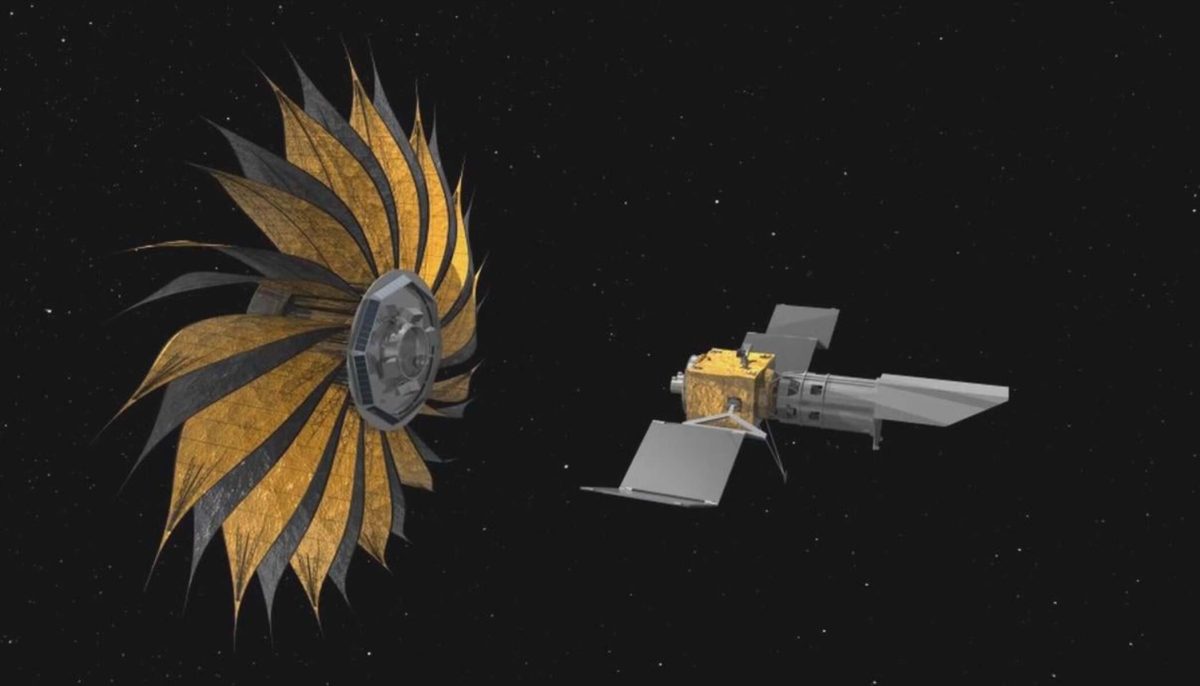
HOEE Hybrid Observatory
A ground-based telescope would capture the reflected light of an exoplanet while a space platform blocks the light of its parent star. The concept based on this arrangement is called the Hybrid Observatory for Earth-like Exoplanets, or HOEE.
For this purpose, the platform would be placed into an elliptical Earth orbit at a distance of about 175,000 kilometers. The screen itself would have 48 petals, each 24.5 meters long, and a central disk 50 meters in diameter.
For precise positioning within six meters, the platform would use microthrusters operating, most likely, on hot hydrogen. This would make it possible to keep the screen aligned between the ground-based telescope and the target star.
The Contrast Problem
In the optical range, the light of an exoplanet is approximately a billion times fainter than the radiation of its star. Existing instruments, including the near-infrared camera of the James Webb Space Telescope and the coronagraph of the future Roman telescope, are not capable of directly observing such objects.
According to Vladimir Airapetian, senior astrophysicist at NASA’s Goddard Space Flight Center, HOEE could block starlight before it even enters Earth’s atmosphere. This means that the adaptive optics of the ground-based telescope would receive already filtered light from the exoplanet.
The main partner considered for the project is the European Southern Observatory’s Extremely Large Telescope (ELT) in Chile. Its first scientific observations are scheduled for the end of 2030. In the future, the Thirty Meter Telescope and the Giant Magellan Telescope could also be incorporated into the system.
Hunting for Auroras
The scientific goal is not limited to simply detecting Earth-like planets. Airapetian wants to find active stars that frequently flare and produce auroras on rocky planets in systems of F-, G-, and K-type stars.
The researchers are interested in the spectral lines of red and green auroras. These would indicate the presence of nitrogen and oxygen in the atmosphere, meaning conditions in which primitive life or chemical processes preceding its emergence could be possible.
Sensitivity and Comparison
The sensitivity of the hybrid system is so high that an Earth-like planet could be detected within the first minute of observation. The study was published in the journal Nature Astronomy.
For comparison, traditional space-telescope concepts for direct imaging of exoplanets, such as HabEx and LUVOIR, were not given priority in the 2020 astrophysics decadal survey. HOEE effectively offers an alternative path at a much lower cost.
Funding and Cost
The team has already submitted an application for Phase B funding under the NASA Innovative Advanced Concepts program, Universe Today reports. A decision is expected by 2027.
According to Airapetian’s estimate, the total cost of the project would be about $1 billion. The final screen design would likely be inflatable so that the launch mass does not exceed 1,500 kilograms.