

Scientists have managed to track record-small pieces of “space debris” in the space around Earth. Their diameter is only 5 cm. Now they are considering how many such objects may actually exist in the space around us and what this could lead to.
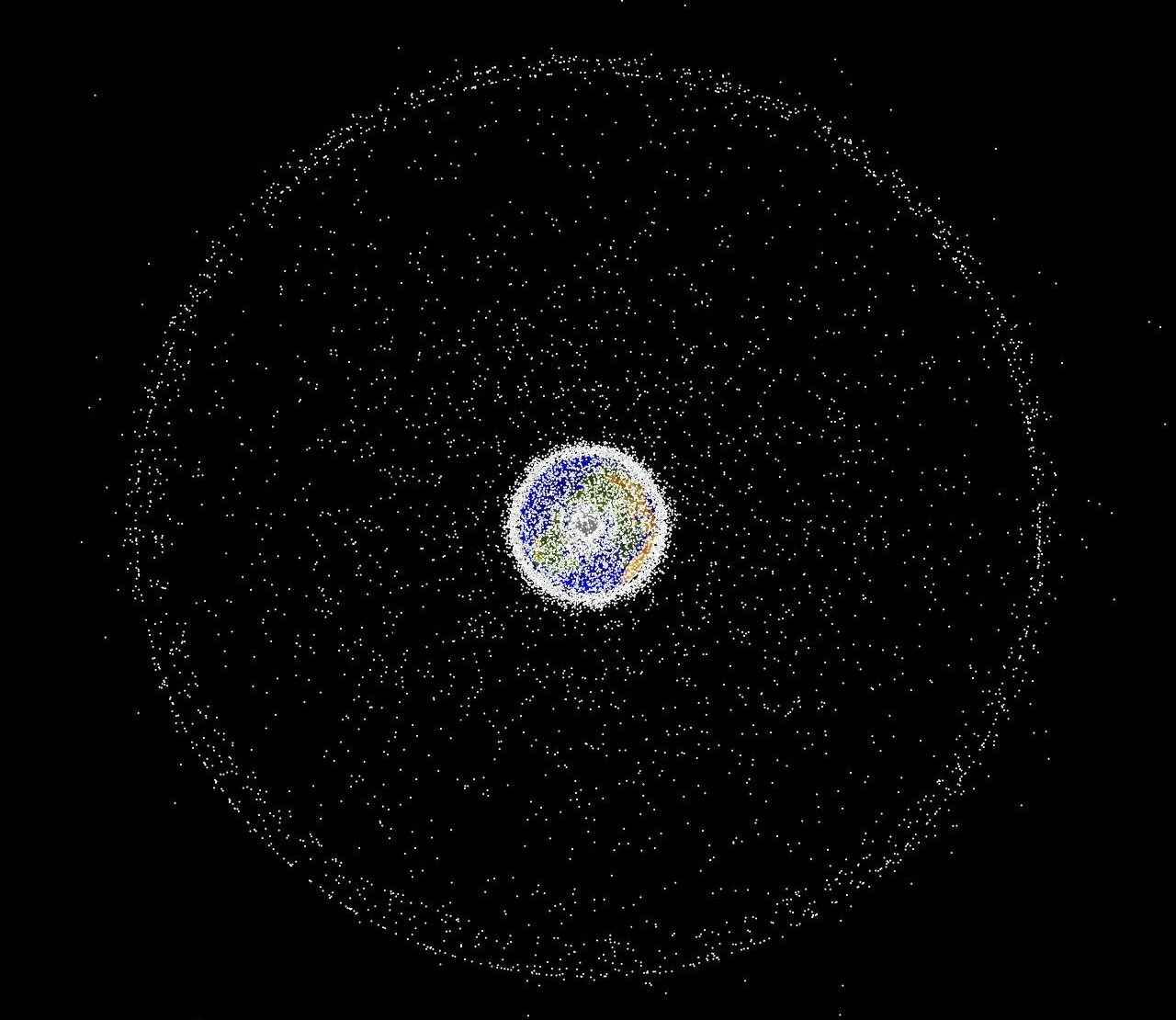
A “Minefield” of Debris in Geosynchronous Orbit
In a new study published in the Journal of the Astronautical Sciences, scientists from the University of Warwick led an international team that detected some of the faintest debris ever observed in geosynchronous orbit, finding fragments as small as 5 centimeters, or 2 inches, and obtaining valuable data to characterize their behavior. This was reported by phys.org.
“Space debris fragments can move very quickly relative to one another — at speeds of up to several kilometers per second,” explained the study’s lead author, Dr. James Blake, a research fellow at the University of Warwick’s Centre for Space Domain Awareness. “The energy involved is extremely high, and even small debris can cause significant damage to very expensive satellites, so even small objects matter a great deal.”
The geosynchronous orbit is located at an altitude of about 36,000 km above the Earth’s surface. Objects in such orbits make one revolution per sidereal day, i.e., synchronously with the rotation of our planet. A special case of this is the geostationary orbit – a circular orbit in the plane of the equator, in which the satellite appears stationary over one point on the Earth. This is where most communications, broadcasting, meteorological, and environmental satellites operate.
Debris in the geosynchronous orbit is a particular problem, researchers say. It lies far outside the atmosphere, so even the smallest fragments can remain in orbit for a very long time. In addition, due to the great distance from Earth, any debris is extremely faint, which makes it difficult to detect and track.
“Space debris in geosynchronous orbit is a potential minefield,” added co-author of the paper and space consultant Dr. Stuart Eves of SJE Space Ltd. “No sensible person would enter a terrestrial minefield without a mine detector. Likewise, no sensible person should launch a satellite into geosynchronous orbit without a proper survey for space debris.”
Detecting Faint Objects Using “Blind Stacking”
Studies of space debris in geostationary orbit, or GEO, usually focus on the region around the main orbit in order to search for drifting abandoned satellites and uncontrolled fragments. The team of scientists reanalyzed an archival dataset from a previous GEO space-debris survey carried out with the 2.54-meter, or 8.3-foot, Isaac Newton Telescope, or INT, on the island of La Palma in the Canary Islands.
By applying newly developed image-processing algorithms, the team was able to detect very faint objects, including some of the faintest debris ever found, and characterize their behavior by analyzing light curves. They found that many of the objects are tumbling in space.
To find these faint objects, the team used a “blind stacking” technique, which revealed 25 objects that had not been noticed during the original analysis. As Dr. Ben Cook, a research fellow at the University of Warwick, explains: “Blind stacking is a very powerful technique for pushing the sensitivity limit of astronomical datasets. It involves testing many potential trajectories in a sequence of images along which hidden objects may be moving, and stacking the images to bring those objects above the noise level. This project demonstrates a successful practical application of the method — any dataset containing objects moving linearly is suitable for its use.”
Most Objects Were Not Listed in Catalogs
Taking the new discoveries into account, almost 80% of the faint objects detected in this study had not previously been documented, meaning they do not appear in publicly available catalogs. This highlights the need for scientifically grounded surveys. The team now plans to expand the scope of its search using observational data from other telescopes around the world.
Professor Will Felin, senior principal scientist at the Defence Science and Technology Laboratory in the United Kingdom, said: “After carrying out the initial study, the team sought to expand its geographic coverage. This was achieved by using large telescopes in Australia and Japan in cooperation with the Australian National University and the Japan Aerospace Exploration Agency, or JAXA, which contributed their considerable technical expertise to the project. This truly underscores the importance of multinational cooperation in addressing global problems such as space-domain monitoring, as well as the benefits of using the United Kingdom’s world-class academic expertise for the benefit of UK defense.”
The researchers conclude that the number of orbital slots in the geostationary belt is limited, so it is important to know how much debris is there, how it behaves, and what risks it poses to operational satellites. Studies of faint debris help build a clearer picture of the situation.
