

What happens to a space rock when it falls through Earth’s atmosphere and becomes a meteorite? Researchers studied 75 meteorite falls recorded on video and in photographs and identified seven distinct stages in the journey from space rock to meteorite. Their results show that melting and fragmentation, rather than simply evaporation and “burning up,” determine how the rock loses mass, slows down, and ultimately reaches Earth.
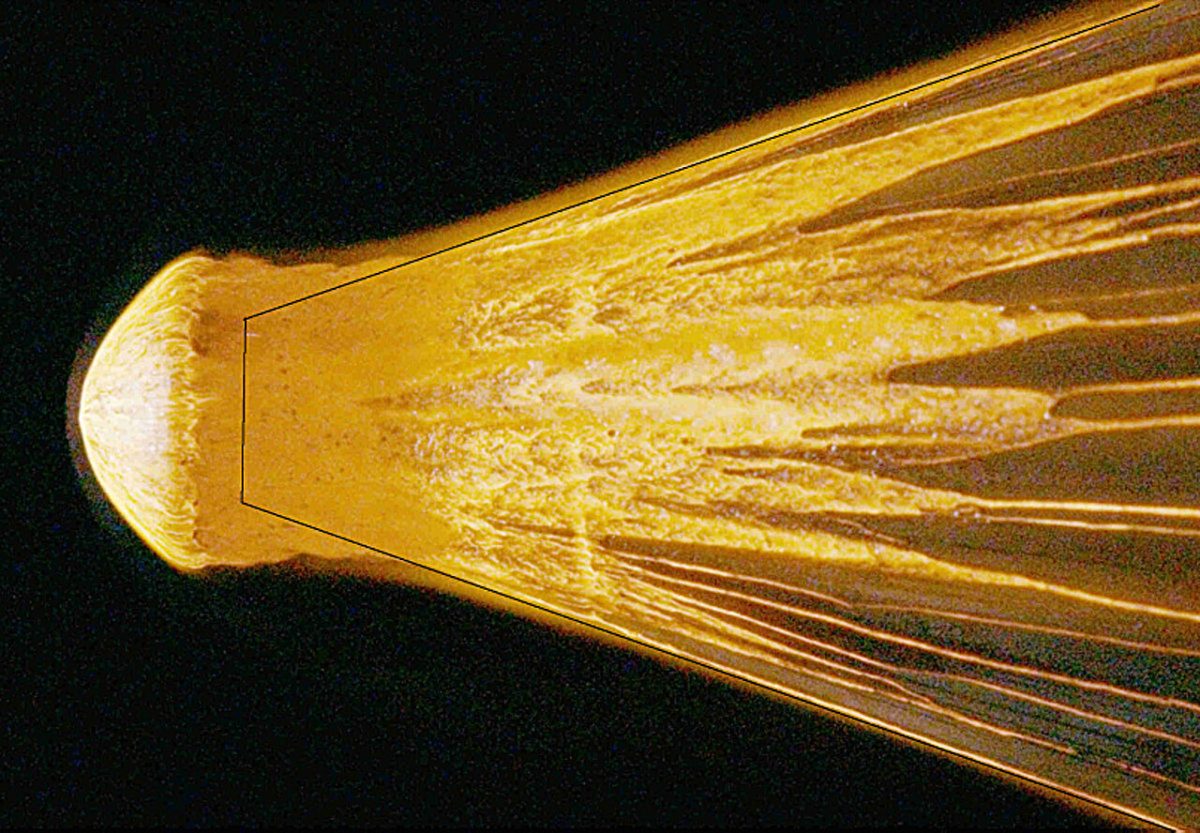
Seven Stages of Meteorite Formation
Scientists previously thought that solid rocks evaporated because of the enormous heat and bright light generated by collisions with the air. Instead, they found that melting first, followed by fragmentation, determines how the rock loses mass. The team determined that a fireball passes through seven stages as it travels through Earth’s atmosphere. Each stage is shaped by different physical processes. This is reported by phys.org.
Phase 1 begins high in the atmosphere, when the air becomes dense enough to create a shock wave in front of the falling rock. Collisions with air molecules heat the rock and the surrounding gas until they begin to glow. This is what we see as a meteor or “shooting star.”
As the rock falls into denser air, Phase 2 begins and the meteor becomes brighter. Some meteors show that the rock is spinning rapidly, with its brightness changing in a regular pattern. The fastest-rotating rocks in the study completed one full rotation every 0.5–5 seconds.
During Phase 3, the meteor becomes much brighter and turns into a fireball. The researchers found that melting now causes most of the rock’s mass loss. The fast airflow strips molten material from the surface, leaving droplets that continue to evaporate.
At an altitude of about 60 kilometers (around 40 miles) above Earth, the fireball reaches Phase 4, establishing a melting equilibrium. Its brightness remains constant or increases steadily. The rock may eventually lose up to 40% of its mass through melting alone.
Breaking Apart on the Way Down
Deeper in the atmosphere, higher pressure causes the rock to break apart, beginning Phase 5. The fireball may flare several times as pieces break off.
The researchers found that rocks begin to fragment when the air pressure in front of the rock reaches only about one-fifth of the strength measured in meteorites recovered on Earth. They believe that heat and fractures caused by earlier collisions in space may explain why the rocks break apart sooner than expected.
Only at this point does the remaining rock rapidly shrink and slow down significantly, even faster if the fragmentation is particularly violent. “We were able to connect this deceleration caused by fragmentation with earlier mathematical descriptions based on ablation,” said study co-author Stu Pilorz of the SETI Institute.
If the rear portion of the main rock remains intact, it creates a low-pressure region behind it that pulls smaller fragments along.
When the back of the rock finally breaks apart during Phase 6, the fireball produces one last bright flare and ejects fragments even more rapidly. Because the rock has already slowed down, these late flashes are usually red rather than the bright green seen earlier.
Reaching Earth
“The final breakup sends fragments out at higher relative velocities,” said lead author Peter Jenniskens of the SETI Institute and NASA’s Ames Research Center. “In previous falls, we noticed that meteorites weighing more than 20 grams were often scattered over a wider area, and many of them came from the near-surface part of the original space rock, which was probably its rear side.”
Meteorites that reach the ground began as larger pieces, but they underwent more intense melting and continued to fragment before slowing enough to land.
During Phase 7, melting and fragmentation continue until the final pieces slow down enough to stop glowing. Melting ends, leaving a thin fusion crust on their surfaces. Winds can then blow the darkened fragments off course as they complete their fall to the ground as meteorites.
Large Rocks That Explode in the Atmosphere
Among the 75 meteorite falls studied were several different types of meteorites. The researchers determined the altitudes at which these different materials passed through the seven phases.
By studying the atmospheric deceleration of small, solid space rocks of different types, the researchers also gained insight into what happens to more dangerous airburst asteroids ranging in size from cars to city blocks.
“Asteroids up to tens of meters across are also solid rocks because they tend to rotate faster than large rubble-pile asteroids,” Jenniskens said. “The 20-meter-wide asteroid that caused the airburst over Chelyabinsk, Russia, in 2013 passed through the same phases.”
