
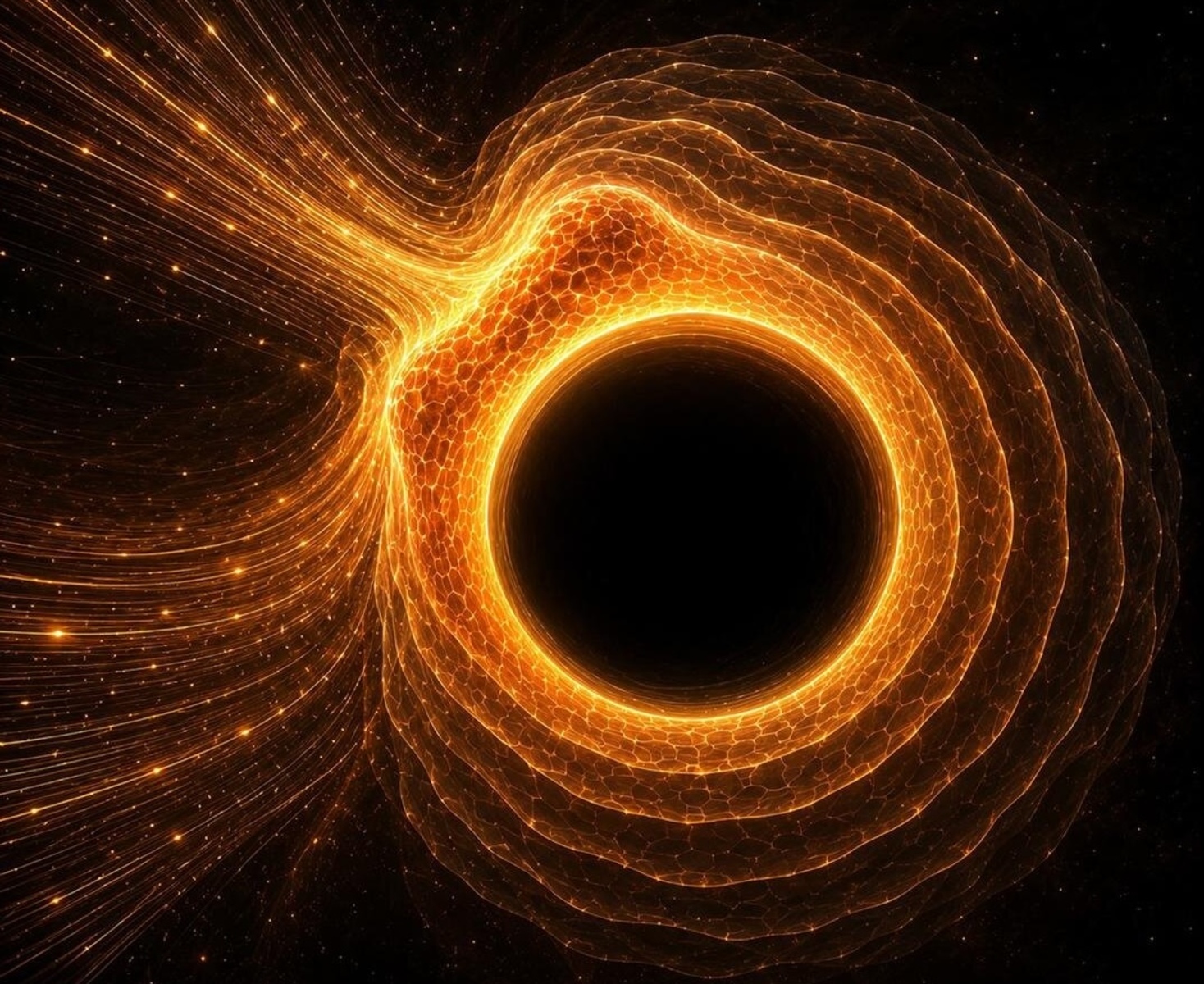
Black holes constantly change throughout their existence. A team of physicists led by Abhay Ashtekar of Pennsylvania State University has proposed an alternative way to define entropy for such dynamic objects. The new measure is more closely connected to a black hole’s spin and energy.
Parallels with Thermodynamics
Scientist Stephen Hawking and other physicists in the 1970s discovered parallels between the laws of thermodynamics for ordinary systems and the mechanics of black holes. They showed that the area of the event horizon is proportional to entropy, while temperature is inversely proportional to a combination of mass and spin.
These relationships became the dominant paradigm for half a century. However, they were formulated for stationary black holes that are in equilibrium and do not change over time. In reality, black holes are constantly undergoing change: they form, merge, and eventually evaporate.
The Teleological Nature of the Event Horizon
The event horizon has a teleological nature. Its properties are not determined by local physics at a specific moment, but depend on events that may or may not occur in the future.
For example, an event horizon can form and grow in flat regions of spacetime where nothing is happening at all. It is because of this feature that the area of the event horizon may inadequately describe entropy black holes, which was one of the motivations for the new study.
Dynamical Horizons as an Alternative
The researchers propose using so-called dynamical horizons instead of the concept of the event horizon. Unlike an event horizon, a dynamical horizon is characterized solely by the properties of a black hole at a given moment in time and does not have the teleological problem.
Such horizons are already used in numerical simulations. The results of the study were published in the peer-reviewed journal Physical Review Letters and on the arXiv server. The new measure of entropy makes it possible to overcome the limitations of a paradigm that has been used for more than half a century.
The proposed approach allows the first and second laws of thermodynamics to be extended to black holes that are far from equilibrium. As the authors note, this makes it possible to apply generalized laws to better understand the dynamic processes black holes undergo.
These include evaporation in quantum theory and mergers similar to those detected by the LIGO-Virgo-KAGRA collaboration using gravitational waves, phys.org reports. The authors of the paper are Abhay Ashtekar, Daniel Paraizo, and Jonathan Shu.
