

Galaxy LEDA 1313424 is located 551 million light-years away from us. Because of its shape, it is known as the “Bullseye.” Recently, scientists were able to explain the origin of its concentric rings, which resemble ripples from a stone thrown into water. The culprit turned out to be dark matter.
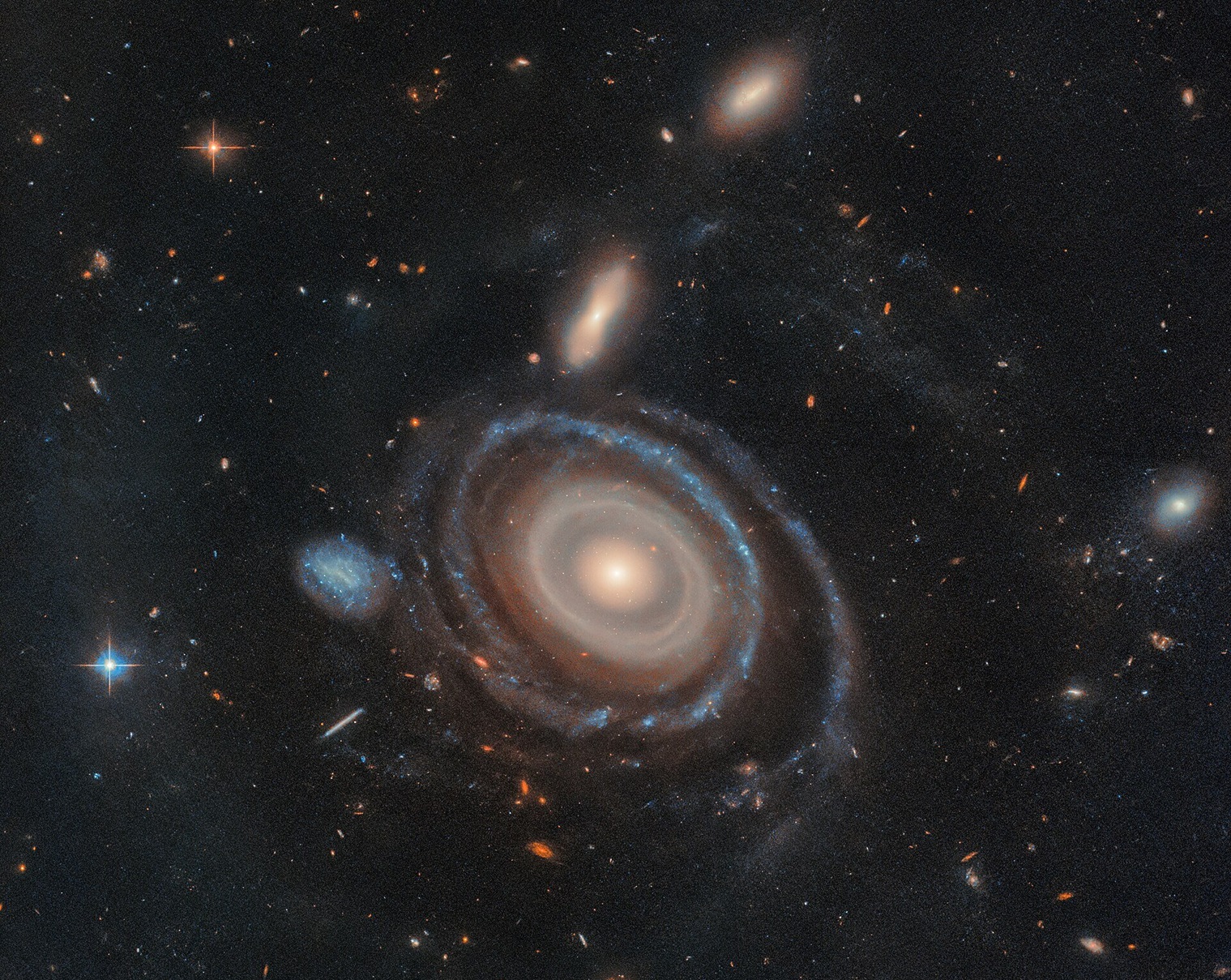
The Mystery of the Rings of the “Bullseye” Galaxy
In 1941, astronomers discovered a galaxy that appeared to be surrounded by a luminous ring, but they could not explain why. Named the “Cartwheel” galaxy, this pioneering object eventually paved the way for numerous discoveries of ring galaxies in the following decades — most often with one ring, and some with two or three.
To explain this unusual phenomenon, astronomers proposed that such rings appear when a smaller galaxy strikes directly through the center of a larger one, creating density waves that spread outward. But in 2025, astronomers led by Imad Pasha of Yale University discovered something even stranger: a galaxy surrounded by nine concentric rings. Soon afterward, this remarkable structure became known as the “Bullseye.”
After the discovery, astronomers suggested that the rings formed as a result of a particularly energetic collision with LEDA about 56 million years ago. But when Sikivie and Zhao examined this interpretation, they found a problem. If the theory were correct, the outer ring would have had to move outward from the galaxy’s center at a speed of 1,220 kilometers per second, or 758 miles per second — an extremely high speed, given the presumed nature of the collision and the known behavior of galactic material.
The Influence of Dark Matter on the Formation of Galactic Rings
As an alternative explanation, the duo suggests that the rings of the “Bullseye” galaxy may have formed because of the properties of dark matter — a substance believed to make up about 85% of the total mass of the universe, yet one that researchers still cannot detect directly.
Based on observations of gravitational motions in galaxies, astronomers have concluded that dark matter accumulates in spherical halos surrounding many stellar systems. However, in his earlier studies, Sikivie argued that deeper conclusions could be drawn by assuming the validity of one of the leading theories about the nature of dark matter — the one involving hypothetical particles called axions, which interact only very weakly with ordinary matter.
If dark matter exists in this form, Sikivie argued, it must still obey the conservation of angular momentum. When axions interact with galaxies, the innermost parts of the dark matter halo form structures known as caustic rings. “We had previously proposed that disk galaxies have caustic rings of dark matter with a specific regular pattern of ring radii, very similar to the pattern of ring radii observed in LEDA 1313424,” Sikivie explains.
Developing this idea further, “we fitted the observed ring radii to the pattern of ring radii in the caustic-ring interpretation and argued that the rings of LEDA are an imprint of dark matter caustic rings on the baryonic matter in LEDA’s disk,” he continues.
Quantum States of Dark Matter
Another element of the theory concerns the quantum nature of axions. When a low-density gas of bosons is cooled to near absolute zero, a large fraction of its particles can enter their lowest quantum state — something that is impossible in a more energetically excited system.
When particles collectively occupy the same quantum state, their identical quantum properties manifest on a macroscopic level, forming a Bose-Einstein condensate. Under such conditions, axions could interact with detectable baryonic matter in precisely the way astronomers observe.
Thus, ring galaxies, including LEDA, may not necessarily be the result of collisions, as is commonly believed. Instead, they could be a manifestation of Bose-Einstein condensation of dark-matter axions.
For now, axions remain extremely elusive, avoiding direct detection despite decades of searches. As a result, the theory proposed by Sikivie and Zhao cannot yet be confirmed directly. However, if it is correct, it could offer a far more plausible explanation for one of the strangest recent observations in astronomy — and one of the clearest insights into the quantum nature of dark matter.
According to phys.org
