

Comet 10P/Tempel 2 is currently approaching Earth. On August 3, it is expected to pass at a distance of 62 million kilometers from our planet. This proximity will not have any impact on Earth; however, the event presents an intriguing opportunity for observation. Therefore, what is known about this celestial body?
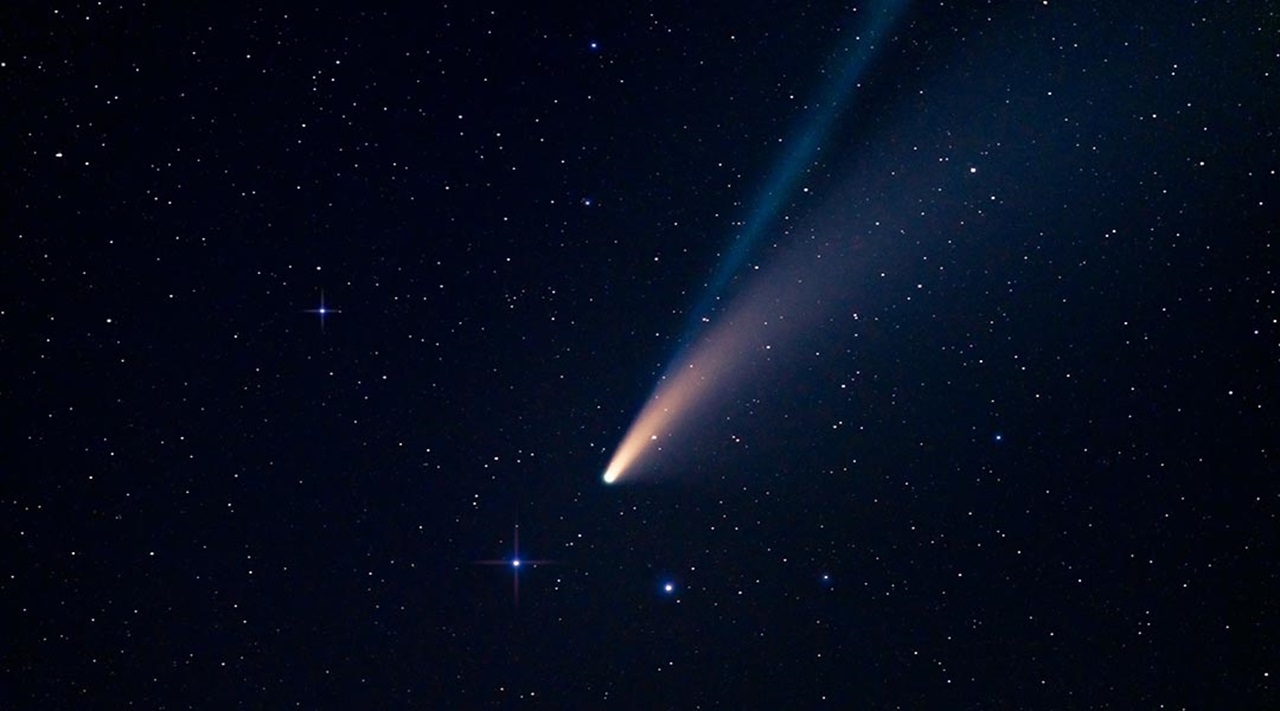
Comet Tempel 2
On August 3, 2026, Comet 10P/Tempel 2 will approach Earth at its nearest proximity in the past century. Some media outlets have reported that, at that time, the comet will be merely 62,000 km from our planet. Although this information might suggest a possible threat to Earth, such reports are, in fact, inaccurate.
During its closest approach in early August, Comet Tempel 2 will be approximately 62 million kilometers from Earth. This distance is indeed considerable, constituting approximately 40% of the distance between Earth and the Sun.
In general, astronomers have not regarded Comet 10P/Tempel 2 as a potential threat to Earth. When Wilhelm Tempel, who was conducting research in Milan, discovered it in 1873, he was able to ascertain its trajectory with relative promptness and concluded that it was a short-period comet classified within the so-called Jupiter family.
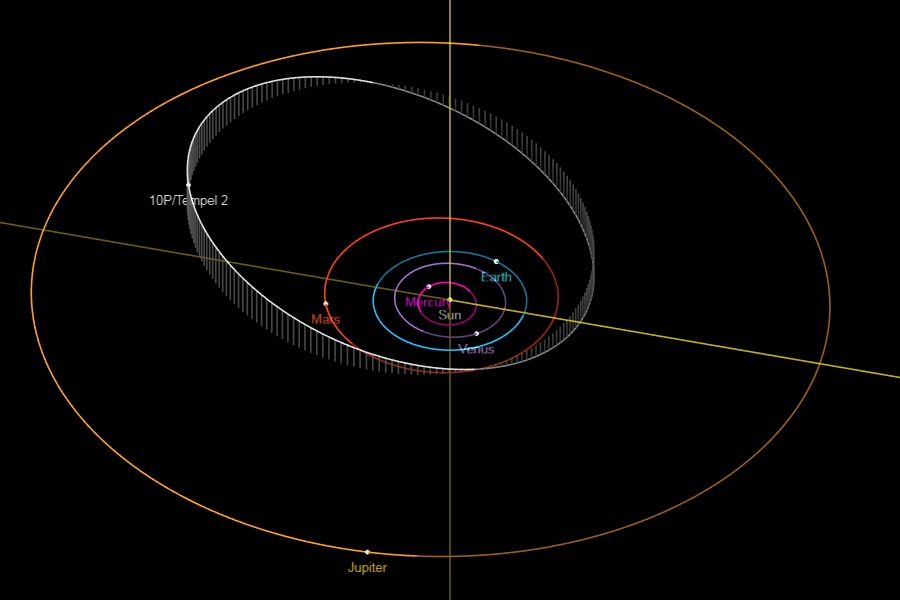
The orbital period of Comet 10P/Tempel 2 is 5.16 years. Its aphelion, which is the point in its orbit farthest from the Sun, is situated at a distance of 4.715 astronomical units (AU), corresponding to the outer region of the main asteroid belt. The perihelion, representing the point closest to the Sun within its orbit, is measured at 1.424 AU from the star.
This indicates that, in actuality, this comet neither intersects Earth’s orbit nor approaches it closely. Consequently, despite the comet having a diameter of 10.6 km and possessing the potential to inflict damage comparable to that of the Chicxulub asteroid — widely regarded as the cause of the dinosaurs’ extinction — it is not considered hazardous.
The period of rotation of comet 10P/Tempel 2 around the Sun is about 5.4 years. At aphelion, it moves away from the Sun by about 4.7 AU, almost to the orbit of Jupiter, and at perihelion it approaches it by 1.42 AU.
Thus, the orbit of the comet passes completely outside the Earth’s orbit and does not intersect it. That is why 10P/Tempel 2 has never been considered a potentially dangerous object, despite the fact that its nucleus has a diameter of about 10.6 km. A hypothetical collision of such a body with the Earth could cause a global catastrophe, comparable in scale to the consequences of the fall of the Chicxulub asteroid, which is believed to be the cause of the extinction of the dinosaurs. However, orbit calculations do not give grounds to consider such a scenario realistic.
Guidelines on observing Comet Tempel 2
Generally speaking, by comet standards, 10P/Tempel 2 has a relatively non-elongated orbit; it never comes very close to the Sun and never actually strays very far from it. Consequently, its cometary activity is relatively moderate and stable.
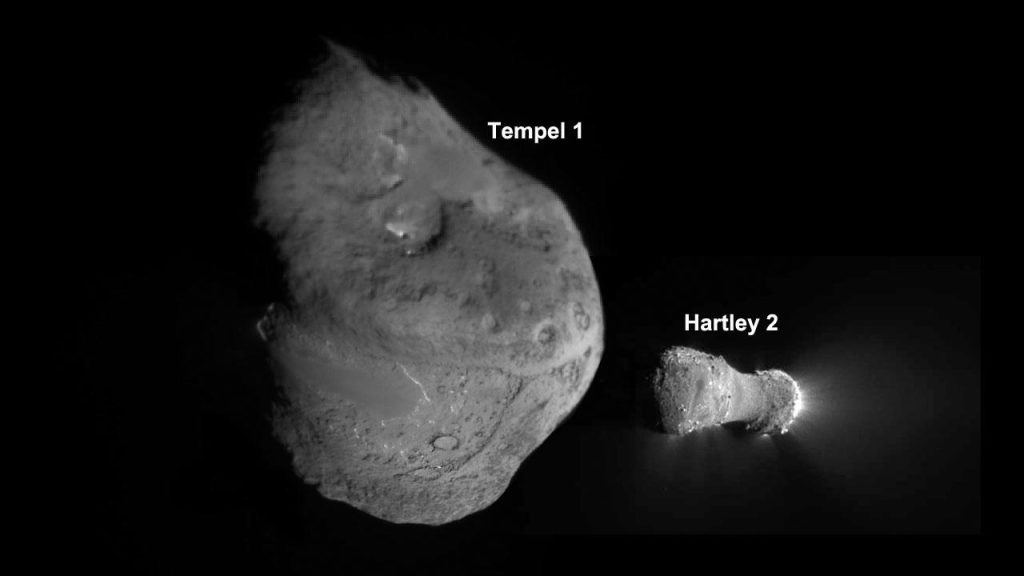
However, this means that even near perihelion, its brightness remains too low to be visible to the naked eye. The record was set in 1925, when 10P/Tempel 2 approached Earth to a distance of 52.4 million km. At that time, its magnitude reached 6.5m, but even that was not enough for the comet to be visible without optical instruments.
Although the comet reaches perihelion approximately every 5 to 6 years, this does not necessarily imply that it is frequently sufficiently luminous to be observable. Typically, during such periods, our planet occupies a different position within its orbital path.
However, in 2026, we shall be fortunate, and with the aid of binoculars or a compact telescope, we shall be able to observe this comet adequately. In early June, 10P/Tempel 2 was situated in the constellation Aquarius and exhibited a brightness of approximately magnitude 11. Nevertheless, on July 9, it transitioned into the constellation Capricorn and will remain there until the commencement of the subsequent month.
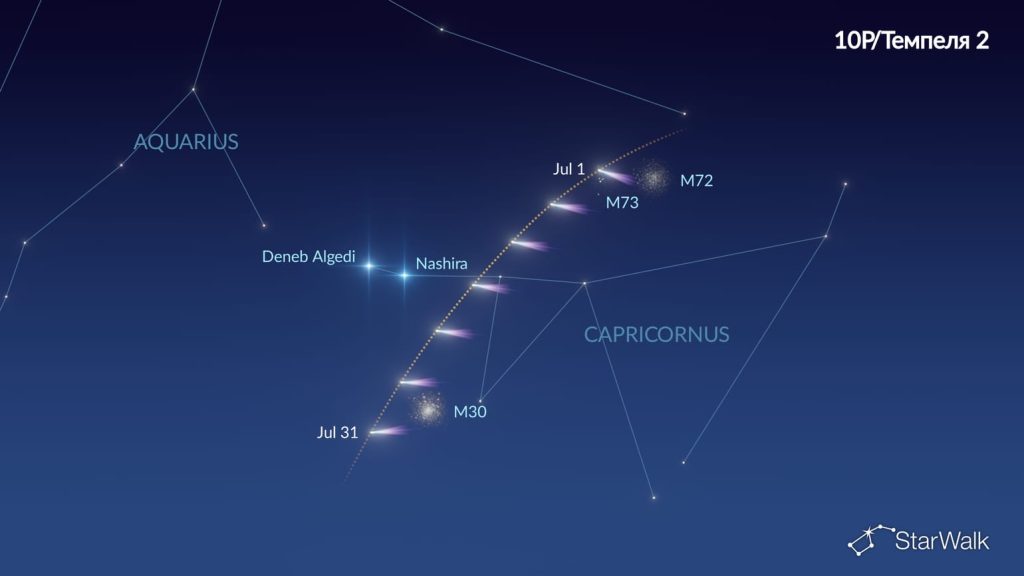
The comet currently exhibits an apparent magnitude of approximately 10m. The optimal period for observation is projected to be between July 10 and 16, coinciding with the new moon on the 14th, which will not contribute illumination to the sky. On July 29, the comet will approach within 0.5° of the globular cluster M30. Nevertheless, the observational conditions for this event will be suboptimal due to the presence of a full moon, resulting in significant moonlight interference.
For optimal observation of 10P/Tempel 2, it is advisable to observe the night sky during the middle of the night from a location with minimal light pollution. This period is considered the most suitable for viewing the constellation Capricorn, where the comet will be situated, as it attains its highest position above the horizon.
Nevertheless, for inhabitants of the Northern Hemisphere, the constellation Capricornus will remain situated very low on the southern horizon. Consequently, it is advisable to observe it from an unobstructed vantage point with a clear view towards the south. This article delineates the procedures for achieving such an observation.

Residents of the Southern Hemisphere will find it significantly easier to observe the comet, as that region of the night sky will remain well above the horizon.
Perihelion and the closest approach to Earth
On August 2, while remaining within the constellation Capricorn, 10P/Tempel 2 will reach perihelion. Observers monitoring the comet nightly in the days preceding this event will be able to observe a gradual change in the direction of its tail.
On August 3, the comet will enter the constellation Piscis Austrinus and reach its closest approach to Earth. It is difficult to predict how bright it will be at that time, because gas emissions during its closest approach to the Sun are unpredictable. Approximately 7–8m. This means that even on that day, it will not be possible to see Comet Tempel 2 with the naked eye. However, for those with binoculars or a small telescope, it could be an interesting object to observe, although, again, the Moon will still be quite bright on August 3.
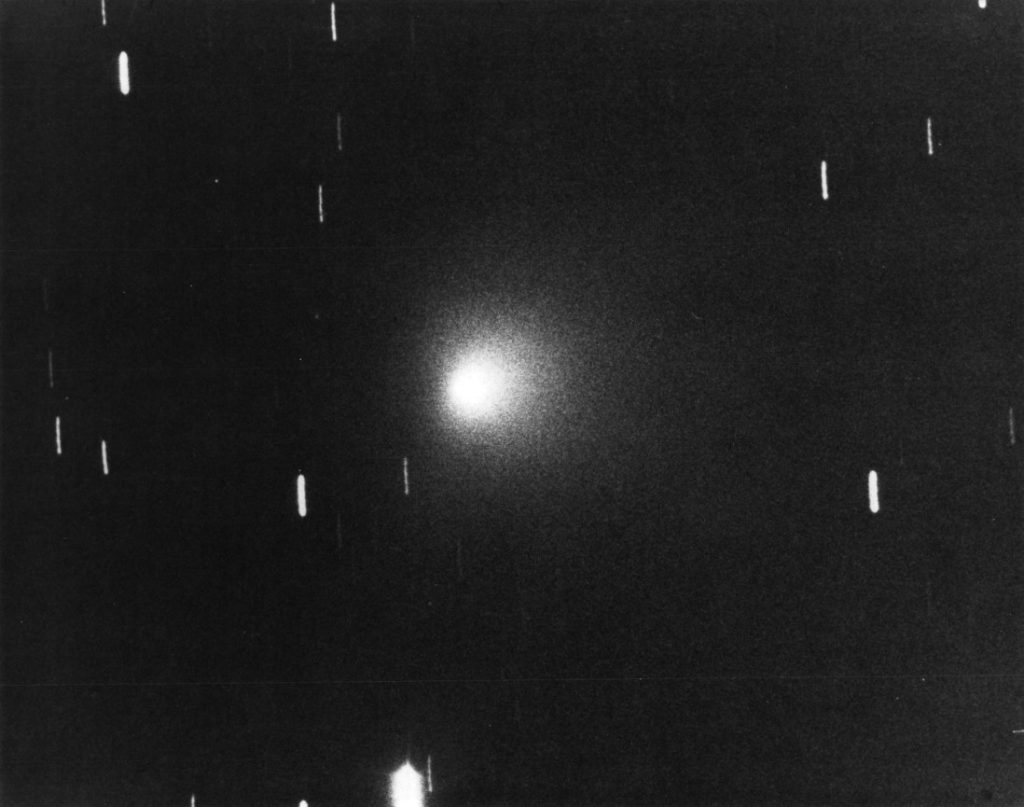
Observation conditions are expected to improve considerably on August 12, coinciding with the return of the new moon. Nevertheless, until that date, observers situated in the Northern Hemisphere will find the comet either too low above the horizon or entirely obscured by it. The comet will remain within the constellation Piscis Austrinus until October 19. On October 12, it will pass in close proximity to Fomalhaut, the brightest star within this constellation. However, by that time, its luminosity will have diminished to the extent that only observers equipped with small telescopes will be able to detect it.
