

The idea of warming Mars with artificial particles in the atmosphere appears controllable only as long as water is left out of the calculation. Once polar ice and clouds are added to the model, the picture changes. Warming begins quickly, while the water cycle takes decades to reorganize. In some places, the clouds do not warm the surface at all but cool it during the day.
Ten Times More Water Vapor
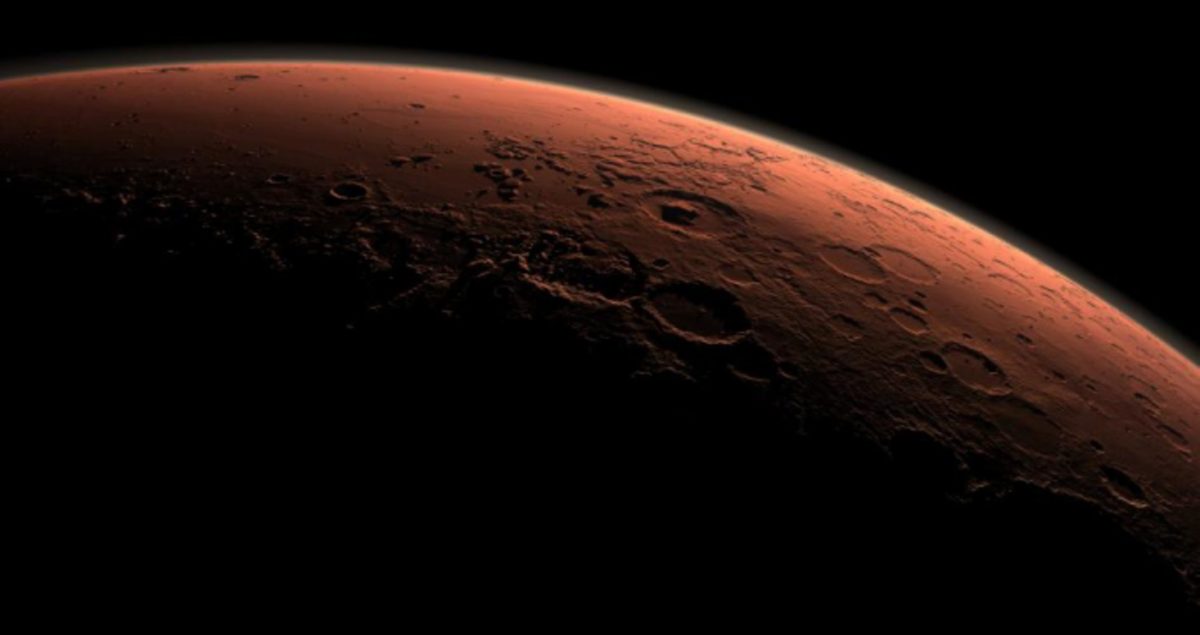
Every 20 degrees of global warming produces approximately a tenfold increase in the amount of water vapor in the atmosphere during the first two Martian years. Ashwin Braude, Edwin Kite, and their co-authors obtained this result using the three-dimensional MarsWRF climate model and published the calculations as a preprint on arXiv, whose conclusions have not yet undergone formal peer review. The source of the vapor is the sublimation of water ice from the edge of the northern polar cap.
The concentration of the engineered particles themselves reaches equilibrium in less than three Martian years because settling balances the continuous release. Water behaves differently. Vapor and cloud cover continue increasing for decades after the aerosol has stabilized.
Warmer Nights, Colder Winter Days
The additional vapor itself contributes almost nothing as a greenhouse gas. Its direct contribution to the global mean temperature is less than 0.1 degrees. The main effect appears only after the vapor condenses into water-ice clouds.
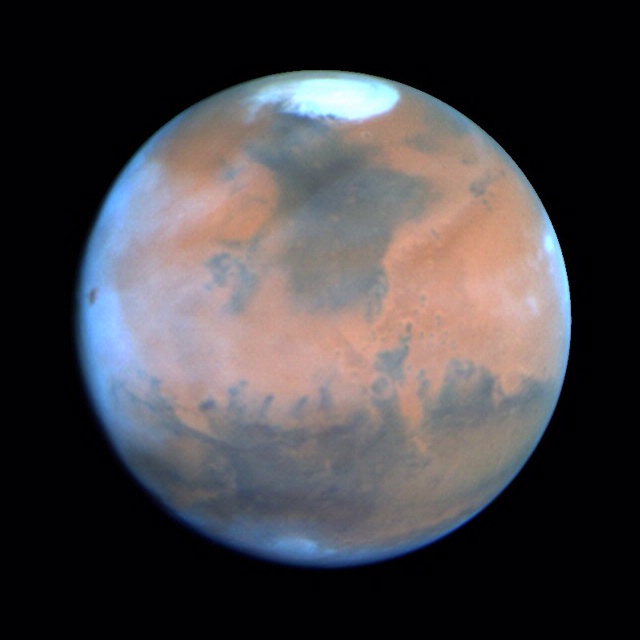
At night, a cloud layer more than 10 kilometers above the surface redirects infrared radiation back toward the ground. The preprint abstract reports nighttime warming at low latitudes of approximately 5 to 10 degrees. During the day, the sign of the effect reverses.
At winter mid-latitudes, dense clouds reflect enough sunlight to lower the surface temperature by 40 degrees compared with the same model in which their radiative effect is disabled. In the Hellas Basin, the winter daily temperature range shrinks to no more than five degrees. This is not a prediction of global cooling, but the difference between two versions of the same warmed planet in a specific region and season.
In summer, the same cloud cover in Hellas can extend the period during which the daily average temperature remains above the freezing point of water, according to SpaceDaily.
Redistribution of Ice Toward the South Pole
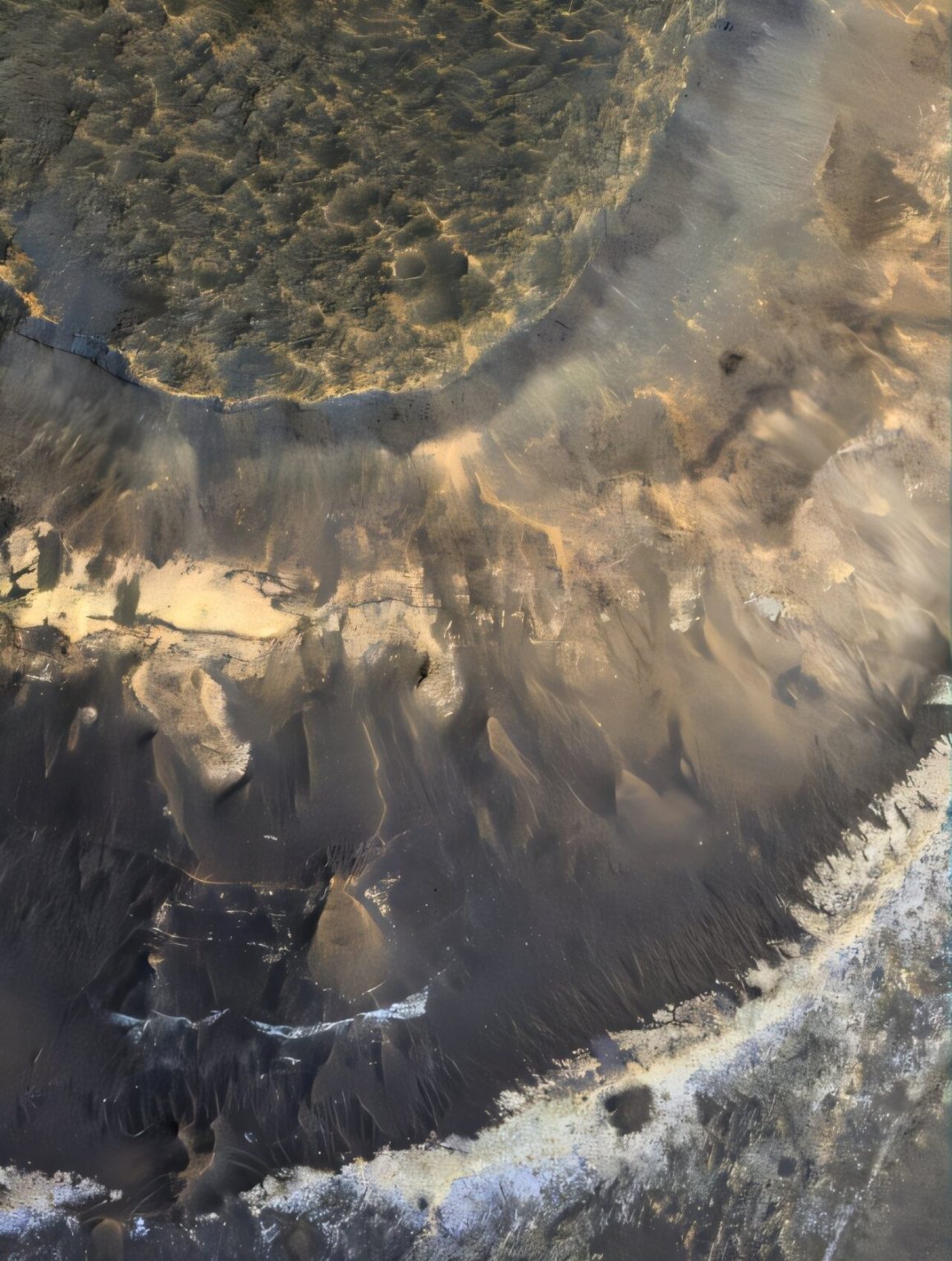
Over the course of a Martian year, between 15 and 20 gigatons of ice sublimate from the belt near the edge of the northern cap. The net transfer between hemispheres is smaller, amounting to 5 to 10 gigatons, but this is enough to form a new perennial water-ice cap around the south pole.
Twenty gigatons of water ice corresponds to approximately 20 cubic kilometers, which is more than five times the total volume of the Kyiv Reservoir, at 3.7 cubic kilometers.
The seasonal transport mechanism itself also changes. The southern deposit begins releasing vapor during the local summer, while winter cloud cover causes frost to settle at lower latitudes.
Inertia of the Water System
When particle release stops, their concentration declines with a characteristic timescale of about 0.6 Martian years. Their direct contribution to warming disappears over the next four seasonal cycles of the planet.
The water system returns to its previous state much more slowly. Winter cooling at mid-latitudes of more than 20 degrees persists for another 15 Martian years after the release stops, while the altered ice distribution keeps the atmosphere wetter than it was initially.
Limits of the Calculation Itself
The model does not account for interactions between the engineered aerosol and natural dust or cloud formation, and the radius of all cloud particles is fixed at five micrometers.
The dry deposition rate of small particles under Martian conditions is poorly measured, and doubling it reduces the warming from the same material flux by half.
A 2014 calculation for Mars with a large axial tilt also produced more vapor and clouds after warming the poles, but in some winter regions it predicted strong warming where the new study finds cooling.
The authors of the preprint explicitly state that much more data on Martian weather and on the microphysics of candidate materials will be needed before warming Mars can be considered feasible at all.
