

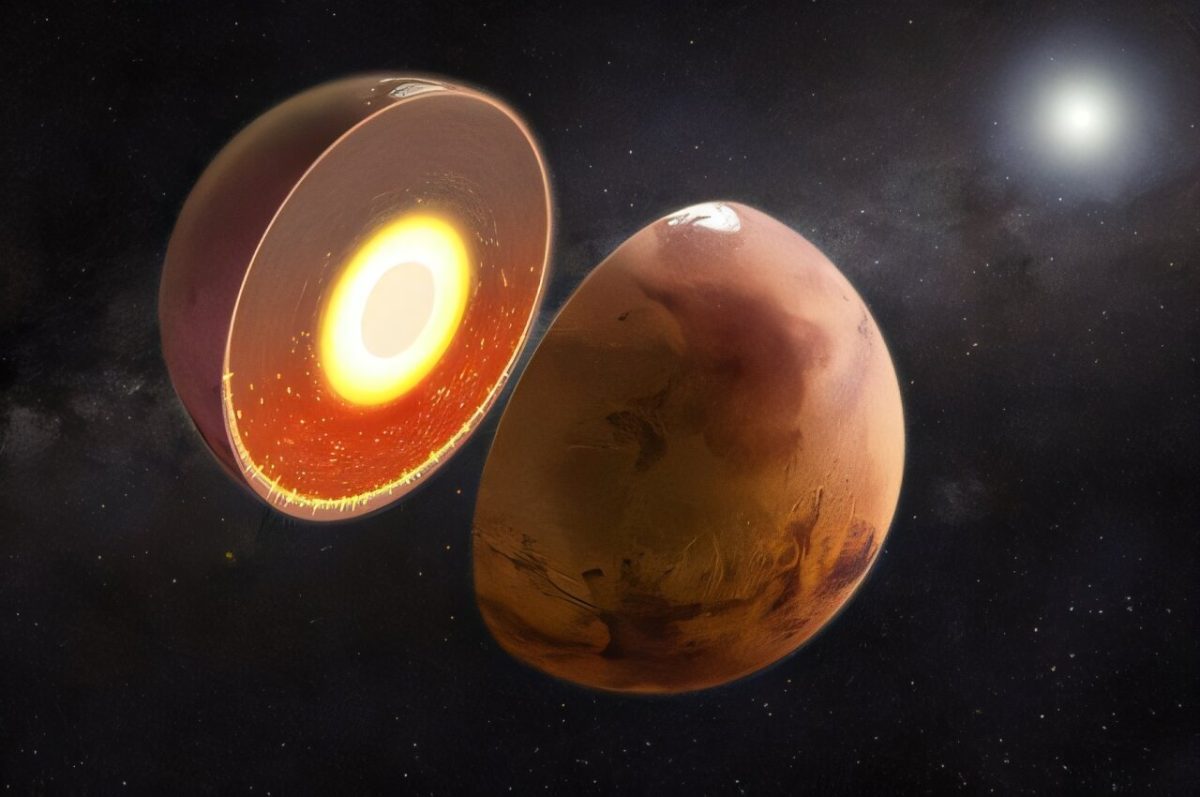
It is believed that molten magma disappeared from the depths of Mars hundreds of millions of years ago. However, scientists have recently detected a thermal anomaly that may indicate that processes deep inside the Red Planet have not completely stopped.
Studying the Planet’s Gravitational Signatures
Researchers have detected a thermal asymmetry deep beneath the surface in the southern hemisphere of Mars. Based on gravitational measurements that provide clues about the internal structure of the Red Planet, its southern part is approximately 200–400°C warmer than its northern half and is partially molten. This unexpected discovery, described by phys.org, adds context to the history of Mars and to the periods when conditions favorable for life may have existed there. The study was conducted by California Institute of Technology graduate Alexander Byrne, who is now a postdoctoral researcher at the University of Arizona.
During his graduate studies at the California Institute of Technology, Byrne developed a model that uses variations in gravitational data to determine the structure of a planet’s interior. Byrne and his colleagues then set out to apply this model to study the internal structure of Mars. Using data collected over decades by three different Mars missions — Mars Global Surveyor, Mars Odyssey, and Mars Reconnaissance Orbiter — the team measured tiny changes in spacecraft velocities and used them to reconstruct the gravitational field around Mars.
The gravitational forces exerted by the Sun on Mars vary with the seasons because of Mars’s slightly elliptical orbit and tilted rotational axis. A technique called tidal tomography measures how these gravitational signatures change over time and creates a model of the planet’s internal structure.
Byrne says that if we obtain more gravitational data, we can determine three-dimensional details of the planet’s internal structure. These findings, in turn, provide a blueprint for designing future missions and scientific studies of these worlds. Understanding the internal structure of planetary bodies helps us uncover the processes that shaped their formation and evolution.
Mars’s Hotter Southern Hemisphere
At the surface, Mars is a geologically asymmetric planet: its southern hemisphere has enormous mountains and deep craters, while the northern hemisphere consists of low-lying plains. In the new study, the team was surprised to discover that the interior of Mars is also thermally asymmetric — the southern hemisphere is hundreds of degrees hotter than the northern one.
The new observation also offers an explanation for other phenomena observed on Mars, such as magnetic anomalies found in iron-bearing minerals in the south. The thermal anomaly in the southern mantle may indicate that a magnetic field once existed that was strong enough to create magnetic differences between the north and south. In addition, NASA’s InSight mission previously found that seismic waves scatter more rapidly in the south, which could be explained if this region were hotter.
“The dichotomy we see between the north and south is important to understand because it provides information about processes that may have influenced the hydrology of Mars, including the formation of basins that may have contained water,” says Amirhossein Bagheri, a postdoctoral researcher at the California Institute of Technology and a co-author of the paper. Bagheri was also previously a member of the InSight team.
It is still unknown what caused the thermal anomaly. Several hypotheses have been proposed regarding its origin, including a giant impact that released heat from the north, past spontaneous convection in Mars’s southern mantle, and thick geological structures that trap excess heat and prevent it from escaping.
