

For an extended period, scientists held the belief that Mars’s crust possessed a very simple structure, due to the absence of tectonic plate movement on the planet, and consequently, no renewal of the crust via liquid magma. However, current research indicates that the planet has historically hosted — and may still host — a well-developed system of magma reservoirs, which impacts the structural composition of the crust.
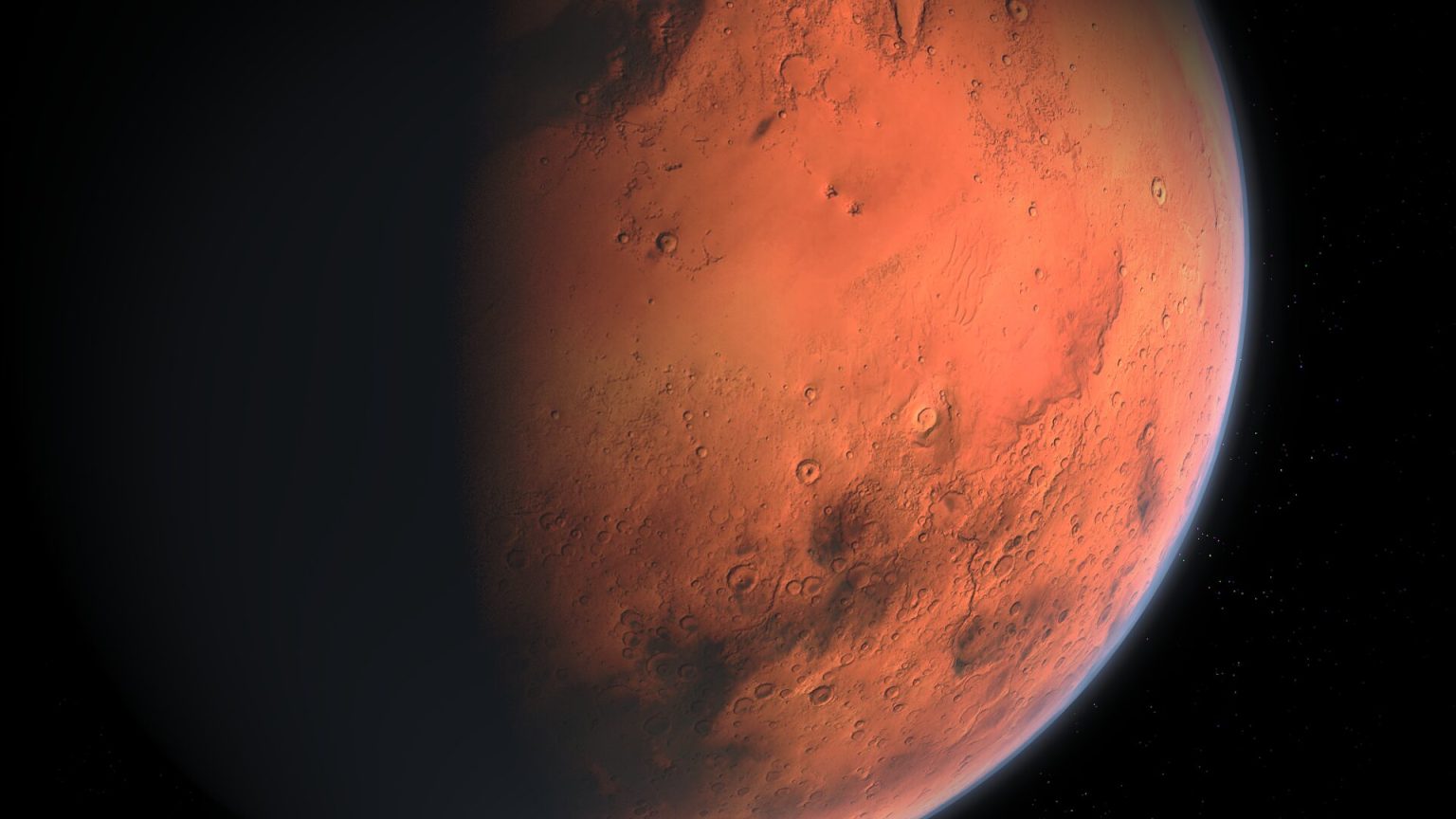
The crust of Mars and its internal structure
Researchers from the University of Oxford have published an article in Nature Astronomy, asserting that the depths of Mars may indeed be significantly more geologically active than previously assumed. Alternatively, it is plausible that reservoirs of liquid magma existed there for a sufficiently extended period.
Mars is generally regarded as a planet that is geologically inactive. Unlike Earth, its crust neither consists of distinct tectonic plates nor has it ever been divided into separate blocks. Consequently, although volcanic activity persisted on this planet for at least the initial billion years of its existence, it differed significantly from the volcanic phenomena observed on Earth.
In particular, Mars has never experienced crustal renewal through the melting of ancient sections in subduction zones and the formation of new ones along mid-ocean ridges, a process that occurs continually on Earth. Consequently, scientists have posited that the planet’s crust possesses a remarkably simple structure — the same as it was upon its initial formation from primordial magma.
Magma reservoirs
Scientists, citing data from NASA’s InSight lander — which has been operational on the Martian surface since 2018 — have disclosed new and intriguing findings. Specifically, they have identified a modification in the characteristics of Mars’ crust at a depth of approximately 24 kilometers. This conclusion was reached through the analysis of seismic vibrations recorded by the lander’s seismometer as they traveled through the planet’s interior.
Scientists attribute this phenomenon to the fact that above the 24-kilometer mark, the rocks are chemically typical (mafic), whereas below this threshold, the rocks exhibit higher concentrations of iron and manganese and lower silicon content (referred to as “ultramafic” rocks). This composition closely resembles what is observed on Earth. However, it raises the question: how could such a crustal structure have developed without any tectonic plate movement on Mars?
The authors of the article assert that the requisite condition for this phenomenon is the presence of substantial reservoirs of liquid magma situated in proximity to the crust. This phenomenon is observed on Earth beneath volcanic arcs. Although on Mars, we are most likely talking about large underground reservoirs of heat, rather than an ocean of liquid magma. It could be a thin, heterogeneous zone with a small percentage of melt. While this hypothesis could elucidate numerous aspects of Mars, it simultaneously prompts further, more comprehensive questions.
This discovery reaffirms the inquiry among scientists regarding the timeline of liquid magma’s disappearance from Mars. It is conceivable that magma persisted deep within the planet as recently as a few hundred million years prior. Moreover, it is possible that magma remains stored beneath the surface, implying that the planet may not be entirely geologically inactive.
Provided by: phys.org
