

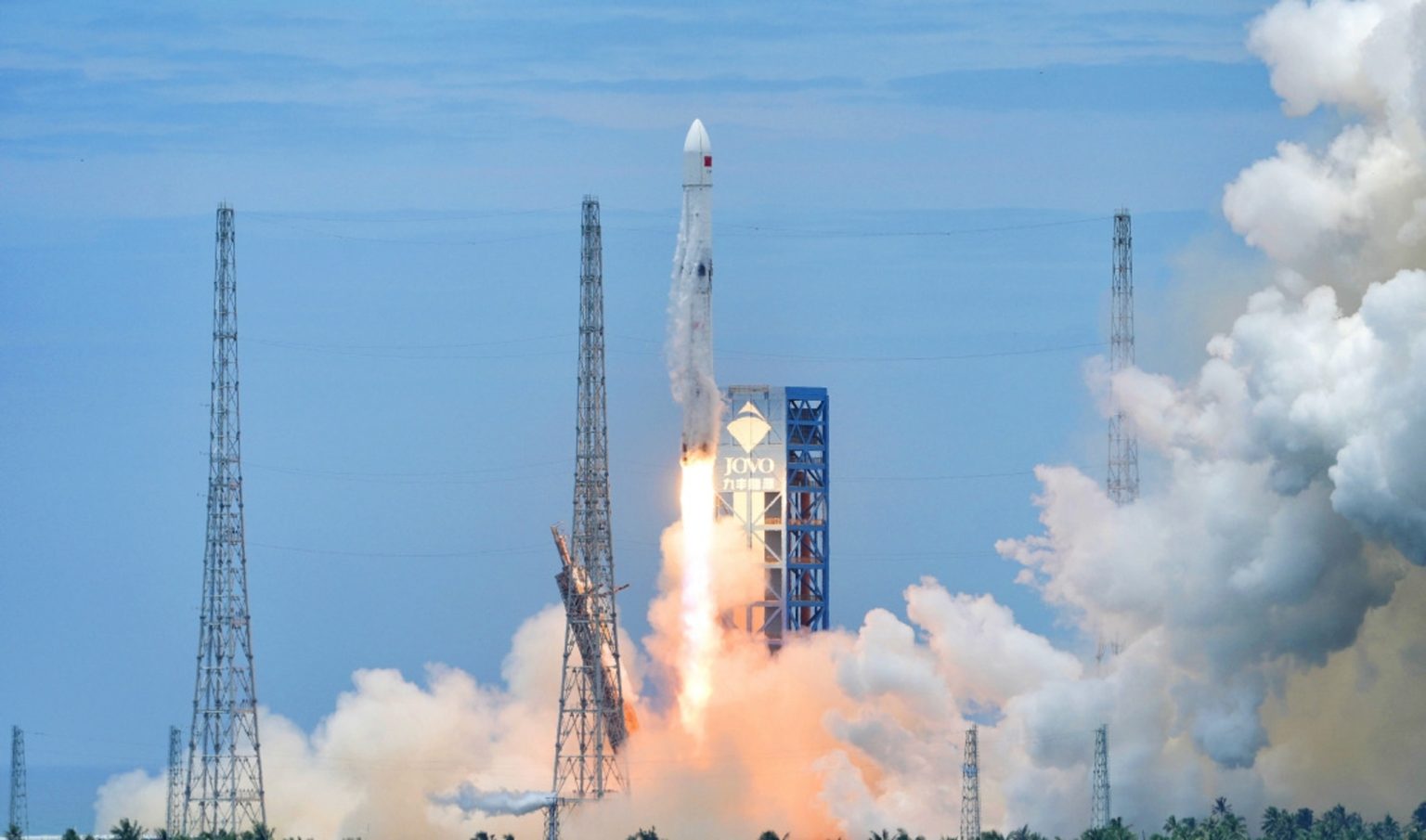
China’s state-owned corporation CASC successfully launched the Long March 10B carrier rocket into orbit, and its first stage returned to a sea vessel after completing the mission. This made China the second country in the world to successfully recover the first stage of an orbital rocket after launch.
A Different Method of Recovery
The demonstration took place on Friday, TechCrunch reports. The key difference between China’s approach and the Falcon 9 method is that instead of landing legs, it uses a special vessel with a steel-cable net stretched over a frame, which catches the stage during its final descent. Four hooks are installed on the body of the launcher near the grid fins; they catch onto the cables, while a shock-absorption system dissipates the energy in a way similar to aircraft-carrier arresting cables.
Such a maneuver requires complex guidance software, a set of sensors, and engines reliable enough to restart in flight and strong enough to withstand the loads during reentry through the dense layers of the atmosphere. In terms of payload capacity, this launcher is roughly comparable to Falcon 9. CASC said it will attempt to reuse the recovered stage by the end of 2026.
The first stage of the Long March 10B carrier rocket lands on a sea platform after launch from the Wenchang Space Launch Site on July 10, 2026. Source: SciNews / YouTube
The Economics of Reusability
The reuse of boosters fundamentally changes the cost of launches. SpaceX continues to set new annual records for the number of flights precisely because of its reusable Falcon 9 launch vehicles.
They support both the deployment of the Starlink network and contracts for NASA and the U.S. Space Force. The China Aerospace Science and Technology Corporation, CASC, now has a chance to reproduce this model.
Geopolitics in Orbit
Victoria Samson, Chief Director of Space Security and Stability at the Secure World Foundation, called the demonstration a major turning point. According to her, once China masters reusability, it will dramatically reduce launch costs and allow cheap launches to be used as a tool of soft power by placing satellites for potential allies at very low prices.
There will be no direct competition with Elon Musk’s company for commercial customers. The global launch-vehicle market is divided by national security restrictions. On one side are the United States and Europe; on the other are Russia and China. A reusable rocket of its own will give Chinese satellite communication networks and hypothetical orbital data centers a chance to compete with Starlink’s offerings.
This is already a direct threat to the dominance of the American satellite network in global markets, especially in Africa, the Middle East, and Southeast Asia. For the U.S. military, such a development means a reduction of its advantage in space.
The recovery of the Long March 10B stage took place only a few days after a consortium of investigative journalists published documents about cooperation between China and Russia in searching for ways to damage Starlink because of its successful use in Ukraine.
Other Players
Meanwhile, SpaceX is trying to restore successful flights of the much larger Starship system. The previous launch ended ambiguously: the upper stage performed nominally, but the booster failed to carry out a soft splashdown in the ocean.
A new attempt is expected in July 2026, and a recent static fire test of the giant booster’s engines appears to have gone smoothly. This is a test during which the launch vehicle is fixed on the launch pad while all engines run at full thrust for several seconds.
Other companies in the United States are also working on reusable rockets. Jeff Bezos’s Blue Origin recovered its first stage back in 2025 and reused it in early 2026. However, in May, one of the company’s rockets exploded directly on the launch pad, delaying further attempts.
Rocket Lab is developing the Neutron launcher with a reusable stage, while Stoke Space is developing a fully reusable system and hopes to test it this year.
