

Scientists have proposed a new exotic mechanism for the formation of low-mass black holes. They may exist inside massive stars if dark matter gets inside them. In this case, their existence is sustained by the gravity of the star.
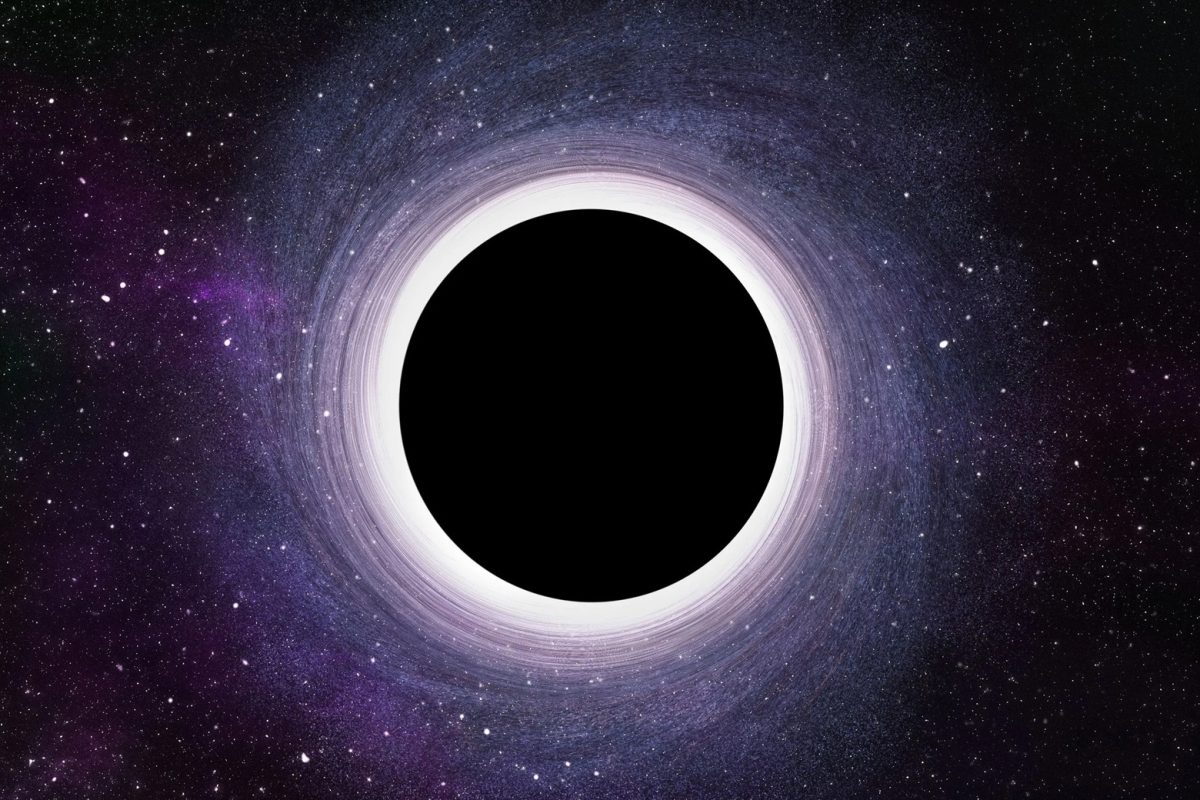
Ultralight Black Holes
Black holes are among the most exotic objects in the Universe. And although most people are fascinated by how massive they can become, scientists are more interested in the lower limit of their possible mass. As phys.org reports, citing Physical Review D, scientists have an idea according to which this limit may be much lower than previously thought.
In the modern Universe, black holes cannot generally form with masses smaller than several solar masses. However, scientists suggest that immediately after the Big Bang, conditions may have existed in which fluctuations in space itself could create black holes. These are known as primordial black holes, and theoretically they could have had almost any mass.
However, primordial black holes have one problem, and it is called Hawking radiation. In reality, a black hole does produce a small number of particles that continuously carry away its mass into space. In the case of very small black holes, they should have completely evaporated over billions of years. Only objects with masses of at least a billion tons could have survived until today. Yet even these have not been observed.
Black Holes Inside Stars
Now a theory has appeared suggesting the existence of black holes with masses below one billion tons. Its authors propose that dark matter falling inside stars could be enough to create them. However, not just any stars would work, but only the densest ones: neutron stars and white dwarfs.
Scientists are still uncertain about what dark matter actually is and whether it truly exists. But among the various possibilities are models that predict particles capable of existing not only far from galaxies, but also within them, between stars. At the same time, these particles would interact with ordinary matter only through gravity.
This means that some amount of dark matter could be attracted by a white dwarf, for example, and end up inside it. It would not participate in any chemical reactions with the star and would instead accumulate somewhere deep within it. There, the star’s gravity could compress the dark matter to a size at which it becomes a black hole.
Such a black hole would effectively “parasitize” the star. Without the star’s gravity, it could not survive and would evaporate through Hawking radiation. Even here, however, there is a lower mass limit below which a singularity would not form even under these conditions. For white dwarfs in the Milky Way’s disk, this limit is about 10,000 tons. For white dwarfs in the bulge — the dense, matter-rich central region of the galaxy — it is about 40 tons. For neutron stars in the same bulge, about 600 tons would be required.
At the same time, scientists emphasize that the mere possibility of such hidden black holes existing does not mean we will be able to observe them. On the contrary, their existence is expected to remain almost completely concealed from us. However, they could gradually grow and eventually consume the star.
