

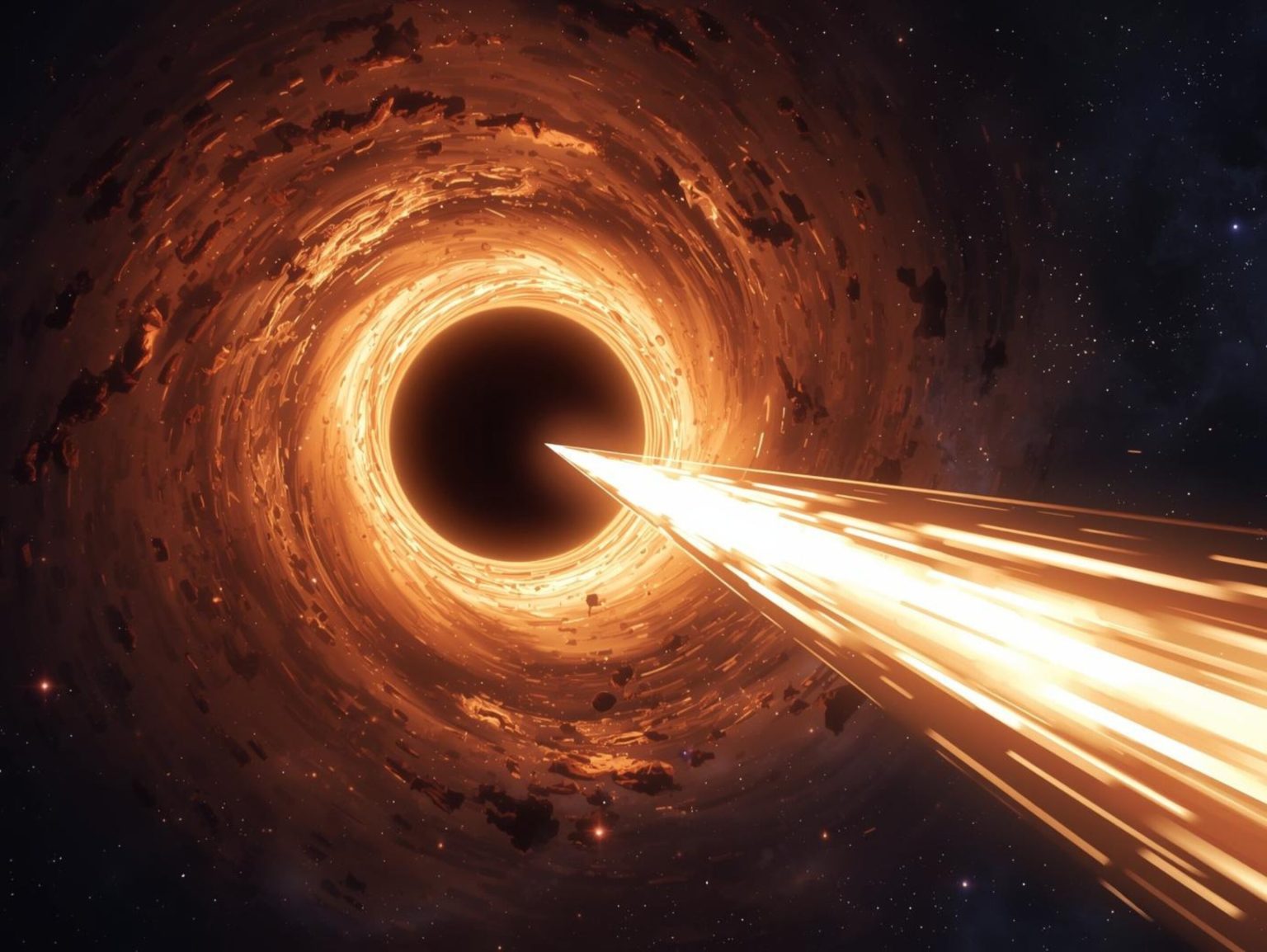
A galaxy in the constellation Leo is showing a radio flare that has continued for more than eight years. Its central black hole emits in the radio range with an intensity 10 quadrillion times greater than the Sun’s and shows no signs of fading. It is the first known object of this type and is located surprisingly close to us.
An Unfading Radio Glow
The spiral galaxy SDSS J110546.07+145202.4 is located approximately 1.8 billion light-years from Earth. Its shape, with two twisted arms, is clearly visible in optical and near-infrared images. At the center of the galaxy is a supermassive black hole of relatively small mass, which is growing extremely rapidly through the accretion of matter.
The intensity of the object’s radio emission increased by more than 20 times over a short period. Most radio transients associated with galactic centers fade within days or weeks. This one, however, continues to shine brightly without weakening. “We are dealing with the prototype of a new class of galaxies undergoing rapid changes in the radio range,” comments study co-author Phil Edwards of the Australian science agency CSIRO.
A research group led by Stefanie Komossa of the Max Planck Institute for Radio Astronomy analyzed new observations and archival data across a wide range of wavelengths, Phys.org reports. “Bright radio emission from rapidly growing low-mass black holes is rare in itself. And their transition into a long-lasting radio-bright state had never been observed before,” Komossa notes. The results were published in the peer-reviewed journal The Astrophysical Journal.
The observations used the Effelsberg radio telescope, the Australia Telescope Compact Array, or ATCA, and space observatories. The data allowed the team to suggest that, over several years, more matter has been falling into the black hole, triggering a jet — a concentrated stream of particles moving at nearly the speed of light. Why exactly the inflow of material increased, and why the flare has lasted so long, remains unresolved.
A Local Laboratory of the Early Universe
A small mass combined with rapid growth is precisely the set of properties expected from central black holes in galaxies of the early Universe. Usually, such objects are located billions of light-years away, making detailed study extremely difficult. At the same time, SDSS J110546.07+145202.4 lies in our cosmic neighborhood and makes it possible to investigate the same physical mechanisms in a much closer example.
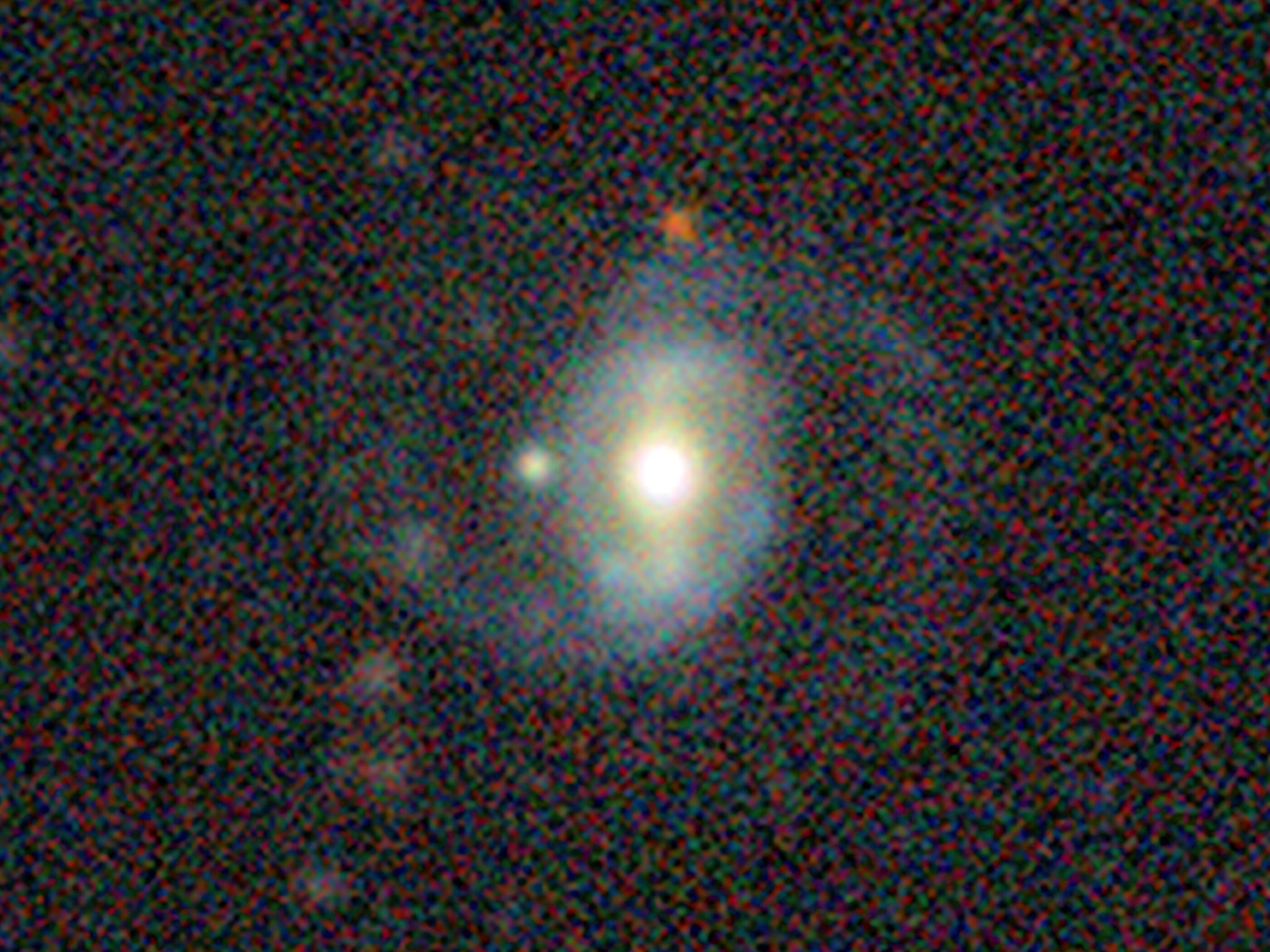
By classification, it is a narrow-line Seyfert 1 galaxy, or NLS1. Its spectrum contains characteristic narrow hydrogen emission lines, indicating an active nucleus with moderate luminosity. Scientists regard such objects as key to understanding how supermassive black holes gained mass during the first billion years after the Big Bang.
“Such high-energy events open many possibilities for astronomers. By observing jets and flares, we can study physical processes in some of the most extreme environments in the Universe,” says co-author Kovi Rose of the Sydney Institute for Astronomy at the University of Sydney.
Future Observations
Further studies using high-resolution instruments, such as the Very Long Baseline Array, or VLBA, will make it possible to map the structure of the jet and track the evolution of its emission.
“Sensitive next-generation instruments, such as the SKA, or Square Kilometre Array telescopes, will allow us to identify similar radio transients in future sky surveys. This is critically important for filling gaps in our understanding of the early Universe,” explains Stefanie Komossa.
