August promises a month abundant with remarkable astronomical phenomena, warranting early mornings or overnight observation. This period includes an eclipse, a significant meteor shower, and visible bright planets before dawn. Additionally, there will be an unforeseen event at the nexus of astronomy and space exploration — one that, despite its lack of prior planning, will attract the interest of both amateur and professional astronomers.
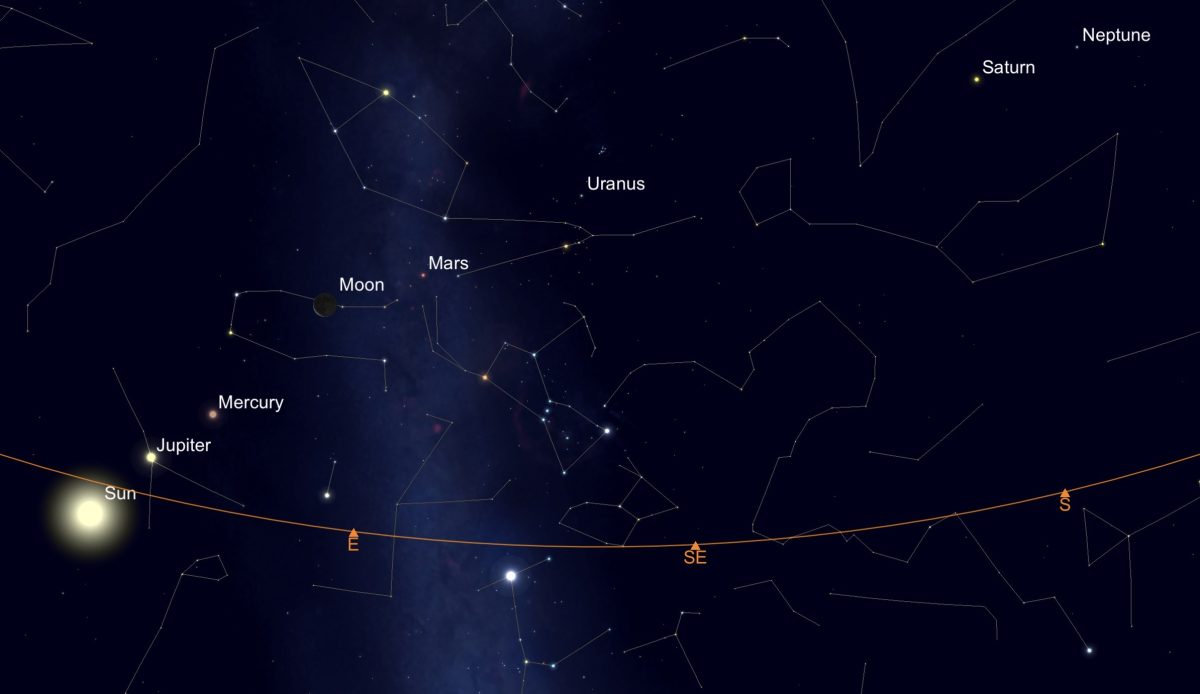
Throughout August, Venus will be observable low in the western sky during the evenings. Notably, on August 15, the planet will attain its maximum eastern elongation — that is, it will be at its greatest angular distance from the Sun — and will consequently set after the Sun. Nonetheless, Venus will be the sole planet remaining visible in the evening sky.
What phenomena can be anticipated in the morning sky? At the commencement of August, Mercury will attain its greatest western elongation. However, it is important to note that the observational window is quite limited. A more accessible target for observation will be Saturn, which will be traversing the constellation Pisces and reaching an altitude of approximately 45° in our latitudes. Within the same constellation, in close proximity to Saturn, observers will also have the opportunity to witness Neptune, the most distant gas giant in the Solar System.
Jupiter will gradually become visible in the eastern sky. On the night of August 15-16, it will be in close conjunction with Mercury. Subsequently, the fastest-moving planet in the Solar System will be positioned at the easternmost point, rendering it nearly impossible to observe in the sky.
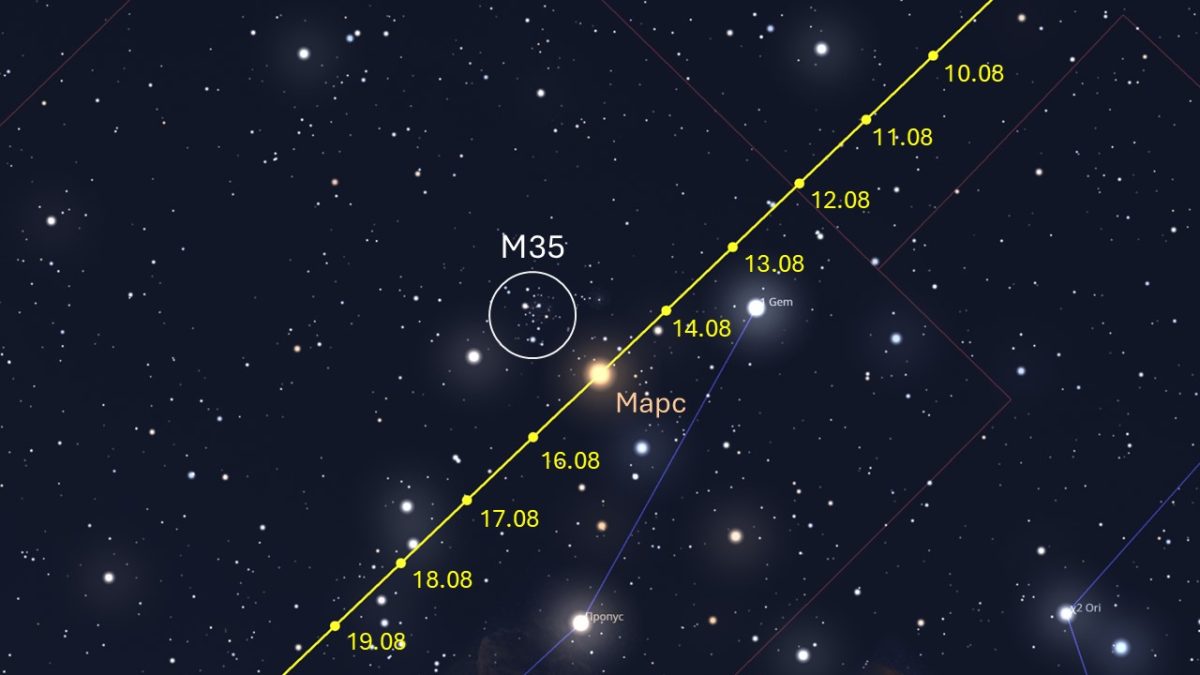
All the other planets will be situated between Mercury and Neptune. Aside from Saturn, which is gradually revealing its rings, Mars is certainly noteworthy. Specifically, on August 9, there will be a conjunction with the Moon, and on August 15, the Red Planet will be approximately 0.5° from the open star cluster M35. This presents an opportunity not only to appreciate the aesthetic pleasure of visual observations but also to capture memorable photographs.
Uranus, which traverses the sky at a sluggish pace, remains situated within the constellation Taurus. Observation conditions are progressively enhancing, and in principle, the planet may be visible to the naked eye under dark sky conditions. It is advisable to observe it between the notable star clusters — the Pleiades and the Hyades. However, to ensure accurate identification, the utilization of a digital planetarium is highly recommended.
Therefore, in August, we shall observe what the media will refer to as a “parade of planets.”
The middle of the month appears to be quite busy; however, this is not the complete schedule. Notably, a total solar eclipse is scheduled for August 12, with the partial phase observable in western Ukraine. Furthermore, on the night of August 12-13, the peak of one of the most significant meteor showers, the Perseids, is anticipated. This provides an excellent opportunity to enjoy the spectacle of “shooting stars” against a dark sky, unilluminated by the Moon.
August will conclude with two relatively minor astronomical events, both associated with the Moon: on the 28th, shortly before dawn, there will be a partial lunar eclipse, with only the penumbral phase observable in Ukraine; and on the 31st, the Moon will pass in close proximity to Saturn.
Finally, a few words regarding the event mentioned at the outset. This is not a “classic” astronomical event — in the sense that one participant is an astronomical object, the Moon, while the other is a man-made artifact, the upper stage of the Falcon 9 rocket. It is anticipated that, on August 5 at 09:35 a.m. (Kyiv time), the rocket stage will collide with the Moon at the very edge of its visible surface. At that time, the Moon will be above our horizon; however, observing the predicted flash on the Moon’s illuminated side will be exceedingly difficult, particularly against the daytime sky. Professional astronomers aim to observe the dust cloud generated by the impact and to analyze its dynamics. More information about this event can be found in the related article.
General astronomical circumstances
August 2 – short-period comet 10P/Tempel (Tempel 2) will pass through perihelion. Its brightness is anticipated to reach +8m, suitable for observation with large binoculars or a medium-sized telescope. For observers in Ukraine, the optimal viewing time is approximately 2:00 a.m., when the comet attains its highest elevation in the sky, approximately 16° above the horizon. When planning observations, it is important to consider the relatively high phase of the waning Moon, which is at 89%.
August 2 –Mercury will reach its greatest western elongation. The planet will be visible low above the horizon prior to dawn. The optimal observing time is approximately 4:40 a.m., though this may vary depending on your precise geographic location.
August 3 – Comet 10P/Tempel will pass at its closest proximity to Earth, approximately 62.1 million kilometers. The atmospheric and observational conditions remain largely consistent with those of the preceding day; however, the Moon will be in a narrower phase at 82%, positioned slightly farther from the comet. Additionally, the comet will attain its highest elevation at a marginally lower position in the sky.
August 7 – the Moon will be in proximity to the Pleiades. The nearest approach is scheduled for 10:10 a.m., which occurs during daylight hours.
August 9 –conjunction of the Moon (18%) and Mars (+1.3m). The conjunction occurs at 07:45 a.m. (04:45 UTC), during which the angular separation between the two celestial bodies will be 4°, allowing the phenomenon to be observable before dawn on the same day.
August 12 – a total solar eclipse will occur. The optimal viewing conditions are anticipated in eastern Greenland and Spain.
August 12 – new moon, occurring at exactly 8:37 p.m. Kyiv time (5:37 p.m. UTC).
August 12–13 – peak of the Perseid meteor shower is anticipated. The expected Zenithal Hourly Rate (ZHR) is 100; the shower will reach its maximum activity during the latter half of the night, when the radiant, situated on the boundary between Perseus and Cassiopeia, will have ascended sufficiently high in the sky.
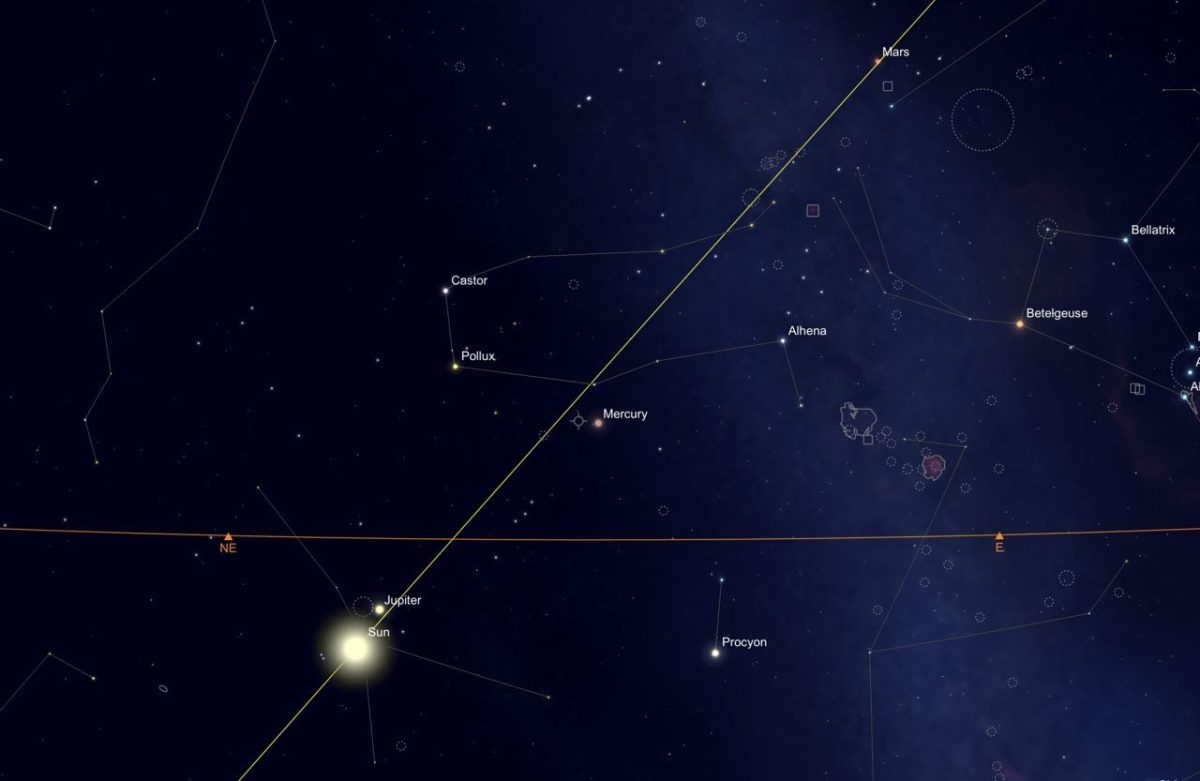
August 15 – Mercury-Jupiter conjunction; at 1:43 p.m. (10:43 a.m. UTC), the angular separation between the two planets will be merely 0.5°. Since this event transpires during daylight hours in Ukraine, it is advisable to attempt to observe the planets either on August 15 or 16 before sunrise. Please note that Jupiter and Mercury will be situated very low above the horizon; thus, optimal viewing conditions require an unblocked eastern horizon, a calm and clear atmosphere, along with binoculars or a small telescope.
August 15 – Venus is at its greatest eastern elongation (45.9°).
August 28 – a partial lunar eclipse will occur shortly before dawn. The most favorable viewing conditions will be in western Ukraine, where observers will have the opportunity to witness the Moon entering the Earth’s penumbra, and, low on the horizon, a portion of the Moon entering the Earth’s umbra.
August 28 – it coincides with the full moon, with the exact time being 07:00 a.m. Kyiv time (04:18 a.m. UTC).
August 31 – before dawn, the Moon, at 91% illumination, will be positioned near Saturn, with an apparent magnitude of +0.5. The approximate angular separation between these two celestial bodies is approximately 6 degrees.
A detailed overview of the most interesting circumstances
August 2: Mercury’s greatest western elongation
It is not surprising that Mercury is occasionally referred to as the “elusive planet.” Despite its relatively high luminosity, it is concealed by the Sun’s rays for the majority of the time. It is generally understood that the optimal opportunity to observe Mercury occurs on days nearest to its maximum elongation, when the planet reaches its greatest angular separation from the Sun.
In reality, however, the circumstances are more complex, and the conditions at maximum elongation vary considerably. At times, it is relatively straightforward to observe the planet at these points in its orbit; at other times, it becomes nearly impossible. Several factors influence this variability. Firstly, Mercury follows a notably elongated orbit. Ideally, maximum elongation occurs around the time of aphelion, when the planet is not only visible in the sky but also at its greatest physical distance from the Sun. Secondly, the slight inclination of its orbit, approximately 7°, relative to the plane of the ecliptic, plays a role. This inclination causes Mercury to be intermittently positioned ‘below’ or ‘above’ the Sun’s apparent path at maximum elongation. The third factor pertains to the dynamics of Earth’s motion, which results in the ecliptic being inclined at different angles relative to the horizon during various seasons, before sunrise and after sunset.
What will the conditions be like this time? Actually, not very favorable. On August 14, just 12 days after its greatest elongation, Mercury will reach perihelion — that is, the point in its orbit closest to the Sun. On top of that, the planet will be below the ecliptic, whereas it would be better for us if it were the other way around. Moreover, the ecliptic itself forms only a small angle with the horizon in the morning — just ~50°. Taken together, this means that despite a configuration that seems favorable for observation, Mercury will not be all that easy to spot. Choose a location with an unobstructed eastern horizon, hope for clear morning skies, and time your observations so that the Sun is at least 7° below the horizon, while Mercury is at least 6° above the horizon. This gives an approximate average optimal time of 4:40 a.m. for Ukraine, but in reality, it varies by location.
August 12: the day on which the Moon will obscure the Sun
A total solar eclipse is undoubtedly a remarkable phenomenon. However, this assessment primarily pertains to the total phase of the eclipse. An observer on Earth perceives the Moon completely obscuring the Sun for several minutes, leaving only the Sun’s tenuous, hot atmosphere — the corona — visible. Conversely, if this phenomenon were observed from the Moon, one would witness the shadow of its substantial satellite gradually advancing across the Earth. Only an observer situated within this shadow perceives a total eclipse. Surrounding this shadow is a considerably wider penumbra. All individuals within this region have the opportunity to observe a partial eclipse, during which the Moon covers only a specific percentage of the Sun’s disk.
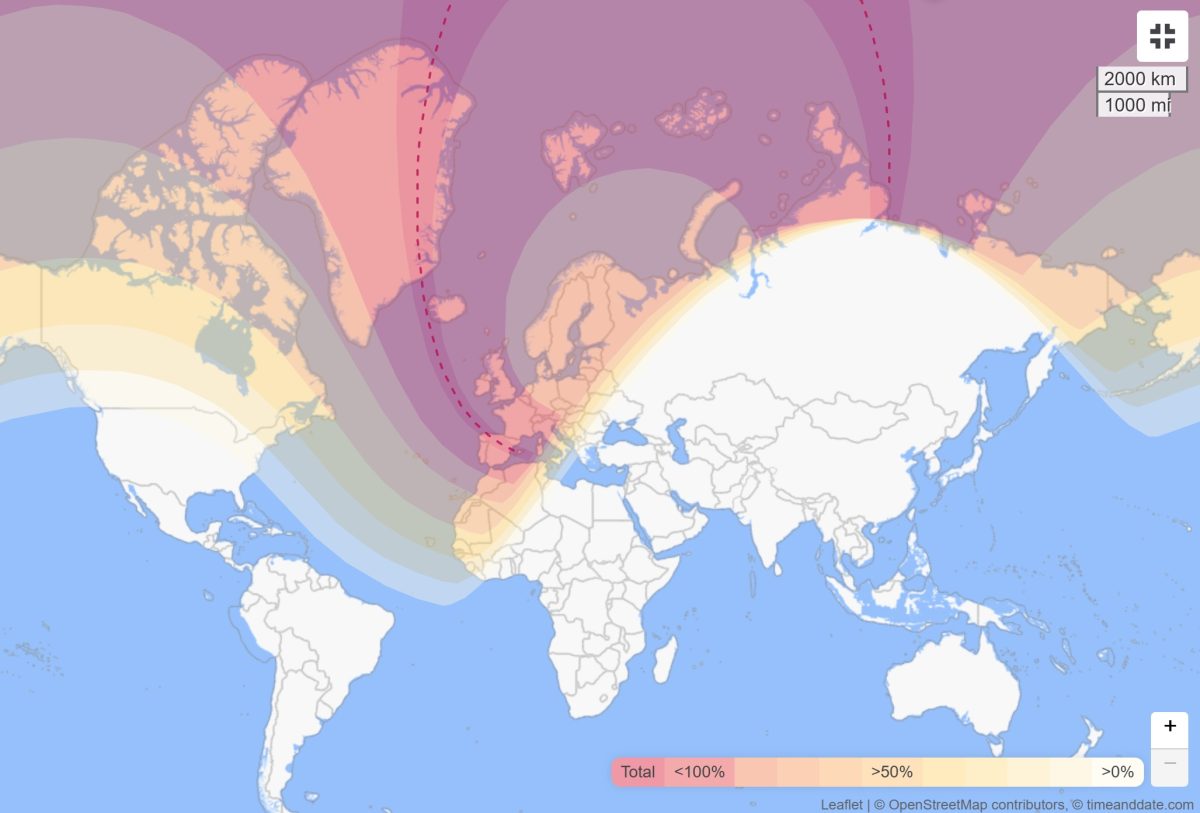
On the map above, the darker the area, the greater the percentage of the Sun that will be obscured by the Moon during the peak of the eclipse. Therefore, in Europe, individuals in Spain will experience the most optimal view, whereas outside of Europe, a total eclipse can be observed in the less densely populated region of Greenland.
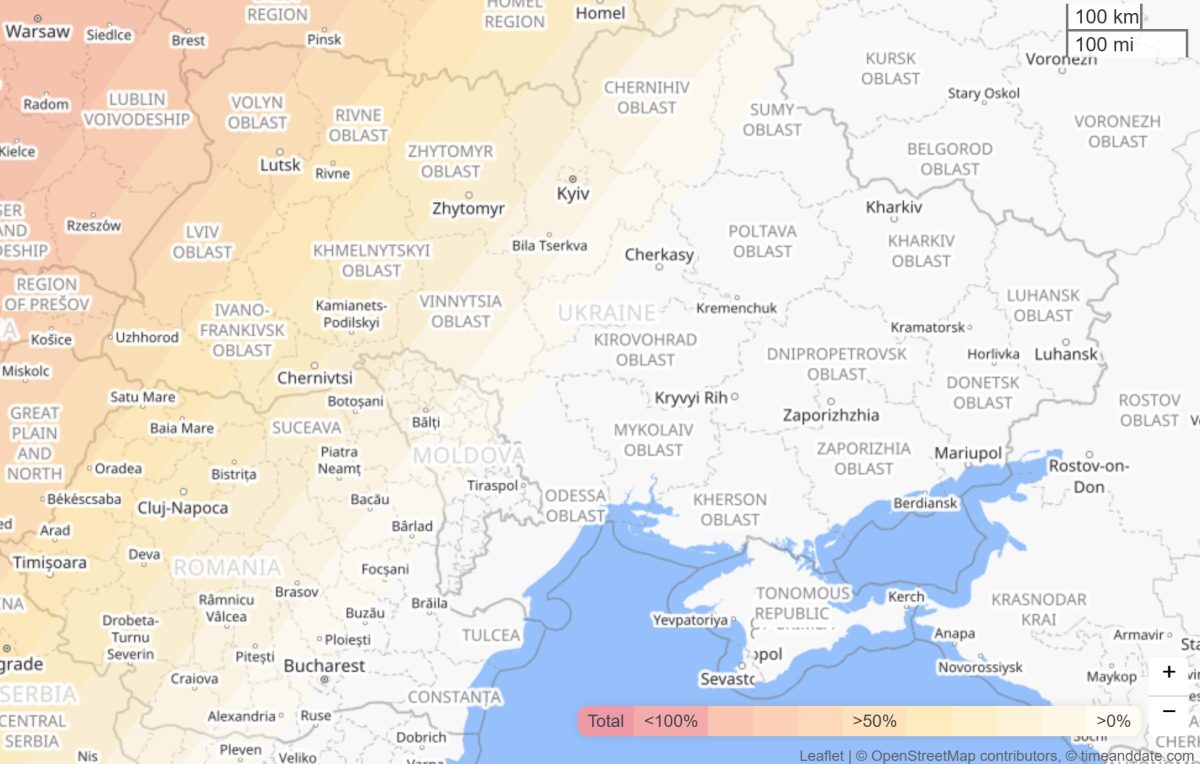
What are the prospects for Ukraine? Will there be any observable phenomena? In this context, only western Ukraine will be fortunate; the eastern, central, and southern regions will not witness the eclipse at all. The northern region will minimally experience the event, only as the Sun approaches setting. For those wishing to observe the eclipse extensively within the country, the Shatsk Lakes are recommended. In this location, the Moon will obscure 57% of the Sun’s disk diameter, corresponding to approximately 65% of the Sun’s surface area being covered. The peak of the eclipse will occur shortly before sunset at 8:50 p.m. The event is scheduled to take place from 8:15 p.m. to 8:54 p.m.
August 12-13: the night of the most renowned “shooting star”
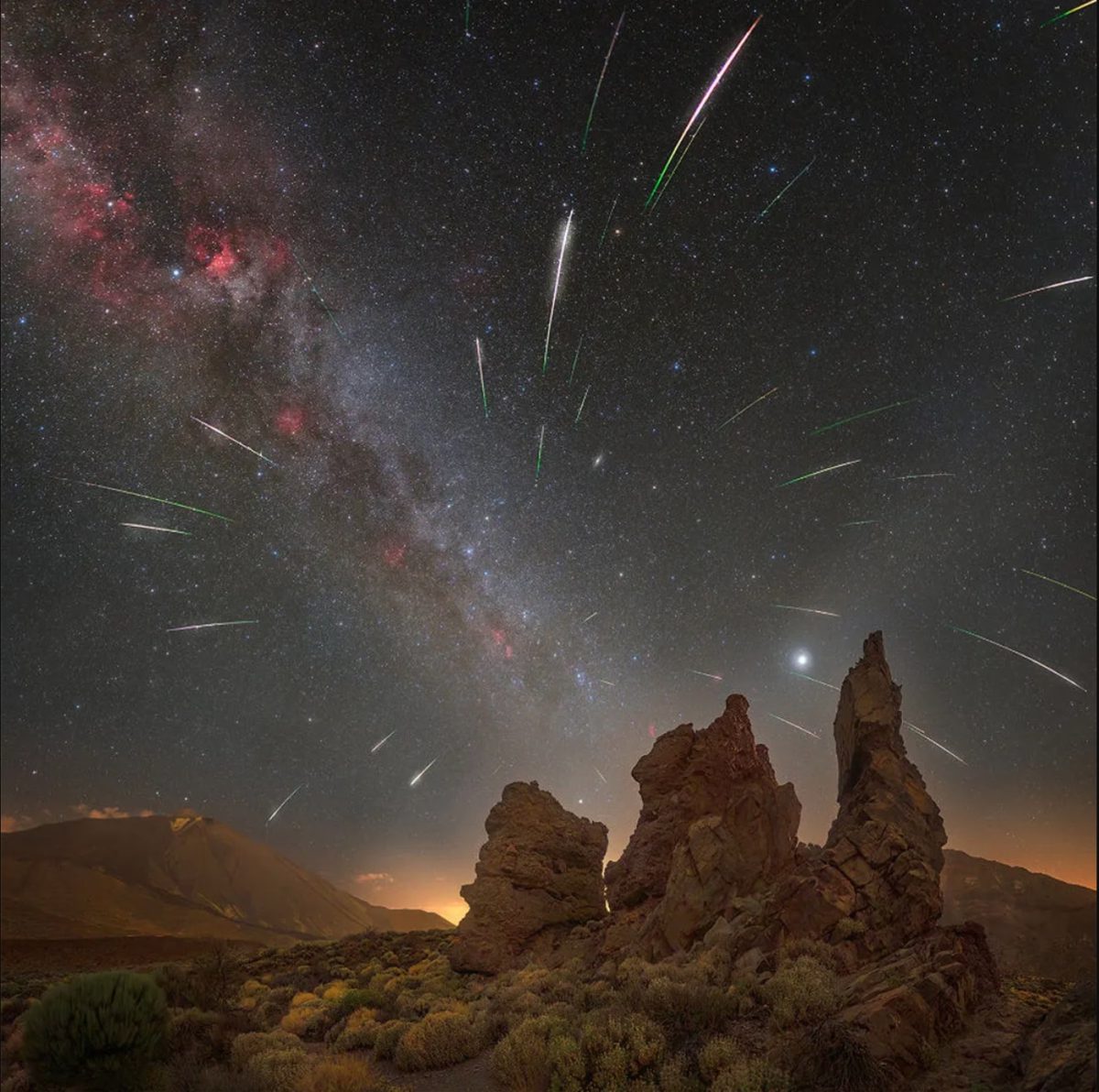
Although the Perseids are not the most spectacular meteor shower, they are the most frequently mentioned when discussing meteor showers. This is primarily due to favorable weather conditions — August nights are typically warm and clear. In recent years, our observations of this shower have been hampered, partly because the Moon was excessively bright and partly because our expectations did not align with the actual weather conditions. While it is challenging to predict cloud cover for the nights of August 12-13 with such accuracy, one certainty is that the Moon phase will be optimal. With the Moon absent from the sky, the sky will be as dark as possible. Furthermore, venturing outside the city increases the likelihood of a successful observation night.
From a physical perspective, a meteor results from the combustion of a minute fragment of asteroid or comet material as it enters Earth’s atmosphere. A meteor shower, commonly referred to as a “starfall,” transpires when Earth traverses a trail of such particles. These celestial phenomena appear to emanate from approximately the same area, known as the radiant. The higher the radiant’s position at any given time, the greater the number of meteors from the shower that can be observed.
Annually, between July 17 and August 24, the Earth traverses the diffuse tail of Comet 109P/Swift-Tuttle. During this interval, an active meteor shower, the Perseids, with a zenithal hourly rate (ZHR) of 100, can be observed. The year 2026 conforms to this pattern. According to the forecast provided by the International Meteor Organization, the peak activity is anticipated to occur on the night of August 12–13, specifically between 02:00 a.m. and 04:00 a.m. Coordinated Universal Time (UTC), prior to dawn in Ukraine. However, meteors will be visible throughout the night. Enthusiasts are encouraged to observe the spectacle as soon as night falls — approximately at 11:00 p.m. You are not required to precisely locate the radiant, as meteors will appear unpredictably across the entire sky.
August 28: The Moon will pass through the Earth’s shadow
Unlike a solar eclipse, a lunar eclipse can be observed from any location where the Moon is visible above the horizon. Before dawn on August 28, almost exactly two weeks after the total solar eclipse, we can anticipate a partial (but quite pronounced) lunar eclipse. The Moon will not assume a deep copper coloration as observed during total eclipses; however, at least a portion of its disk will exhibit a reddish tint.
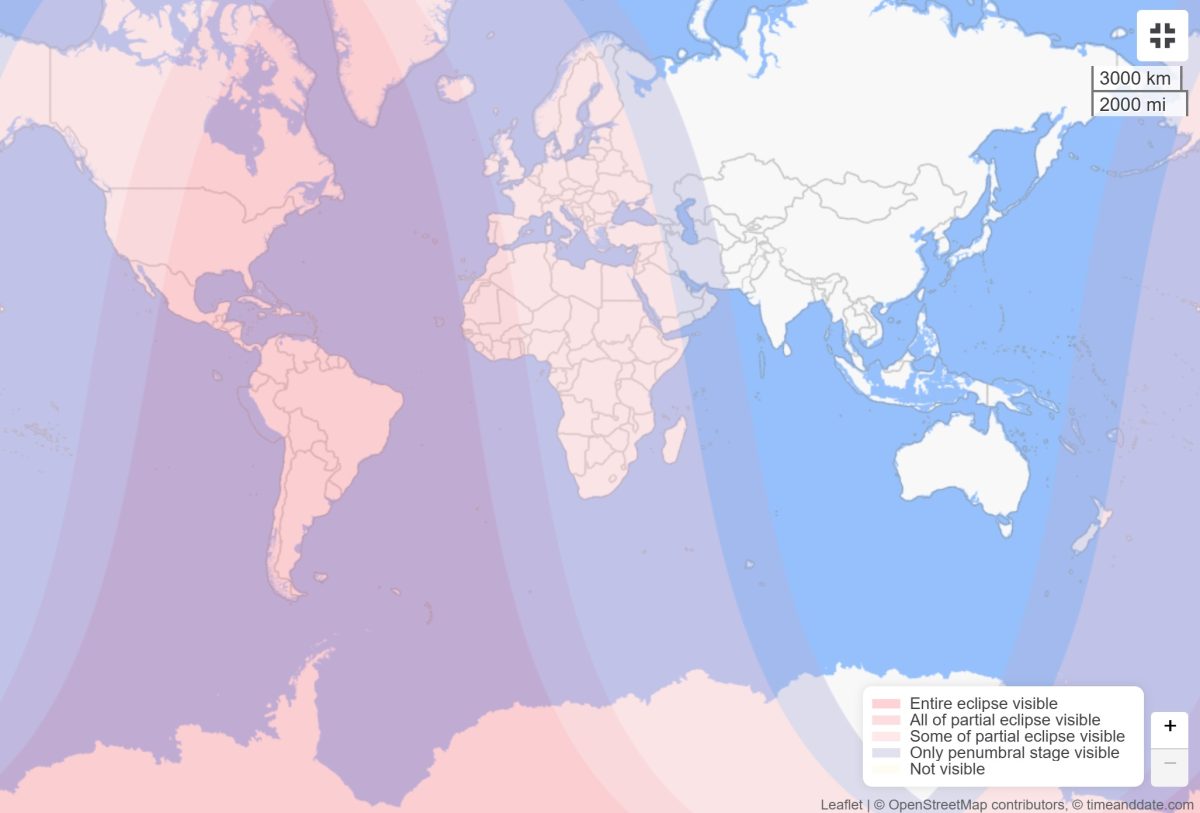
Regrettably, our efforts have once again been unsuccessful. As illustrated on the map below, the most favorable conditions are anticipated in South America, the eastern region of North America, and, to a certain extent, in Greenland and Antarctica. Specifically, the polar researchers stationed at the Ukrainian Akademik Vernadsky Station will have the opportunity to observe all phases.
What about the rest of the Ukrainians? For everyone in Ukraine, the maximum phase of the eclipse will not be visible. The eastern part of the country will see only the Moon entering the Earth’s penumbra, while the western part may also see the partial phase. To know exactly what to expect, check any planetarium app to see when the Moon sets on the horizon at your location and compare it with the eclipse schedule:
4:25 a.m. (1:25 a.m. UTC) – the commencement of entry into the penumbra.
05:33 a.m. (02:33 a.m. UTC) – the Moon is entirely within the penumbra and commences the process of entering the umbra.
07:14 a.m. (04:14 a.m. UTC) – the event reaches its maximum phase, with 93% of the Moon’s disk immersed in the Earth’s shadow.
08:52 a.m. (05:52 a.m. UTC) – the Moon has completely emerged from the shadow and is now in the penumbra;
10:01 a.m. (07:01 a.m. UTC) – conclusion of the penumbral phase of the eclipse.