

Consider a power station that consumes electricity at night and begins generating it in the morning. At first, this may seem paradoxical: why consume electricity only to return a portion of it later? However, this is precisely the principle behind one of the world’s most powerful energy storage technologies: pumped storage power stations (PSPs). They function like giant batteries, storing energy not in lithium but in millions of metric tons of water elevated to a great height. The U.S. Department of Energy estimates that the typical efficiency of this cycle is approximately 70–80%. Although some energy is lost, this reserve can be generated on a massive scale and rapidly supplied to the grid precisely when it is needed most.
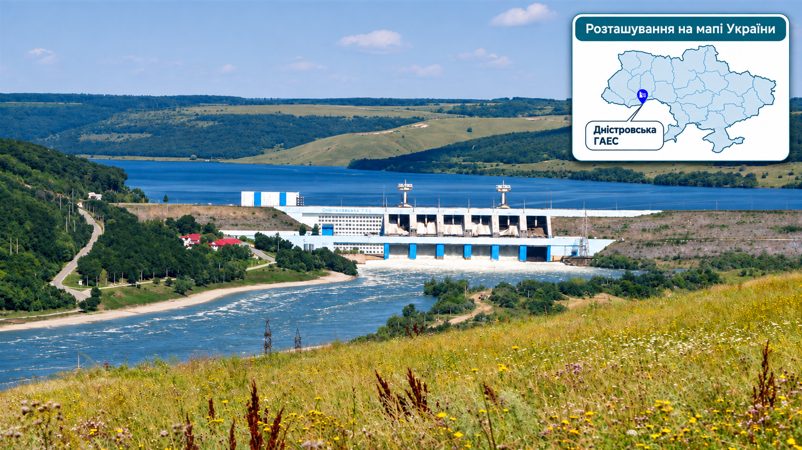
For Ukraine, the Dniester Pumped Storage Power Station near Novodnistrovsk has become one of the defining symbols of this technology. Its history is often summarized by the statement: “The first unit was commissioned in 2009.” However, an important distinction should be noted. Hydroelectric Unit No. 1 was first connected to the power grid on November 8, 2009, in generator mode, producing 325,000 kWh. On December 21, 2009, the acceptance commission placed the unit into pilot commercial operation. Subsequently, on December 22, 2010, following testing and refinements, the unit entered full-scale operation. Accordingly, all three dates may appear in various sources, as they refer to different stages in the commissioning process.
In 2009, the project — which had spent decades in the planning stages, amid excavation work and funding shortfalls — finally became operational.
How water can become a battery
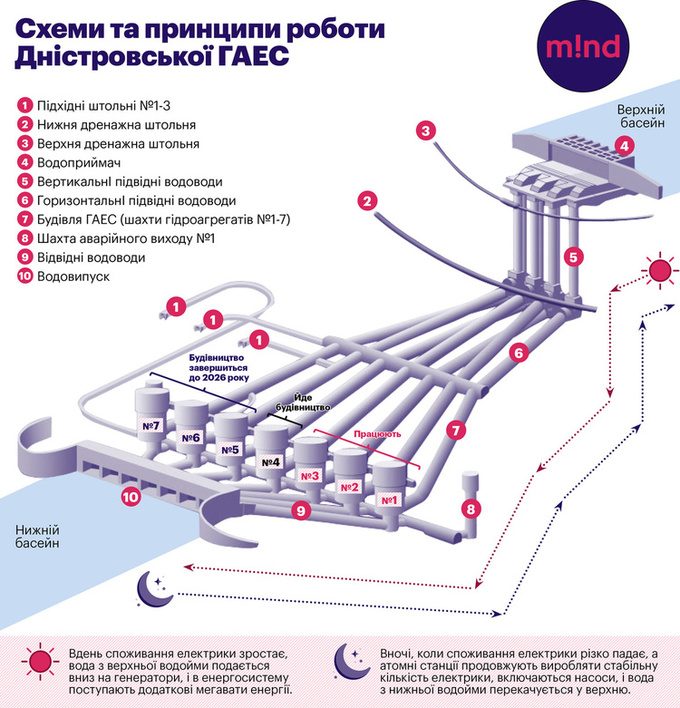
A conventional hydroelectric station harnesses the natural flow of water: water passes through a turbine, drives a generator, and produces electricity. A pumped-storage hydroelectric power station operates differently, requiring two reservoirs at different elevations. When the grid has a surplus of electricity, the unit functions as a pump, lifting water to the upper reservoir. When demand increases, the water is released downstream, and the same unit operates as a turbine, returning the stored energy to the grid.
The underlying physics is consistent with standard school-level principles. Elevated water possesses potential energy, given by the equation E = mgh,
where m represents the mass of the water, g denotes the acceleration due to gravity, and h indicates the difference in height. The greater the quantity of water and the higher it is raised, the greater the “capacity” of the battery.
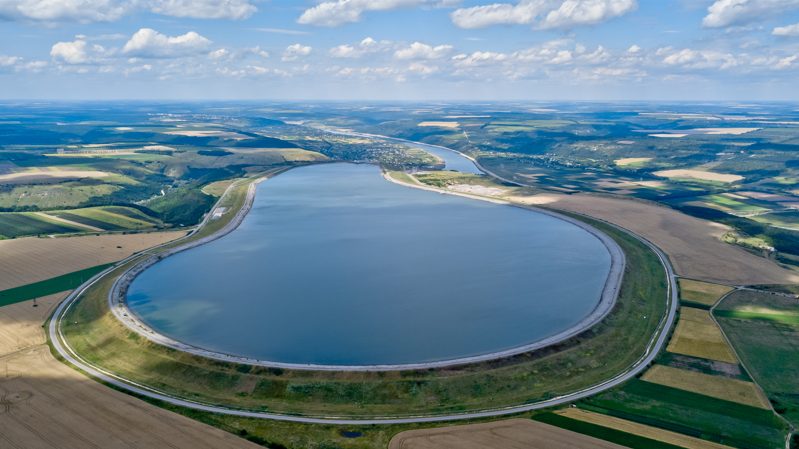
At the Dniester Pumped Storage Power Station, the normal operating level of the upper reservoir is approximately 229.5 m (753 feet) above sea level, while the normal operating level of the lower reservoir is approximately 74.5 m (244 feet). The upper reservoir has a usable volume of 32.7 million m³ (approximately 8.64 billion U.S. gallons).
Source: mind
Seven water conduits extend from the upper reservoir to the machine room. Each conduit’s vertical section is approximately 100 m (328 feet) high and has a diameter of about 7.5 m (24.6 feet), while its horizontal section is approximately 400 m (1,312 feet) long. These conduits are large enough to accommodate a two-story building.
Today, the first four units of the Dniester Pumped Storage Power Station were commissioned, with a total installed capacity of 1,296 MW in generation mode and 1,684 MW in pumping mode. Each unit can generate up to 324 MW and consume approximately 421 MW while pumping water uphill. The project comprises seven units, with a total generation capacity of 2,268 MW and a pumping capacity of 2,947 MW. As of 2026, Ukrhydroenergo’s current project page lists units No. 5–7 as part of the third phase, which has yet to be implemented.
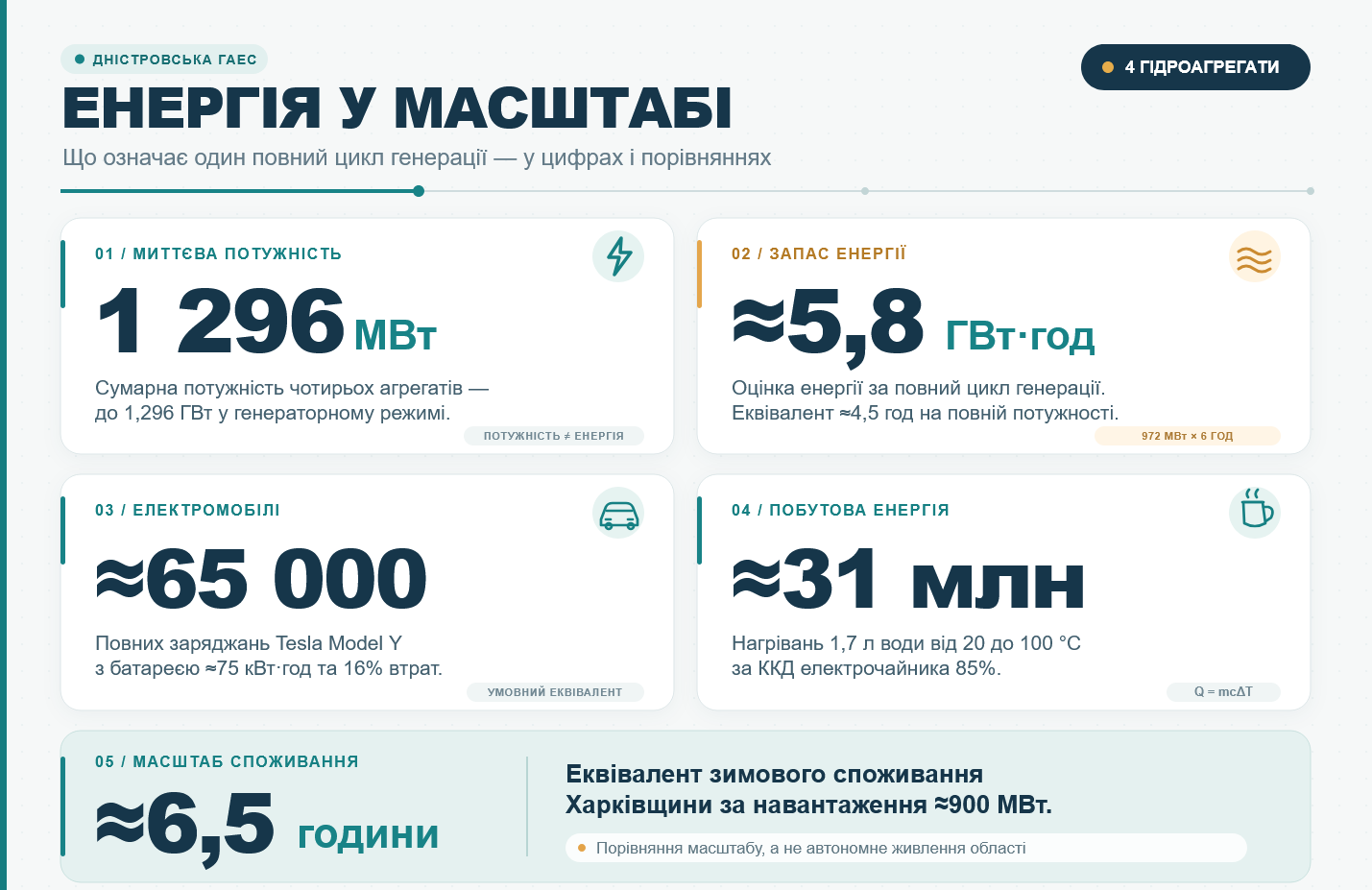
That is why it is more accurate to state not that the Dniester Pumped Storage Power Station is already the largest in Europe, but that, according to the original design, its installed generating capacity is expected to reach 2,268 MW once all seven units have been commissioned. This would make it one of Europe’s largest pumped storage facilities. The phrase “sixth in the world,” which appears in the company’s older materials, is rapidly becoming outdated due to the large-scale construction of new pumped storage power stations, particularly in Asia. Therefore, it would be incorrect to present it as a current record without specifying a date.
A construction project that spanned an era
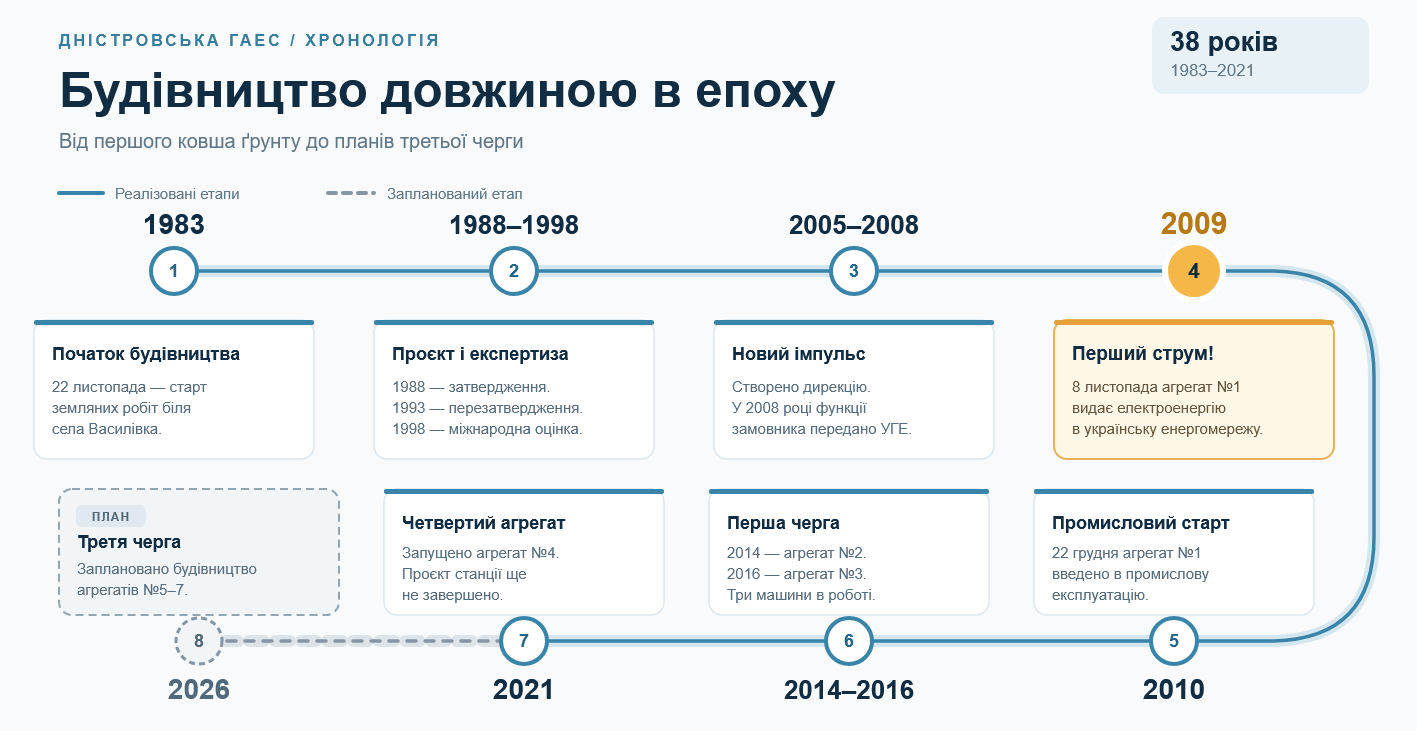
The concept for the Dniester Pumped Storage Power Station dates back to the Soviet era. The project, which forms part of the Dniester Hydropower Cascade, was developed during the 1980s. Earthworks at the site of the main structures commenced on November 22, 1983, and construction of the first phase began in earnest toward the end of the decade.
Following the dissolution of the Soviet Union, Ukraine inherited a large, unfinished project. The economic crisis of the 1990s, limited funding, and changes to implementation plans repeatedly delayed the work. In 1996, Ukraine approached the World Bank to discuss potential funding, after which a decision was made to construct the first phase using three units. An updated project plan was prepared in 2005.
More than two decades elapsed between the commencement of major construction and November 8, 2009, when the first unit began supplying electricity to the Unified Power System. The second unit entered commercial operation in 2014, the third in 2016, and the fourth in December 2021.
The Dniester Pumped Storage Power Station represents a continuation of Ukraine’s extensive history of hydropower development. The first unit of the Dnipro Hydroelectric Station began operation in May 1932, and the ceremonial launch of its first phase took place on October 10 of that year. Following World War II, the station was reconstructed, and the Dnipro Cascade was developed during the 1960s and 1970s. In 1970, the first unit of the Kyiv Pumped Storage Power Station — Ukraine’s first pumped-storage facility, completed in 1972 — was commissioned. This facility served as a testing ground where Ukrainian power engineers gained experience operating reversible pump-turbines, well before the Dniester project.
Why does the Power Grid need Pumped Storage Hydroelectric Power Stations?
The electricity grid has a notable operational constraint: electricity generation and consumption must remain balanced almost continuously. A nuclear power unit can operate reliably for extended periods at a stable output; however, it is not designed to adjust constantly to meet demand during morning and evening peaks. Solar power generation depends on sunlight, while wind power generation varies with weather conditions. At the same time, consumers may switch on millions of kettles, air conditioners, or space heaters simultaneously.
This is precisely where flexible generation is required. During off-peak periods, pumped-storage power stations absorb excess energy; during peak periods, they rapidly return it to the grid. They also help maintain frequency and voltage stability and provide an emergency reserve. Ukrhydroenergo explicitly identifies the Dniester Pumped-Storage Power Station as a means of enhancing power-system flexibility and compensating for outages of large generating units.
The importance of such a reserve for Ukraine became particularly evident after 2022. The destruction of the Kakhovka Hydroelectric Power Plant on June 6, 2023, deprived the grid of hundreds of megawatts of hydropower generation and, according to “Ukrhydroenergo,” 192 MW of regulating capacity. This does not make the Dniester Pumped Storage Power Plant a “replacement” for the Kakhovka facility — the functions of these hydroelectric installations differ — but it demonstrates the considerable value of fast-response reserves in a power grid operating under wartime conditions.
The cost of green energy
It would be an oversimplification to describe any large hydroelectric facility as simply “environmentally friendly.” Pumped-storage hydroelectric power stations do not burn fuel during electricity generation; however, reservoir construction, fluctuations in water levels, and changes to flow patterns can affect river ecosystems.
This matter is particularly sensitive in the case of the Dniester, a transboundary river on which both Ukraine and Moldova depend. The agreement between the two countries on the protection and sustainable development of the Dniester River Basin provides for cooperation on matters including flow regulation, biodiversity, monitoring, and data exchange.
The Ukrainian side emphasizes that the upper reservoir of the Dniester Pumped Storage Power Station is located outside the natural riverbed and that water is repeatedly transferred between the upper and lower basins as part of the operating cycle. The project underwent state environmental review procedures.
At the same time, independent studies and the Moldovan authorities have highlighted the broader cumulative effects of the Dniester Hydropower Complex as a whole, including downstream changes in temperature and hydrological conditions, fluctuations in water levels, and impacts on fish and riparian ecosystems. As early as 2008–2009, the UNECE addressed the transboundary impact assessment of the Dniester Pumped Storage Power Station. Current documents from Moldova and international organizations also emphasize the need for joint monitoring across the entire basin.
Therefore, the primary challenge today is not choosing between “energy or nature,” but rather developing a model that combines power-grid flexibility with guaranteed environmental safeguards, level controls, and transparent cross-border monitoring.
The role of satellites in hydropower
Earth observation satellites can monitor water surface area, changes in coastlines, the effects of droughts and floods, vegetation conditions, and large-scale changes in river basins. The NASA Earth Observatory and European Earth observation programs are founded on this principle: satellites convert hydrological features into a series of measurements over time.
There is also a compelling engineering parallel. A spacecraft cannot generate energy on demand; instead, it stores energy in batteries when sunlight is available and uses it during periods of peak consumption or while in the shade. Pumped-storage hydroelectric power stations operate similarly at the scale of the power grid: they store energy when it is abundant so that it can be released when it is most valuable.

In 2009, Ukraine brought its largest battery of this kind into operation. The importance of this technology has only increased over time: as the share of solar and wind power in the grid grows, the ability to store electricity for later use becomes increasingly valuable alongside the ability to generate it.
The Dniester Pumped Storage Power Station exemplifies how engineering ingenuity can harness even the force of gravity to manage energy. Its construction spanned decades and endured changes in historical periods and government priorities. However, the plant’s greatest achievement lies not only in its generating capacity, but also in its ability to store surplus energy and return it to the grid precisely when it is most needed. Ultimately, the future of the energy sector depends not only on how much electricity is generated, but also on how intelligently it is managed.
