

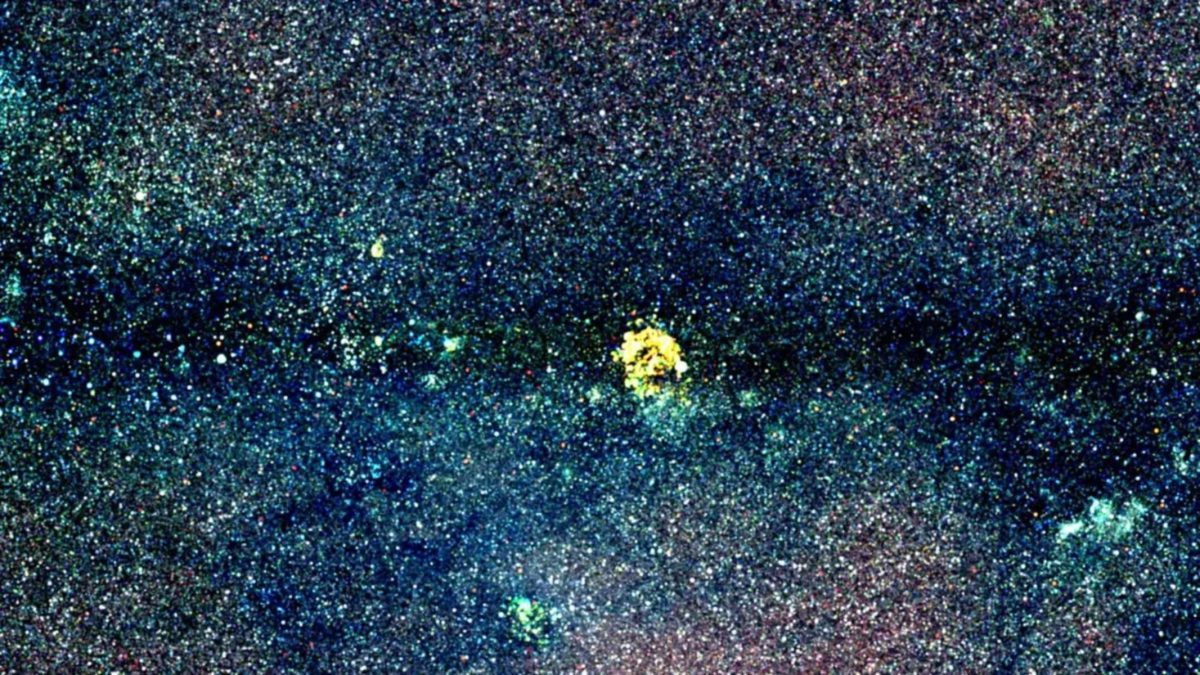
Scientists have detected nearly twice as many X-ray sources as were previously known. The data were collected during repeated all-sky scans using the eROSITA orbital telescope. Astronomers have obtained the most complete inventory to date of the hottest and most energetic objects. Most of the entries correspond to active supermassive black holes at the centers of distant galaxies.
Contents of the New Dataset
The main part of the catalog contains more than 1.9 million point sources in the energy range from 0.2 to 2.3 kiloelectronvolts. Most of them are stars in our Galaxy and supermassive black holes around which matter is actively accreting.
Another approximately 64,000 entries correspond to extended sources. These include galaxy clusters, nearby stellar systems, and supernova remnants that trace some of the largest structures in the Universe.
A separate catalog for the harder X-ray band adds almost 15,000 sources in the range from 2.3 to 5 kiloelectronvolts. Such systems are obscured by dense layers of dust and gas and therefore are usually harder to detect in the soft X-ray range.
Three Passes Across the Entire Sky
The data for the second public release, eROSITA Data Release 2 (DR2), was collected during the first 556 days of scientific operations, covering three consecutive surveys of the entire celestial sphere. Observations have been conducted since December 2019 using the eROSITA telescope aboard the Spectrum-Roentgen-Gamma spacecraft, with a complete all-sky scan taking six months, as reported by the Max Planck Institute for Extraterrestrial Physics. Аccumulation of data from multiple surveys revealed substantially fainter emission than was visible in the first release.
The classic ROSAT all-sky survey catalogs from the 1990s contained about 125,000 entries, meaning that the current catalog is approximately sixteen times larger. “DR2 is the best inventory of the X-ray sky available and opens the way to robust statistical studies of cosmic populations,” says Miriam Ramos-Ceja, the instrument’s ground-segment manager and lead author of the publication.
What Other Wavelengths Revealed
Probable counterparts at other wavelengths have been added to the X-ray positions and compiled into six new catalogs. Approximately 88% of the identified sources turned out to be extragalactic, with active supermassive black holes dominating the population.
“Detection in X-rays is only the first step,” explains project spokesperson Mara Salvato. According to her, comparison with other wavelength ranges reveals what these objects actually are and how far away they are located.
A Joint Stage with the Sloan Survey
The publication coincided with the twentieth data release of the Sloan Digital Sky Survey (SDSS), which contains optical spectroscopy of the same sources. Combining the spectra with X-ray measurements makes it possible to construct three-dimensional maps of the distribution of active black holes and trace how they evolved over cosmic time.
One of the first studies based on these data concerns the brightest supermassive objects at high redshifts. “Thanks to DR2, we found more than we expected, and this indicates that rapidly growing black holes were more common in the early Universe than previously thought,” says William Roster, lead author of the corresponding study.
Survey Limits and Future Plans
The material covers the western Galactic hemisphere, in accordance with the data-sharing agreement between the German and Russian consortia. The catalog is described in a paper submitted to Astronomy & Astrophysics, with a preprint already available on arXiv, meaning that the findings have not yet undergone formal peer review.
Scientific observations ended in early 2022, but the accumulated material is sufficient for further publications. The next release, DR3, is planned for 2028, according to Space.com. The catalogs, upper-limit flux service, and complete documentation are already available in the project’s scientific archive.
