

Most massive stars in our Galaxy exist in pairs, gradually shaping the surrounding space and ending their lives in powerful supernova explosions. For a long time, it was believed that such binary systems always form from a single gas-and-dust disk that later fragments. However, new observations made with an international network of telescopes have shown that stars can pair up into gravitational duos after they have already formed.
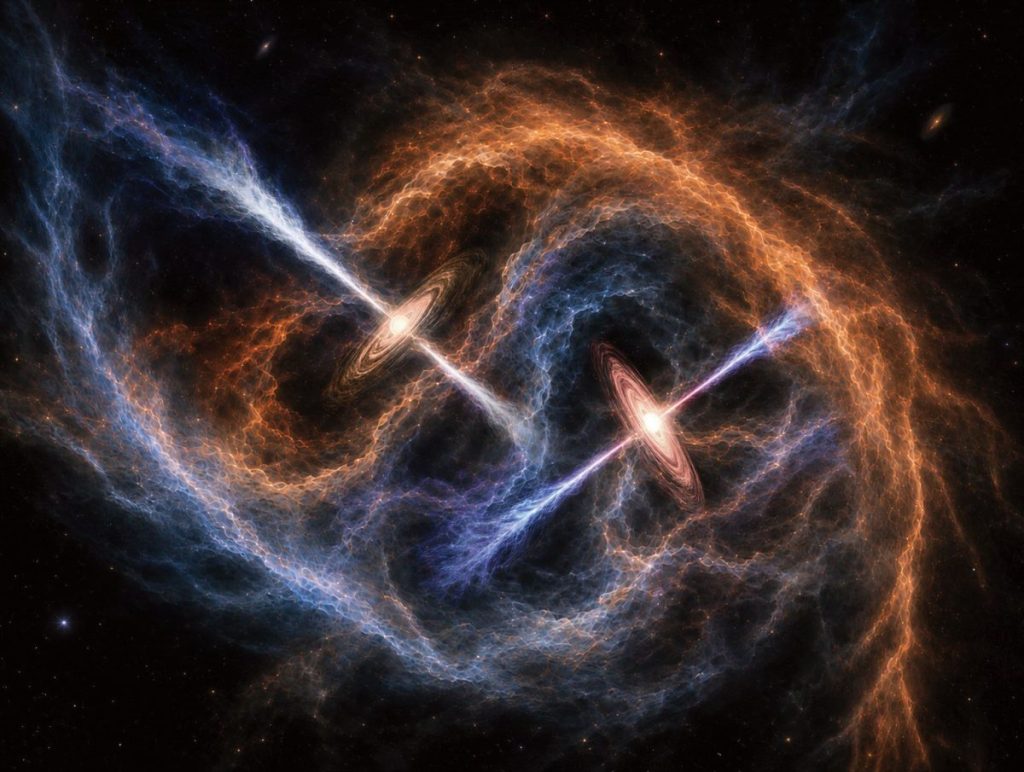
The object studied by the scientists was the system IRAS 07299−1651, located about 5,300 light-years from Earth. Two massive protostars are forming there, and astronomers have been observing them for more than eight years.
Analysis of data collected by the ALMA and VLA radio telescopes, as well as the JWST and VLT infrared observatories, made it possible for the first time to build a complete three-dimensional model of the system. Scientists were able to determine in detail the parameters of the stellar orbits, the inclination of the feeding disks, and the direction of the jets — powerful streams of matter that young stars eject into outer space.
Unexpected Chaos Instead of Harmony
The results of the observations surprised the researchers. The stars were expected to move in orderly, nearly circular orbits within a common plane. Instead, the orbits turned out to be highly elongated, or eccentric, while the protostellar disks themselves are positioned at sharp angles to one another and to the overall orbital plane.

Such a misaligned geometry virtually rules out the possibility that the two stars formed together from the same nebula. Scientists concluded that both objects formed separately in their own gas cocoons and later happened to approach one another.
A Meeting at Cosmic Speed
By calculating their trajectories, astrophysicists determined that this gravitational capture occurred approximately 60 years ago. On the timescale of the Universe, that is essentially an instant. Despite the dynamic encounter, the gas disks around each star have retained their structure.
At present, scientists cannot accurately predict the system’s future. Interaction with the surrounding interstellar gas will determine whether these stars remain together permanently or eventually drift apart. Long-term observations of IRAS 07299−1651 will help researchers understand how common such chance stellar unions are in the Universe.
Earlier, we reported on how the young Sun may have swallowed a planet more massive than Earth.
According to almaobservatory.org
