

The merger of two compact objects left enough information in gravitational waves to test whether the larger member of the pair is a black hole. The shape of the signal preserves an imprint of how rotation deforms the distribution of mass inside the object. For this pair, the measurement turned out to be the most precise of its kind in the history of observations. Some hypothetical black-hole-like objects could therefore be ruled out.
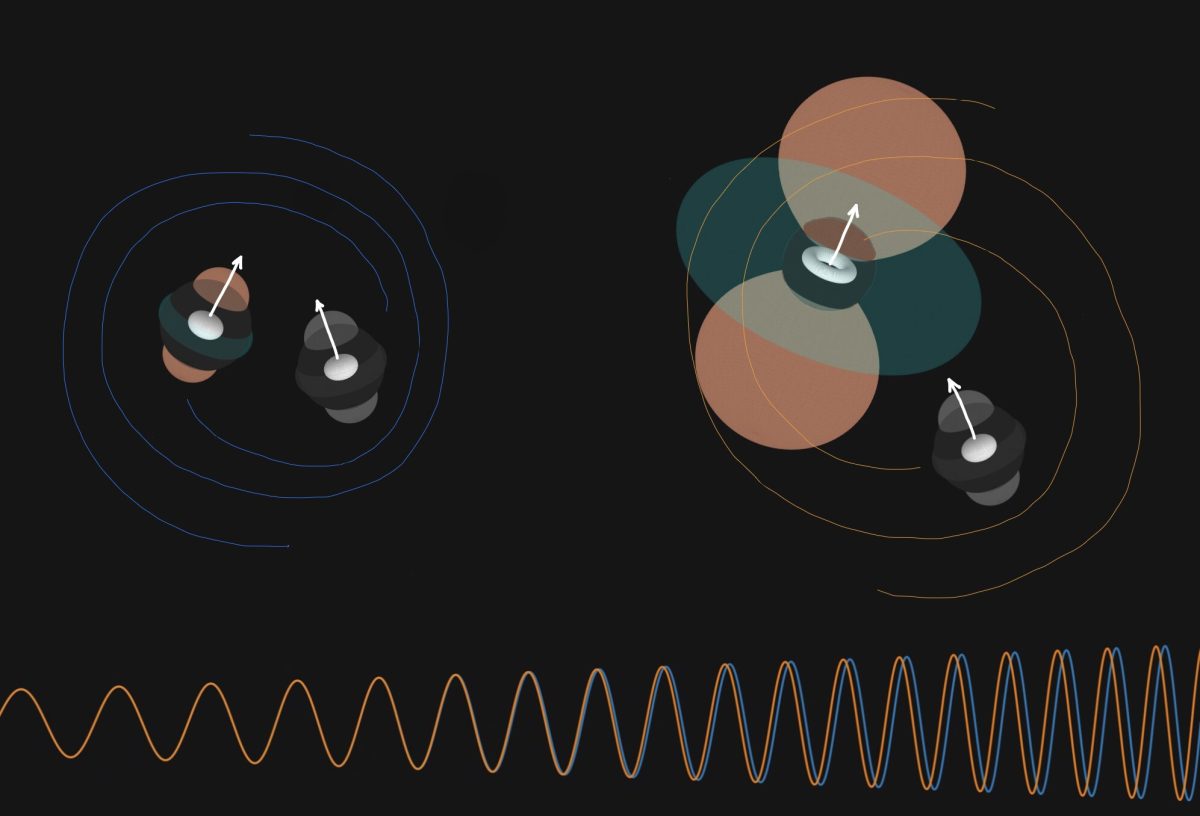
A Signal with the Right Combination of Parameters
The event designated GW241011 was detected in October 2024 by the LIGO Hanford detector in the United States and Virgo in Italy. According to calculations, the masses of the two merging objects were about 19.6 and 5.9 solar masses.
The larger object was rotating rapidly, with a spin of about 0.78 on a scale where one corresponds to the limiting rotation rate. Combined with the large mass difference and a signal-to-noise ratio of about 36 across the detector network, this provided exactly the combination needed to measure the relevant quantity precisely, Phys.org reports.
How Rotation Reveals Internal Structure
In general relativity, a black hole is described by only two numbers: its mass and spin. Any other compact object has an internal structure, and that structure changes the extent to which rotation distorts it from a perfect sphere.
This deformation is called the spin-induced quadrupole moment, and it leaves a characteristic imprint on gravitational waves as the binary spirals inward. For a boson star, a hypothetical object made of bosonic particles, the value would differ from that of a Kerr black hole — a rotating black hole described only by mass and spin.
The method was proposed back in 2017, but researchers had to wait almost eight years for a signal of sufficient quality. Rather than assuming from the outset that the larger object was a black hole, the team allowed the data themselves to show how far the measured quantity could deviate from the Kerr prediction. The results were published in the peer-reviewed journal Physical Review Letters.
What Could Be Ruled Out
Entire classes of hypothetical compact objects are incompatible with the measured parameters. In particular, rotating boson stars with quartic self-interaction would produce a quadrupole moment inconsistent with the detector data.
At the same time, the study does not provide a definitive answer. According to its conclusions, sufficiently dense exotic objects with a compactness of about 0.24 or higher remain possible explanations.
That limit alone rules out most alternatives. By definition, the compactness at a black hole horizon is 0.5, while for neutron stars — the densest confirmed objects — this value does not exceed 0.2. Thus, only objects denser than anything astronomers have observed so far remain compatible with the description.
A Constraint for Only One Binary
The authors emphasize that they are not proving the nature of the object, but narrowing the range of alternatives. Aditya Vijayakumar separately notes that the conclusion applies to this specific binary system and does not justify claims about how common such objects may be in the Universe as a whole.
The next step requires statistics from many events. The fifth observing run, with significantly higher sensitivity, is expected around 2029, while third-generation detector projects and the space-based LISA observatory will expand the sample of sources. Together with measurements of tidal deformability, these tests will challenge models of matter beyond standard physics.
